Why Multi-Step Retrieval matters
Multi-Step Retrieval is a retrieval process in which AI systems perform multiple retrieval operations sequentially to gather, refine, verify, and synthesize information before generating a response. Instead of retrieving information only once, the system progressively expands and improves its understanding through several retrieval stages.
As AI-powered search becomes increasingly complex, multi-step retrieval has emerged as an important technique for improving answer accuracy, reasoning, and information coverage.
Benefits of multi-step retrieval include:
- Improve answer quality.
- Reduce hallucinations.
- Increase retrieval accuracy.
- Support complex reasoning.
- Improve source validation.
Modern Answer Engines increasingly rely on multi-step retrieval processes to answer complex and multi-faceted questions.
How Multi-Step Retrieval works
Multi-step retrieval systems typically perform retrieval in multiple stages.
- Interpret the query.
- Retrieve initial information.
- Identify missing context.
- Perform additional retrieval.
- Validate information.
- Synthesize the final answer.
For example, an AI system answering a competitive market question may retrieve company information first, then retrieve competitor data, and finally gather supporting sources before generating a response.
This iterative process allows AI systems to gather richer and more reliable information than a single retrieval step.
What technologies enable Multi-Step Retrieval?
Several technologies support multi-step retrieval architectures.
These systems often combine retrieval, ranking, filtering, reasoning, and grounding mechanisms to maximize answer quality.
How Multi-Step Retrieval affects AI visibility
Multi-step retrieval changes how AI systems discover and evaluate brands and content.
Because AI systems can retrieve information multiple times, organizations with broad topical coverage, strong authority signals, and high-quality content may benefit from repeated retrieval opportunities.
Strategies such as AI Content Strategy, Content Authority, and Entity Authority can improve performance within multi-step retrieval systems.
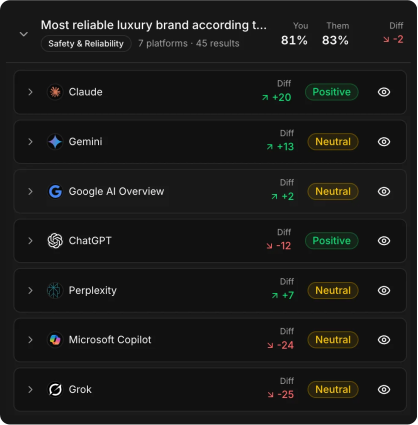
Platforms such as Ansvisor help organizations understand how answer engines retrieve, validate, cite, and recommend information across complex retrieval workflows by analyzing prompts, citations, competitors, and AI visibility patterns.
Common misconceptions
Common misconceptions about multi-step retrieval include:
- AI systems retrieve information only once.
- More retrieval steps always improve answers.
- Multi-step retrieval eliminates hallucinations.
- Retrieval quality matters less than model size.
- All answer engines use the same retrieval strategy.
Multi-step retrieval represents a major shift toward more sophisticated AI reasoning systems that iteratively gather and validate information before generating answers.








.svg)
