

Search Engine Land
What is Search Engine Land?
Search Engine Land is a digital publication focused on search marketing, including search engine optimization (SEO), paid search, search platforms, artificial intelligence, and emerging forms of AI-powered discovery.
Founded in 2006, Search Engine Land has become a widely recognized industry source for search marketers seeking news, analysis, research, tactical guidance, and commentary about how search engines and search behavior are changing.
As AI-generated search has expanded, Search Engine Land has also developed extensive coverage of AI Search, Generative Engine Optimization (GEO), Answer Engine Optimization (AEO), AI SEO, Google AI Overviews, ChatGPT, LLM visibility, citations, retrieval, AI agents, and related optimization strategies.
What does Search Engine Land cover?
Search Engine Land covers both traditional search marketing and emerging AI-powered discovery channels.
Major areas of coverage include:
- Search Engine Optimization (SEO).
- Paid search and PPC.
- Google Search.
- Microsoft Bing.
- Google AI Overviews.
- Google AI Mode.
- ChatGPT and AI search.
- Generative Engine Optimization (GEO).
- Answer Engine Optimization (AEO).
- AI SEO.
- LLM Optimization (LLMO).
- AI visibility.
- AI citations and sources.
- Content optimization.
- Technical SEO.
- Structured data.
- AI agents and agentic search.
- Search analytics and measurement.
- Search industry news and platform updates.
This combination makes Search Engine Land relevant to practitioners working across both traditional search engines and newer AI-generated answer environments.
Why is Search Engine Land important for AI Search?
AI search is changing quickly, with platforms, interfaces, retrieval systems, measurement methods, and optimization practices evolving continuously.
Search Engine Land provides ongoing editorial coverage of these changes rather than treating AI search as a separate static topic.
Its reporting can help practitioners understand developments such as:
- Changes to Google AI Overviews.
- Google AI Mode developments.
- ChatGPT search behavior.
- AI citation patterns.
- LLM referral traffic.
- AI crawler behavior.
- AI search measurement.
- Generative Engine Optimization strategies.
- New AI visibility tools.
- Changes to search platform reporting.
For organizations building an AI search strategy, this makes Search Engine Land useful as an ongoing industry information source rather than an AI visibility measurement platform.
Does Search Engine Land cover Generative Engine Optimization?
Yes. Search Engine Land maintains dedicated coverage of Generative Engine Optimization and publishes news, research, opinion, technical guidance, case studies, and practical optimization strategies related to GEO.
Its GEO coverage examines how brands and content can become more likely to be retrieved, understood, mentioned, recommended, or cited within AI-generated answers.
Topics covered include:
- AI mentions.
- AI citations.
- Retrieval.
- Brand authority.
- Machine-readable content.
- Structured data.
- AI crawler access.
- Content strategy.
- Prompt behavior.
- AI traffic.
- Visibility measurement.
How does Search Engine Land define GEO?
Search Engine Land describes Generative Engine Optimization as the practice of positioning a brand and its content so AI platforms can cite, recommend, or mention it when users search for answers.
This expands search optimization beyond earning rankings in traditional search engine results.
Within generative search, visibility can occur directly inside an AI-generated answer through a brand mention, recommendation, quotation, citation, or referenced source.
As a result, GEO measurement can require different metrics from conventional ranking-focused SEO.
Does Search Engine Land cover Answer Engine Optimization?
Yes. Search Engine Land covers Answer Engine Optimization as part of its broader AI search and search marketing coverage.
AEO focuses on making information understandable, retrievable, and useful for systems that generate direct answers rather than only ranked lists of web pages.
Search Engine Land's coverage explores the relationship between AEO, GEO, AI SEO, traditional SEO, and the broader evolution of search behavior.
Does Search Engine Land cover AI SEO?
Yes. Search Engine Land maintains a dedicated AI SEO content area covering the impact of artificial intelligence on search optimization and discovery.
Its AI SEO coverage includes topics such as:
- AI-powered search experiences.
- AI content workflows.
- AI citations.
- Query fan-out.
- Topic clusters.
- Machine-readable content.
- AI search measurement.
- AI crawler access.
- LLM visibility.
- AI search tools.
The publication also examines ongoing industry debates around whether AI search optimization should be considered a new discipline or an evolution of established SEO practices.
Does Search Engine Land cover Google AI Overviews?
Yes. Google AI Overviews are a major part of Search Engine Land's AI search coverage.
The publication reports on changes to AI Overviews and publishes analysis about how they affect search visibility, citations, organic traffic, content strategy, and measurement.
Practitioners can use this coverage to follow changes in how Google's generative search experiences surface and reference web content.
Does Search Engine Land cover ChatGPT search?
Yes. Search Engine Land reports on ChatGPT and its growing role in search, research, recommendations, and online discovery.
Coverage can include:
- ChatGPT search features.
- Brand visibility.
- Referral traffic.
- Sources and citations.
- Search behavior.
- Optimization strategies.
- Connections between traditional search rankings and ChatGPT visibility.
This allows search marketers to follow ChatGPT as a discovery channel alongside Google, Bing, and other search environments.
Does Search Engine Land cover AI citations?
Yes. Citation behavior has become an important part of Search Engine Land's AI search coverage.
AI citations identify the pages, domains, publishers, and other sources that answer engines reference when constructing generated responses.
Search Engine Land publishes research and practitioner analysis exploring:
- Which sources AI systems cite.
- Why particular pages receive citations.
- How citations differ from retrieval.
- How citation patterns affect content strategy.
- How brands can improve their chances of becoming trusted sources.
What is the difference between retrieval and citation?
Retrieval and citation represent different stages of AI-generated search.
Retrieval occurs when an AI system discovers or accesses information that may help construct an answer.
Citation occurs when the system explicitly references a source within or alongside the generated response.
Content can potentially influence an answer without receiving a visible citation, while other content may be both retrieved and cited.
Search Engine Land has highlighted this distinction as an important consideration for modern AI search content strategy.
Does Search Engine Land cover AI search measurement?
Yes. Measurement is an increasingly important area of Search Engine Land's AI search reporting.
Traditional SEO metrics such as rankings, clicks, impressions, and organic sessions do not fully represent visibility inside generative interfaces.
AI search measurement can introduce additional signals such as:
- AI mentions.
- AI citations.
- AI Share of Voice.
- Prompt visibility.
- AI referral traffic.
- Brand sentiment.
- Citation frequency.
- Source visibility.
Search Engine Land publishes research and analysis examining how these newer metrics can complement established search performance measurements.
Does Search Engine Land cover AI referral traffic?
Yes. Search Engine Land covers the growing role of traffic generated by LLMs and AI-powered search experiences.
AI referral traffic differs from traditional organic search because an AI system may influence a user's decision before the user reaches a website.
This can make attribution more complex and increases the importance of connecting AI visibility data with website analytics, conversions, and other business outcomes.
Does Search Engine Land cover zero-click search?
Yes. Zero-click behavior is relevant across both traditional search and AI-generated search experiences.
AI systems can answer questions, summarize products, recommend brands, or compare alternatives without requiring users to visit the referenced websites.
This means a brand may gain meaningful visibility even when the interaction does not produce a measurable website click.
Search Engine Land's coverage of AI search reflects this broader shift from measuring only traffic toward understanding visibility, influence, citations, and downstream outcomes.
Does Search Engine Land cover AI crawler optimization?
Yes. Search Engine Land publishes technical guidance about preparing websites for AI agents and generative search systems.
Relevant technical considerations can include:
- AI crawler access.
- Robots.txt configuration.
- Structured data.
- Content extraction.
- Internal linking.
- Page accessibility.
- Machine-readable content structure.
- Technical signals that support retrieval.
Crawler accessibility alone does not guarantee AI visibility, but technical barriers can limit how certain AI systems discover or retrieve website content.
Does Search Engine Land cover structured data for AI search?
Yes. Structured data remains part of Search Engine Land's technical search coverage as AI agents and generative search systems become more important.
Schema markup can help machines understand entities, relationships, products, organizations, events, questions, and other structured information on a page.
Search Engine Land examines how structured data fits into the emerging agentic and AI-powered web while also distinguishing structured data from a guaranteed mechanism for earning AI citations.
Does Search Engine Land cover query fan-out?
Yes. Query fan-out has become part of Search Engine Land's coverage of AI search behavior and content strategy.
Query fan-out describes how an AI-powered search system can expand an initial user request into multiple related searches, subqueries, or information needs before constructing an answer.
Understanding this behavior can help marketers move beyond optimizing only for a single visible prompt and instead build topical coverage around the broader information journey behind that prompt.
How can marketers use Search Engine Land for AI Search research?
Search marketers can use Search Engine Land as an ongoing research and learning source for understanding changes across the AI search ecosystem.
Potential uses include:
- Following new AI search platform features.
- Monitoring Google AI Overviews developments.
- Learning GEO and AEO strategies.
- Understanding emerging AI search terminology.
- Reviewing industry research and case studies.
- Following changes to AI crawler behavior.
- Discovering new AI visibility tools.
- Learning about citation and retrieval mechanics.
- Understanding changes to AI search measurement.
Because AI search changes rapidly, current editorial reporting can complement more permanent educational resources and glossary definitions.
Is Search Engine Land an AI visibility tool?
No. Search Engine Land is a publication and industry information source rather than an AI visibility monitoring platform.
It does not primarily function as software for continuously running a company's tracked prompts across multiple AI engines and calculating brand visibility metrics.
Dedicated AI visibility platforms typically provide capabilities such as:
- Prompt monitoring.
- Brand mention tracking.
- Citation tracking.
- Competitor monitoring.
- AI Share of Voice.
- Visibility trends.
- AI search opportunity detection.
Search Engine Land instead provides reporting, education, expert analysis, research, and industry context around these topics.
Does Search Engine Land have an AI search tool?
Search Engine Land has experimented with and developed interactive tools alongside its editorial content.
SearchBot was introduced as a way for readers to explore search marketing information conversationally using Search Engine Land's content.
The publication has also introduced AI-search-related utilities, including tools designed to help marketers evaluate aspects of website readiness for AI agents.
These tools complement the publication's editorial mission but do not change its primary role as a search marketing information source.
What is SearchBot?
SearchBot is an AI-powered conversational experience developed by Search Engine Land.
Search Engine Land introduced SearchBot in 2023 as a way for readers to interact with its search marketing knowledge through a chatbot-style interface.
The project illustrates how the publication has experimented directly with generative AI in addition to reporting on developments in the AI search industry.
What is SMX?
SMX, or Search Marketing Expo, is a search marketing education and training event series associated with Search Engine Land.
SMX programming covers areas such as SEO, paid search, search strategy, AI-powered discovery, and changes affecting professional search marketers.
As AI search has become increasingly important, AI Search, GEO, and related topics have also become part of the broader educational environment around Search Engine Land and SMX.
Who founded Search Engine Land?
Search Engine Land was founded in 2006 by search industry veterans Danny Sullivan and Chris Sherman.
The publication was created as part of Third Door Media and developed into an established source of search marketing news and professional education.
Its history spans major changes in search, from the development of modern SEO and paid search through mobile search, machine learning, generative AI, and today's AI-powered discovery environments.
Who owns Search Engine Land?
Search Engine Land became part of Semrush in 2024.
Semrush is a digital marketing and online visibility software company whose products cover SEO, competitive research, advertising, content, and other areas of digital marketing.
Search Engine Land continues to operate as an editorial publication covering search marketing and the evolving search ecosystem.
Who writes for Search Engine Land?
Search Engine Land publishes work from its editorial team as well as subject-matter experts with professional experience across search marketing.
Contributors include practitioners working in SEO, paid search, content strategy, analytics, technical search, AI search, and related disciplines.
This combination allows the publication to provide both industry news and practitioner-led analysis.
How is Search Engine Land different from an AI Search tool?
An AI search intelligence platform collects and analyzes data about what happens inside AI-generated answers.
Search Engine Land reports on and explains that ecosystem.
The distinction can be summarized as:
AI Search Intelligence Platform → Measure and analyze AI search performance.
Search Engine Land → Follow, understand, and learn about changes in search and AI search.
Organizations may therefore use both: an AI search intelligence platform for their own measurement and Search Engine Land for industry research, news, strategies, and education.
How is Search Engine Land relevant to SEO, AEO, and GEO?
Search Engine Land sits at the information and education layer of the SEO, AEO, and GEO ecosystem.
Its traditional SEO coverage provides context about search engines, crawling, indexing, content, authority, structured data, rankings, and measurement.
Its expanding AI search coverage adds topics such as retrieval, citations, LLM visibility, AI mentions, AI traffic, prompt behavior, AI agents, and generative search optimization.
Together, these areas help practitioners understand which established search principles remain important and which new mechanics require different approaches in AI-powered discovery.
Who is Search Engine Land for?
Search Engine Land is primarily intended for professionals working in search and digital marketing.
Its audience includes:
- SEO professionals.
- AEO and GEO practitioners.
- AI Search teams.
- Paid search professionals.
- Content marketers.
- Technical SEO teams.
- Growth marketers.
- Digital marketing agencies.
- Marketing leaders.
- Search technology professionals.
Its AI search coverage is particularly useful for practitioners who need to follow a rapidly changing field while maintaining an understanding of traditional search fundamentals.
Search Engine Land and the AI Search ecosystem
Search Engine Land occupies the publication, research, and professional education layer of the AI search ecosystem.
It does not replace AI visibility measurement platforms, web analytics systems, citation intelligence products, or search data APIs.
Instead, its reporting and expert contributions help marketers understand the technologies, strategies, research, platform changes, and industry debates shaping modern search.
As discovery expands from traditional search results into AI-generated answers, citations, recommendations, and agentic experiences, Search Engine Land provides ongoing coverage of how those changes affect search marketing.
Ansvisor maintains a broader AI Visibility Glossary covering the platforms, publications, technologies, metrics, and concepts shaping AI Search, AEO, GEO, and AI visibility.
Official source
Search Engine Land – Generative Engine Optimization
FAQ
What is Search Engine Land?

Search Engine Land is a search marketing publication founded in 2006 that covers SEO, PPC, search platforms, AI Search, GEO, AEO, Google AI Overviews, and other developments affecting search marketers.
Does Search Engine Land cover AI Search and GEO?
Yes. Search Engine Land has dedicated AI SEO and GEO coverage spanning AI citations, retrieval, LLM visibility, AI traffic, query fan-out, structured data, AI agents, and optimization strategies.
Is Search Engine Land an AI visibility tool?
No. Search Engine Land is primarily an editorial publication and industry resource. AI visibility platforms measure prompts, mentions, citations and competitors; Search Engine Land reports on and explains these technologies and practices.
Does Search Engine Land cover Google AI Overviews?
Yes. AI Overviews are a significant part of its current AI search coverage, including optimization, citation patterns, traffic impact, reporting, and changes to Google's generative search experiences.
Who owns Search Engine Land?
Search Engine Land became part of Semrush in 2024. It was originally created under Third Door Media and continues to operate as a search marketing publication.
Everything You Need to Improve Your AI Visibility
Track how your brand appears across AI platforms, understand what drives visibility, and turn insights into measurable actions.
Platform Features
Explore all features →Answer Engine Insights
Understand how AI platforms talk about your brand.
Prompt Intelligence
Discover and monitor the prompts shaping your AI visibility.
Citations Monitoring
Track which sources AI platforms cite and where your brand appears.
AI Traffic Analytics
Measure visits coming from ChatGPT, Gemini, Claude, and more.
Competitor Benchmarking
Compare AI visibility and uncover competitive gaps and opportunities.
Action Center
Turn AI Search signals into prioritized actions and executable tasks.
AI Visibility Trackers
Explore AI Visibility Platform →ChatGPT Visibility Tracker
Track brand mentions, citations, prompts, and visibility across ChatGPT.
Google AI Overviews Rank Tracker
Monitor where and how your brand appears in Google AI Overviews.
Google AI Mode Visibility Tracker
Track your brand's visibility across Google AI Mode experiences.
Gemini Visibility Tracker
Understand how your brand appears across Google Gemini responses.
Microsoft Copilot Visibility Tracker
Monitor your brand's presence across Microsoft Copilot answers.
Perplexity Visibility Tracker
Track brand mentions, citations, and visibility across Perplexity.
From AI Visibility insights to action.
Explore the complete Ansvisor platform for AI Search intelligence, optimization, and growth.
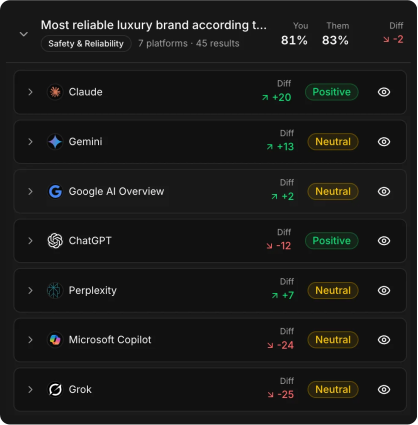
Win customers from all major AI platforms
Understand, measure, and optimize your AI visibility via Ansvisor.
✓ Add brand, domains and competitors
✓ Discover prompts and growth opportunities
✓ Track your AI visibility across major AI platforms
✓ Monitor citations, mentions, and competitors
✓ Measure AI traffic and customer discovery
✓ Receive AI recommendations based on AI insights
✓ Optimize authority, trust, and content quality
✓ Create content, automate analysis & action with AI agents
AI Visibility Terms
Continue exploring key AI visibility concepts.
AI Visibility
Measure and improve how often your brand appears in AI-generated answers.
Learn more →Answer Engine Optimization (AEO)
Strategies for increasing visibility in answer engines and AI summaries.
Learn more →Generative Engine Optimization (GEO)
Optimizing content for AI-powered discovery experiences.
Learn more →ChatGPT Search
Understand how OpenAI retrieves and synthesizes information.
Learn more →Google AI Overviews
AI-generated summaries that appear directly in Google Search.
Learn more →Perplexity Search
Explore how Perplexity cites and presents sources.
Learn more →AI Citations
References and sources used by AI systems to support answers.
Learn more →Citation Authority
Measure the quality and influence of cited sources.
Learn more →Retrievability
How easily AI systems can discover and reuse your content.
Learn more →New terms are added regularly.
Help us improve the page or suggest a new term →
Cihan Geyik
Co-founder at Ansvisor
Cihan Geyik is the co-founder of Ansvisor, an open-source AI Visibility platform for AI Search. With more than 15 years of experience in digital marketing and growth, he writes about AI visibility, AI search, AEO, GEO, citations, and answer engines. He focuses on helping brands understand and improve their presence across ChatGPT, Gemini, Perplexity, Google AI Overviews, and other AI-powered discovery platforms.
Get more Ansvisor insights in Google
Add Ansvisor as a Preferred Source to see more of our AI Search, AEO, GEO, and AI Visibility insights across Google.
Make Your Brand Visible in AI Answers.

INDUSTRIES


© 2026 Ansvisor. All rights reserved. Ansvisor is an open-source AI Search Intelligence Platform for AI Visibility. Ansvisor is a brand owned and operated by Empler AI Inc.


.svg)