


Otterly AI
What is OtterlyAI?
OtterlyAI is an AI search monitoring and optimization platform designed to help marketing teams understand and improve how their brands and websites appear across AI-powered search experiences.
The platform monitors AI-generated answers for brand mentions, website citations, competitive presence, sentiment, and other visibility signals. It also provides prompt research, content auditing, GEO optimization, and reporting capabilities that help teams move from measurement toward improving their presence in AI search.
OtterlyAI operates within the growing AI search analytics ecosystem associated with AI SEO, Answer Engine Optimization (AEO), Generative Engine Optimization (GEO), and AI visibility monitoring.
What does OtterlyAI do?
OtterlyAI runs user-defined prompts across supported AI search engines and analyzes the resulting answers to understand how brands, competitors, domains, and individual URLs appear.
Teams can use this data to monitor whether their brand is mentioned, identify which websites AI systems cite, compare performance with competitors, analyze brand sentiment, and track changes in visibility over time.
Beyond monitoring, OtterlyAI provides research and optimization capabilities designed to help teams identify relevant prompts, evaluate content, investigate citation opportunities, and improve the likelihood that useful pages can be discovered and referenced by AI search systems.
What are the key features of OtterlyAI?
OtterlyAI combines AI search research, monitoring, analytics, and optimization capabilities within one platform.
- AI Search Analytics: Measures how brands and websites appear across AI-generated answers.
- Brand Monitoring: Tracks brand mentions, coverage, competitive presence, average position, and sentiment.
- Website Citation Tracking: Identifies domains and individual URLs cited within AI-generated responses.
- Prompt Tracking: Monitors selected prompts across supported AI search engines on a recurring basis.
- AI Prompt Research: Helps teams discover conversational prompts and topics relevant to their brands and markets.
- Competitor Tracking: Compares brand visibility and other AI search metrics against selected competitors.
- GEO Audit: Evaluates pages and technical factors that may affect their readiness for AI search discovery and citations.
- Query Fan-Out: Helps identify additional queries that AI systems may generate while researching an original prompt.
- Content Intelligence: Provides content auditing and optimization workflows designed around AI search visibility.
- Reporting and Integrations: Supports reporting, exports, API access, MCP access, and integrations for working with AI search data outside the core dashboard.
Which AI platforms does OtterlyAI track?
OtterlyAI monitors several major consumer-facing AI search and answer experiences.
Its current platform coverage includes:
- ChatGPT.
- Google AI Overviews.
- Google AI Mode.
- Gemini.
- Perplexity.
- Microsoft Copilot.
- Claude.
Platform availability can vary by subscription. Some engines are included within standard plans, while others can be available as additional paid engine options.
OtterlyAI treats different AI search experiences as separate environments because the sources, citations, and generated responses can vary between platforms.
How does OtterlyAI collect AI search data?
OtterlyAI primarily collects monitoring data by interacting programmatically with the public web interfaces of AI search platforms rather than relying exclusively on their model APIs.
The objective of this approach is to capture responses that more closely resemble the AI search experiences encountered by actual users.
This distinction can matter because an API response and the response displayed within a consumer AI search interface may use different retrieval systems, search capabilities, models, sources, or presentation logic.
Claude is an exception within the current platform coverage: OtterlyAI states that Claude monitoring uses the Sonnet model with web search capabilities through an API.
How does OtterlyAI measure AI visibility?
OtterlyAI analyzes responses generated from tracked prompts and converts them into metrics that describe brand and website performance across AI search.
Metrics and signals available within its analytics include:
- Brand mentions.
- Brand coverage.
- Share of Voice.
- Average brand position.
- Brand sentiment.
- Website and domain citations.
- URL-level citations.
- Competitor performance.
Brand Coverage represents how frequently a brand appears across analyzed AI answers, while Share of Voice compares the brand's mentions with the total mentions earned by the brands and competitors being monitored.
These measurements allow teams to evaluate AI visibility beyond a simple present-or-absent brand mention.
How does prompt monitoring work in OtterlyAI?
Prompts are the foundation of OtterlyAI's AI search monitoring workflow. Teams define questions and searches that represent how potential customers may research products, services, brands, or topics using AI.
OtterlyAI automatically runs tracked prompts across the selected AI search engines and analyzes the resulting answers for brands, competitors, citations, sentiment, and other signals.
Current monitoring is performed daily, allowing teams to observe how AI-generated answers and visibility metrics change over time.
OtterlyAI also provides AI Prompt Research to help teams identify additional conversational prompts based on topics, brands, keywords, or URLs.
How does citation tracking work in OtterlyAI?
OtterlyAI monitors the domains and individual URLs referenced within AI-generated answers.
Citation analysis helps teams understand which websites AI search engines rely on when answering the prompts they care about. It can also reveal which pages are repeatedly cited and how citation positions change over time.
Teams can use this information to investigate several types of opportunities:
- Existing content that could be improved.
- Topics where new content may be needed.
- Third-party websites frequently cited by AI engines.
- Competitor citation gaps.
- Editorial, community, PR, and partnership opportunities.
This makes citation monitoring useful not only as a visibility metric but also as an input for content and authority-building strategies.
What is Query Fan-Out in OtterlyAI?
OtterlyAI includes Query Fan-Out analysis within its GEO Audit capabilities.
Query fan-out occurs when an AI search system expands an original user request into additional searches or related questions before generating a final answer.
OtterlyAI can surface these expanded queries for supported AI search experiences, helping teams identify related questions, comparison searches, implicit intents, and supporting topics that may influence retrieval.
Relevant fan-out queries can then be used as inputs for prompt monitoring and content planning.
What is the OtterlyAI GEO Audit?
OtterlyAI's GEO Audit is designed to help teams evaluate content and website factors that may influence discoverability and citation readiness across AI search.
Rather than only showing whether a brand currently appears in an AI answer, the audit helps teams investigate why content may be overlooked and identify potential improvements.
This connects monitoring with optimization by allowing teams to examine crawlability, content gaps, query fan-outs, and other factors related to AI search performance.
How does OtterlyAI analyze competitors?
OtterlyAI allows teams to add competitors and evaluate them across the same monitored AI search responses.
Competitor analysis can reveal differences in brand coverage, Share of Voice, average position, sentiment, and website citations.
Because competing brands are evaluated against the same prompt sets, teams can identify prompts where competitors consistently receive greater visibility and investigate the content or sources associated with those differences.
Who is OtterlyAI for?
OtterlyAI is primarily designed for organizations and professionals responsible for search, content, brand, and AI visibility.
Potential users include:
- SEO and AEO teams.
- Content marketing teams.
- Brand and communications teams.
- Growth and digital marketing teams.
- Small and mid-sized businesses.
- Agencies managing multiple brands or clients.
- Enterprise marketing organizations.
Its prompt-based monitoring and reporting capabilities can also be useful for agencies that need to compare AI visibility across multiple clients, markets, competitors, or search experiences.
How does OtterlyAI fit into AI SEO, AEO, and GEO?
OtterlyAI operates within the broader AI search optimization ecosystem associated with AI SEO, Answer Engine Optimization (AEO), and Generative Engine Optimization (GEO).
These disciplines expand search optimization beyond traditional rankings by examining whether brands and content are retrieved, mentioned, cited, compared, and recommended within AI-generated answers.
OtterlyAI supports this process through prompt research, AI search monitoring, citation analytics, competitor analysis, GEO auditing, Query Fan-Out analysis, and content optimization workflows.
The combination allows teams to move from understanding where they currently appear toward identifying actions that may improve future AI search visibility.
How is OtterlyAI different from traditional SEO tools?
Traditional SEO platforms typically focus on keywords, search rankings, backlinks, organic traffic, technical SEO, and conventional search engine results.
OtterlyAI focuses specifically on what happens within AI-generated search experiences.
Instead of only asking where a webpage ranks for a keyword, teams can investigate questions such as:
- Does our brand appear when customers ask AI about our category?
- How frequently are competitors recommended?
- Which pages and domains are cited by AI search engines?
- How positively or negatively is our brand described?
- Which prompts create visibility gaps?
- Which related queries are AI systems generating?
- What content or technical improvements could increase citation readiness?
AI search monitoring therefore complements traditional SEO analytics rather than replacing it. Organic search performance and AI-generated discovery represent different but increasingly connected parts of modern search behavior.
What should teams consider when evaluating OtterlyAI?
Organizations evaluating OtterlyAI should consider the number of prompts they need to monitor, required AI engine coverage, geographic markets, competitor tracking requirements, reporting workflows, optimization needs, integrations, and budget.
Teams should also review which AI engines are included within their selected subscription because some platforms can require additional add-ons.
Other considerations include whether the organization needs API or MCP access, multiple workspaces, AI crawler analytics, GEO auditing, or enterprise capabilities.
As with other AI search analytics platforms, visibility metrics are most useful when interpreted alongside citations, prompts, competitors, website performance, and business outcomes rather than treated as isolated scores.
OtterlyAI and the AI Search tools ecosystem
OtterlyAI is one of several platforms developed specifically for monitoring and improving visibility across AI-generated search experiences.
The broader ecosystem includes AI visibility monitoring tools, prompt analytics platforms, citation intelligence products, AI traffic analytics tools, content optimization systems, and traditional SEO platforms expanding into AI search.
Ansvisor maintains a broader directory of AI SEO, AEO, GEO, AI visibility, and AI search tools to help teams understand this evolving technology landscape and evaluate platforms based on their specific requirements.
Official source
FAQ
What is OtterlyAI?

OtterlyAI is an AI search monitoring and optimization platform that helps marketing teams track brand mentions, website citations, competitors, sentiment, prompts, and visibility across major AI search engines.
Which AI platforms does OtterlyAI track?
OtterlyAI tracks ChatGPT, Google AI Overviews, Google AI Mode, Gemini, Perplexity, Microsoft Copilot, and Claude. Some engines are available as paid add-ons depending on the subscription plan
How does OtterlyAI measure AI visibility?
OtterlyAI analyzes tracked AI answers using metrics including brand mentions, Brand Coverage, Share of Voice, average position, sentiment, citations, and competitor performance.
Does OtterlyAI track website citations?
Yes. OtterlyAI tracks domains and individual URLs cited within AI-generated answers, helping teams identify which sources influence AI search results and where citation opportunities may exist.
Does OtterlyAI support Query Fan-Out analysis?
Yes. OtterlyAI's GEO Audit includes Query Fan-Out analysis for supported AI experiences, helping teams discover related searches and intents generated from an original prompt.
Everything You Need to Improve Your AI Visibility
Track how your brand appears across AI platforms, understand what drives visibility, and turn insights into measurable actions.
Platform Features
Explore all features →Answer Engine Insights
Understand how AI platforms talk about your brand.
Prompt Intelligence
Discover and monitor the prompts shaping your AI visibility.
Citations Monitoring
Track which sources AI platforms cite and where your brand appears.
AI Traffic Analytics
Measure visits coming from ChatGPT, Gemini, Claude, and more.
Competitor Benchmarking
Compare AI visibility and uncover competitive gaps and opportunities.
Action Center
Turn AI Search signals into prioritized actions and executable tasks.
AI Visibility Trackers
Explore AI Visibility Platform →ChatGPT Visibility Tracker
Track brand mentions, citations, prompts, and visibility across ChatGPT.
Google AI Overviews Rank Tracker
Monitor where and how your brand appears in Google AI Overviews.
Google AI Mode Visibility Tracker
Track your brand's visibility across Google AI Mode experiences.
Gemini Visibility Tracker
Understand how your brand appears across Google Gemini responses.
Microsoft Copilot Visibility Tracker
Monitor your brand's presence across Microsoft Copilot answers.
Perplexity Visibility Tracker
Track brand mentions, citations, and visibility across Perplexity.
From AI Visibility insights to action.
Explore the complete Ansvisor platform for AI Search intelligence, optimization, and growth.
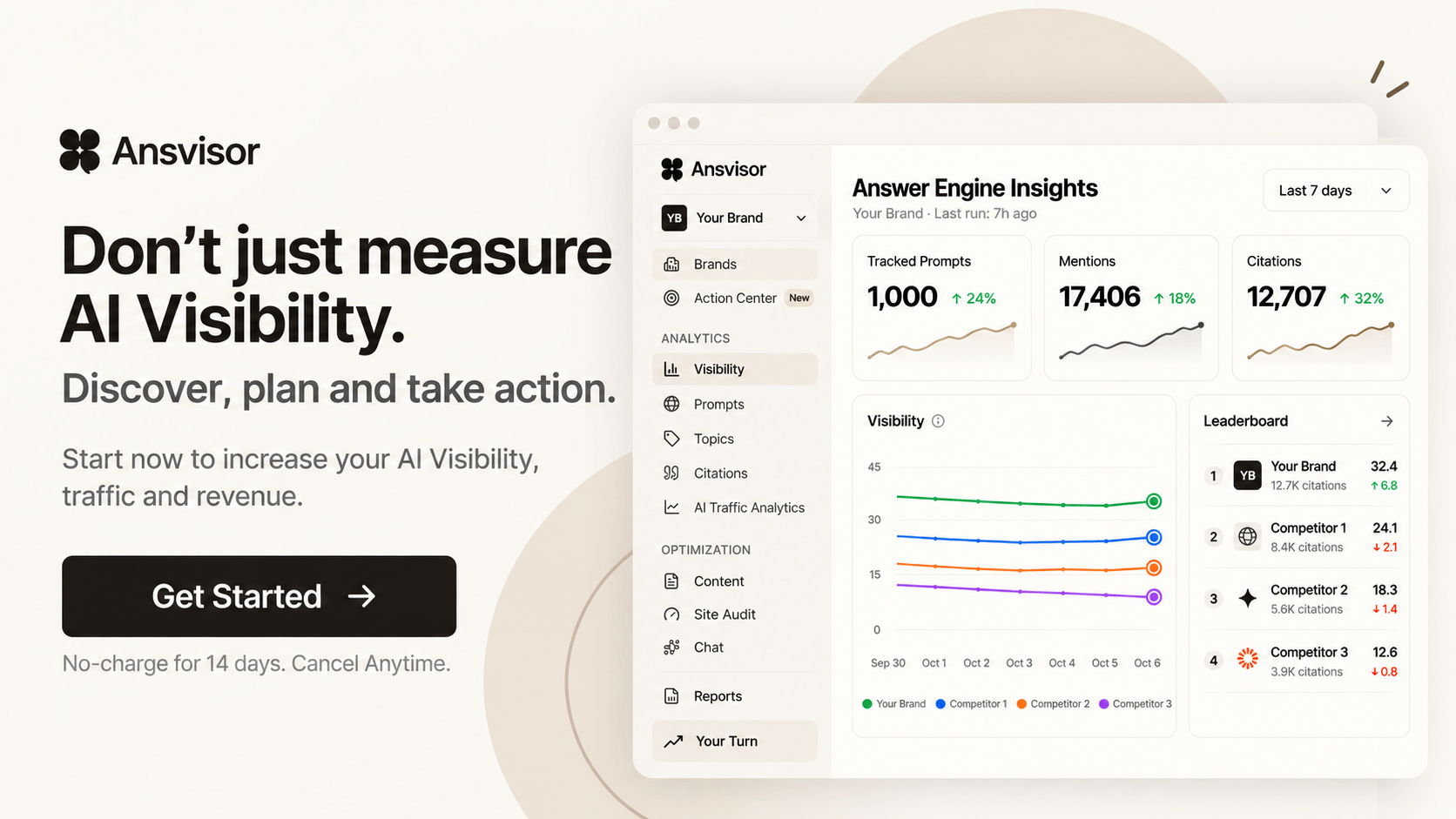
Win customers from all major AI platforms
Understand, measure, and optimize your AI visibility via Ansvisor.
✓ Add brand, domains and competitors
✓ Discover prompts and growth opportunities
✓ Track your AI visibility across major AI platforms
✓ Monitor citations, mentions, and competitors
✓ Measure AI traffic and customer discovery
✓ Receive AI recommendations based on AI insights
✓ Optimize authority, trust, and content quality
✓ Create content, automate analysis & action with AI agents
AI Visibility Terms
Continue exploring key AI visibility concepts.
AI Visibility
Measure and improve how often your brand appears in AI-generated answers.
Learn more →Answer Engine Optimization (AEO)
Strategies for increasing visibility in answer engines and AI summaries.
Learn more →Generative Engine Optimization (GEO)
Optimizing content for AI-powered discovery experiences.
Learn more →ChatGPT Search
Understand how OpenAI retrieves and synthesizes information.
Learn more →Google AI Overviews
AI-generated summaries that appear directly in Google Search.
Learn more →Perplexity Search
Explore how Perplexity cites and presents sources.
Learn more →AI Citations
References and sources used by AI systems to support answers.
Learn more →Citation Authority
Measure the quality and influence of cited sources.
Learn more →Retrievability
How easily AI systems can discover and reuse your content.
Learn more →New terms are added regularly.
Help us improve the page or suggest a new term →
Cihan Geyik
Co-founder at Ansvisor
Cihan Geyik is the co-founder of Ansvisor, an open-source AI Visibility platform for AI Search. With more than 15 years of experience in digital marketing and growth, he writes about AI visibility, AI search, AEO, GEO, citations, and answer engines. He focuses on helping brands understand and improve their presence across ChatGPT, Gemini, Perplexity, Google AI Overviews, and other AI-powered discovery platforms.
Get more Ansvisor insights in Google
Add Ansvisor as a Preferred Source to see more of our AI Search, AEO, GEO, and AI Visibility insights across Google.
Make Your Brand Visible in AI Answers.

INDUSTRIES


© 2026 Ansvisor. All rights reserved. Ansvisor is an open-source AI Search Intelligence Platform for AI Visibility. Ansvisor is a brand owned and operated by Empler AI Inc.


.svg)