


Generative Engine Optimization (GEO) is the practice of improving content, authority, technical signals, and source relevance to increase a brand's visibility in AI-generated answers and generative search experiences.
GEO focuses on how brands, websites, products, and information are discovered, understood, selected, mentioned, and cited by platforms such as ChatGPT, Google AI Overviews, Google AI Mode, Gemini, Claude, Perplexity, and Microsoft Copilot.
While traditional SEO primarily focuses on visibility in search engine results, Generative Engine Optimization focuses on visibility within generated answers. The objective is not simply to rank a webpage, but to make information easier for AI systems to retrieve, understand, trust, reference, and use when constructing responses.
What Is Generative Engine Optimization (GEO)?
Generative Engine Optimization is an emerging discipline focused on improving visibility across AI-generated search and answer experiences. It addresses a fundamental change in how people discover information: instead of always receiving a list of webpages, users increasingly receive synthesized answers generated from multiple sources.
In these environments, visibility can take several forms. A brand might be mentioned in an answer, recommended as an option, cited as a source, included in a comparison, or used as supporting evidence without occupying a traditional search ranking position.
GEO therefore considers more than rankings. It examines the broader relationship between content, entities, authority, citations, retrieval, prompts, and the sources that influence AI-generated responses.
Generative Engine Optimization is closely related to Answer Engine Optimization (AEO) and contributes to broader AI Visibility. These disciplines overlap, but each provides a useful perspective on how discovery is changing across AI Search.
What Does GEO Stand For?
GEO stands for Generative Engine Optimization.
The term describes strategies designed to improve how information performs within generative engines: systems that synthesize information and produce answers rather than simply returning a ranked list of webpages.
In marketing and search, GEO commonly refers to improving the likelihood that a brand, product, website, or piece of content becomes relevant to the retrieval and answer-generation process used by AI-powered platforms.
Why Generative Engine Optimization Matters
AI search is changing how people discover, compare, and decide.
Users can now ask detailed questions, request product comparisons, evaluate vendors, research unfamiliar topics, and receive recommendations directly from AI systems. This means part of the discovery journey can happen before a user visits a traditional search results page or website.
For organizations, this creates a new visibility layer. A company can perform well in traditional search while still being absent from important AI-generated answers. Conversely, competitors and third-party sources may influence those answers even when they do not hold the strongest traditional ranking position.
Generative Engine Optimization can help organizations:
- Improve brand discovery across AI platforms.
- Increase opportunities to be mentioned or cited.
- Strengthen how AI systems understand important entities and topics.
- Identify gaps where competitors appear but the brand does not.
- Expand visibility beyond traditional search results.
- Support conversational, comparison, and long-tail discovery journeys.
- Understand which sources influence AI-generated answers.
GEO does not guarantee inclusion in an AI-generated answer. Generative systems are dynamic, and outputs can vary by platform, prompt, model, location, time, and retrieval method. The objective is to improve the signals and information environment that can contribute to visibility.
How Does Generative Engine Optimization Work?
Generative AI systems can draw on model knowledge, search indexes, retrieval systems, structured information, websites, third-party sources, and other data when producing responses.
The exact process differs across platforms, but GEO generally focuses on making information easier to discover, retrieve, interpret, and reference throughout this process.
A simplified GEO workflow can be represented as:
Optimizing for this environment requires looking at several layers rather than relying on a single ranking factor.
1. Discovery and Crawlability
Content must first be accessible to the systems and search infrastructure that may contribute to AI-generated answers.
Technical accessibility, indexing, crawl directives, page rendering, internal linking, and information architecture can all affect whether important content is discoverable.
2. Retrieval
AI systems may need to identify relevant information for a user's question before generating an answer.
This makes Retrievability an important GEO concept. Content that clearly addresses relevant topics, questions, entities, and relationships can be easier to match with information needs.
3. Content Understanding
Being accessible is not enough. Information should also be understandable.
Clear structure, descriptive headings, direct explanations, consistent terminology, contextual internal links, structured data where appropriate, and strong entity relationships can help machines interpret what a page is about.
4. Source Selection and Authority
Generative systems can evaluate and combine information from multiple sources. This makes source credibility and authority important parts of GEO.
Brands should consider not only their own websites but also the broader information ecosystem around them: publications, reviews, communities, directories, research, documentation, and other sources that may influence AI-generated responses.
5. Answer Generation
Retrieved information can then contribute to a generated response. Visibility at this stage may appear as a brand mention, recommendation, citation, comparison, product reference, or other form of answer inclusion.
Because answers are generated dynamically, GEO performance should be evaluated across multiple prompts and repeated observations rather than from a single response.
Generative Engine Optimization vs SEO
GEO and SEO are related, but they measure and optimize different forms of visibility.
Traditional SEO focuses primarily on improving visibility within search engine results. Common measurements include keyword rankings, organic impressions, clicks, backlinks, and organic traffic.
Generative Engine Optimization focuses on how information appears within AI-generated experiences.
| SEO | GEO |
|---|---|
| Search rankings | AI answer visibility |
| Keywords | Prompts and topics |
| Organic impressions | Answer inclusion |
| Search clicks | Mentions and AI-referred visits |
| Backlinks | Citations and source influence |
| SERP competitors | AI answer competitors |
The two disciplines should not be treated as opposites. Strong technical SEO, useful content, clear site architecture, authority, and discoverability can also support visibility in AI Search.
A modern search strategy can therefore consider both:
GEO vs AEO: What Is the Difference?
Generative Engine Optimization and Answer Engine Optimization are closely related and often overlap.
Answer Engine Optimization (AEO) focuses on improving how brands and information are discovered, understood, represented, and referenced by systems that provide direct answers.
GEO focuses more specifically on visibility within generative systems and AI-generated responses.
In practice, many strategies support both. Clear content, entity authority, useful source material, citations, technical accessibility, and strong topical coverage can contribute to both AEO and GEO performance.
GEO → Optimization for Generative Experiences
AI Visibility → Measurement of Brand Presence Across Those Experiences
Because the terminology and technology are still evolving, organizations should focus less on rigid labels and more on the underlying objective: becoming discoverable, understandable, credible, and useful wherever AI-powered discovery occurs.
Key Signals That Can Influence GEO Visibility
There is no universal GEO ranking factor shared by every generative platform. Different systems use different models, retrieval methods, indexes, and source-selection processes.
However, several areas are useful to evaluate when building a Generative Engine Optimization strategy.
Content Quality and Relevance
Content should provide useful, accurate, and relevant information for the questions and topics an audience cares about.
Pages that directly explain concepts, answer important questions, provide evidence, compare alternatives, or offer original information can create stronger source material than pages written primarily to repeat keywords.
Entity Clarity
AI systems need to understand relationships between brands, products, people, categories, locations, and concepts.
Consistent naming, descriptive information, structured relationships, authoritative references, and clear contextual signals can improve entity clarity across the web.
Source Authority
Authority extends beyond a single domain.
References from credible third-party sources can help establish context around a brand or topic. Monitoring Source Authority can help organizations understand which domains repeatedly influence AI-generated answers in their category.
Topic Coverage
Generative search is highly contextual. Users can ask many variations of the same underlying question.
Comprehensive topic coverage helps a website address the different informational, commercial, comparative, and problem-solving intents that can emerge across a topic.
Internal Linking and Information Architecture
Internal links help establish relationships between related concepts and pages.
A clear architecture can make it easier for both users and machines to understand which pages are authoritative resources, which pages support them, and how topics relate to one another.
Structured Data
Structured data can provide explicit machine-readable information about entities and page content where relevant schemas apply.
It should support accurate content rather than act as a substitute for useful information or authority.
Freshness and Accuracy
Information that changes over time should be reviewed and updated when necessary. Outdated product information, statistics, pricing, platform capabilities, or recommendations can reduce the usefulness of a source.
Citations and Third-Party Presence
AI-generated answers frequently rely on sources outside a brand's own website.
Understanding where competitors are cited and which external domains influence important prompts can reveal authority and distribution opportunities that traditional on-site optimization alone may miss.
Why Prompts Matter in Generative Engine Optimization
Traditional SEO strategies frequently begin with keywords. GEO introduces another important unit of analysis: the prompt.
Prompts can express much more context than short search queries. Users can specify their goals, constraints, industry, budget, location, use case, or desired comparison within a single request.
For example, visibility may differ significantly between:
- “best CRM software”
- “best CRM software for a small B2B SaaS company”
- “compare CRM platforms for a 20-person sales team”
- “which CRM is easiest to integrate with our existing stack?”
These prompts can represent the same general market while producing different brands, sources, citations, and recommendations.
GEO measurement should therefore evaluate groups of relevant prompts rather than drawing conclusions from one isolated AI response.
What Is Query Fan-Out in GEO?
A user question can lead to multiple related searches or retrieval paths before an AI-generated answer is produced. This behavior is commonly discussed as Query Fan-Out.
Query Fan-Out matters because the visible user prompt may represent only one part of the information-retrieval process.
Understanding related questions, subtopics, entities, comparisons, and information needs can help teams build broader content coverage around the topics that influence AI-generated answers.
How to Optimize Content for Generative Engines
GEO should not be reduced to a checklist or a method for manipulating AI systems. A sustainable approach focuses on improving the quality, accessibility, clarity, and authority of information.
Organizations can begin with the following areas:
- Identify important topics and prompts. Understand the questions audiences ask when researching, comparing, and making decisions.
- Measure current AI visibility. Determine where the brand appears, where competitors appear, and which prompts reveal the largest gaps.
- Analyze citations and sources. Identify which websites and pages influence answers for important topics.
- Improve existing content. Strengthen clarity, depth, structure, accuracy, entity relationships, and topical coverage where gaps exist.
- Create content where genuine gaps exist. New pages should address meaningful audience needs rather than simply producing more content.
- Strengthen authority beyond the website. Consider the third-party sources, communities, publications, and references that influence your category.
- Monitor results over time. Compare changes in visibility, mentions, citations, competitors, and traffic after optimization.
How to Measure Generative Engine Optimization
GEO performance cannot be fully represented by one metric.
Organizations should evaluate a combination of visibility, citation, competitive, prompt, platform, and traffic signals.
AI Visibility
Measures whether and how consistently a brand appears across relevant AI-generated answers.
Prompt Coverage
Measures how much of an important prompt set produces brand visibility. This can help identify topics where a brand has strong coverage and areas where it remains absent.
AI Mentions
Tracks how frequently a brand, product, or entity appears within AI-generated responses.
AI Citations
Measures when websites or URLs are referenced as sources in AI-generated experiences.
Citation analysis can also reveal which external sources repeatedly influence answers in a market.
AI Share of Voice
AI Share of Voice compares a brand's presence with competitors across a defined set of prompts, topics, or platforms.
Competitor Visibility
GEO measurement should include competitors because visibility is relative. A brand may remain stable while a competitor rapidly expands across high-value prompts.
Platform Coverage
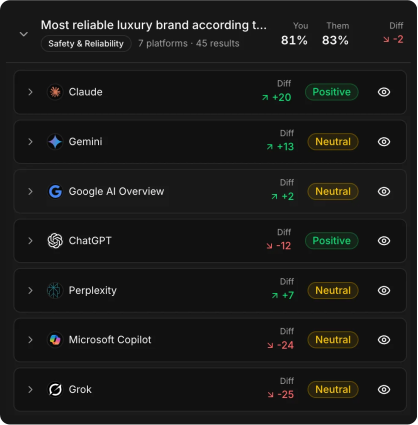
Performance can differ significantly between ChatGPT, Google AI Overviews, Google AI Mode, Gemini, Claude, Perplexity, Copilot, and other platforms.
Cross-platform measurement helps prevent teams from treating one AI system as representative of the entire AI Search landscape.
AI-Referred Traffic
Visibility and traffic are not the same thing.
AI Traffic Analytics can help connect AI Search visibility with visits generated by AI assistants and answer engines.
GEO Metrics to Track
A practical Generative Engine Optimization measurement framework can include:
- AI Visibility %
- Prompt Coverage %
- Brand Mentions
- AI Citations
- AI Share of Voice
- Competitor Visibility
- Platform Coverage
- Country or market coverage
- AI-referred visits
- Changes in cited domains and URLs
These metrics should be interpreted together. A visibility increase without citations, traffic, or improved competitive positioning may mean something different from an increase occurring across several signals simultaneously.
Examples of Generative Engines and AI Search Platforms
GEO can apply across a growing range of AI-powered discovery experiences, including:
- ChatGPT
- Google AI Overviews
- Google AI Mode
- Gemini
- Claude
- Perplexity
- Microsoft Copilot
These platforms do not necessarily retrieve information, generate answers, or display citations in the same way. As a result, GEO should be measured across the platforms that matter to an organization's audience rather than assuming performance on one engine represents performance everywhere.
Common Generative Engine Optimization Mistakes
GEO is still developing, and several approaches can lead teams in the wrong direction.
Treating GEO as Keyword Stuffing for AI
Repeating terms does not create a reliable GEO strategy. Content should be designed around useful information, clear entities, audience needs, and relevant topics.
Optimizing for Only One AI Platform
Different platforms can produce different answers and rely on different sources. Measuring only one system can provide an incomplete view of visibility.
Ignoring Third-Party Sources
A brand's website is only one part of the information ecosystem. External sources can strongly influence how brands and categories are represented.
Measuring Only Traffic
AI-generated experiences do not always produce a click. Mentions, citations, recommendations, Share of Voice, and prompt coverage can provide additional evidence of visibility.
Creating New Content for Every Prompt
Closely related prompts often belong to the same underlying topic or intent. Creating separate pages for every variation can lead to fragmented content and unnecessary overlap.
Assuming GEO Guarantees Citations
No optimization method can guarantee that a generative system will mention or cite a specific source. Outputs can change as models, indexes, retrieval systems, prompts, and source availability change.
GEO Is an Ongoing Optimization Process
Generative search ecosystems change continuously. Models are updated, retrieval systems evolve, new sources become influential, competitors publish new information, and user prompts change.
For this reason, GEO is better treated as a continuous measurement and optimization process rather than a one-time project.
Historical monitoring is particularly useful because individual AI answers can fluctuate. Looking at patterns across prompts, platforms, and time provides a more reliable view of whether visibility is actually improving.
Generative Engine Optimization and AI Search Intelligence
GEO becomes more useful when visibility data is connected with the signals that explain what is happening and what teams can do next.
An AI Search intelligence workflow can combine prompt monitoring, query fan-out, brand mentions, citations, competitor visibility, source intelligence, content opportunities, and AI-referred traffic.
Ansvisor's AI Visibility Platform brings these signals together so teams can monitor AI Search performance, investigate visibility and citation gaps, compare competitors, discover content opportunities, and move from insights toward prioritized actions.
The goal of Generative Engine Optimization is ultimately not to optimize for a single model or metric. It is to build a stronger information presence that can be discovered, understood, trusted, and referenced across an increasingly fragmented AI Search ecosystem.





.svg)
