


LLM Pulse
What is LLM Pulse?
LLM Pulse is an AI visibility and Generative Engine Optimization (GEO) platform designed to help organizations measure and improve how their brands appear across AI-powered search and answer engines.
The platform tracks prompts across multiple AI models and analyzes the resulting responses for brand mentions, citations, competitors, sentiment, Share of Voice, and other visibility signals.
LLM Pulse also extends beyond answer monitoring with AI traffic analytics, owned media tracking, Query Fan-Out analysis, recommendations, content optimization workflows, shopping visibility, reputation monitoring, reporting, and developer integrations.
What does LLM Pulse do?
LLM Pulse monitors questions that matter to a brand and repeatedly evaluates how supported AI search platforms answer those questions.
Teams can use the resulting data to understand whether their brand appears, how often competitors are mentioned, which domains and URLs are cited, how positively or negatively the brand is represented, and which prompts favor competing organizations.
The platform is designed to turn these observations into broader AI search intelligence by connecting response-level visibility with traffic, owned media, recommendations, content optimization, and other GEO workflows.
What are the key features of LLM Pulse?
LLM Pulse combines AI visibility monitoring, competitive intelligence, citation analytics, content optimization, and integrations within one platform.
- Prompt Tracking: Runs selected questions across supported AI models on weekly or daily schedules.
- AI Visibility Monitoring: Tracks whether brands appear across monitored AI-generated answers.
- Brand Mentions: Identifies references to the tracked brand and its configured name variations.
- Citation Tracking: Measures domains and URLs returned by AI models as sources for answers.
- Competitor Benchmarking: Compares mentions, citations, visibility, sentiment, and Share of Voice against selected competitors.
- Sentiment Analysis: Evaluates how AI-generated answers represent the tracked brand and competing brands.
- Share of Voice: Measures the brand's share of mentions compared with competitors within monitored responses.
- Query Fan-Out: Surfaces subqueries actually generated by supported AI systems while answering tracked prompts.
- AI Traffic Analytics: Helps teams analyze website traffic associated with AI-powered discovery.
- Owned Media Tracking: Allows brands to connect owned properties such as YouTube, social profiles, and app listings.
- Recommendations and GEO Writer: Provides optimization guidance and content workflows intended to help teams improve AI search presence.
- Reputation Monitoring: Helps teams understand how AI systems represent and describe a brand.
- ChatGPT Shopping: Provides visibility into AI-powered product discovery and shopping experiences.
- AI Paid Ads Tracking: Extends monitoring into advertising-related activity within AI search environments.
- Reporting and Data Exports: Supports CSV, Excel, PDF, custom reports, and Data Studio connectivity.
- API, MCP and CLI: Makes LLM Pulse data available to external applications, AI agents, reporting workflows, and command-line environments.
Which AI platforms does LLM Pulse track?
LLM Pulse currently includes five primary AI search and answer experiences across its standard plans:
- ChatGPT.
- Perplexity.
- Gemini.
- Google AI Mode.
- Google AI Overviews.
Every tracked prompt is evaluated across the selected AI models, allowing teams to compare how the same question performs across different search environments.
This matters because similar questions can produce different brands, citations, competitors, and recommendations depending on the AI platform being used.
How does prompt tracking work in LLM Pulse?
Prompts are the questions LLM Pulse runs against supported AI models to measure brand visibility.
During project setup, teams can add their own prompts or use AI-generated suggestions based on the website and business context.
Each prompt is then executed across the AI models included in the selected plan. Weekly plans refresh tracked prompts on a weekly schedule, while daily plans run the same prompt set every day.
Prompt data can also be organized by country, language, tags, and collections, allowing teams to analyze different markets, topics, customer journeys, and use cases separately.
How does LLM Pulse measure AI visibility?
LLM Pulse analyzes the responses generated for tracked prompts and converts them into brand and competitor performance metrics.
Teams can investigate signals including:
- Brand mentions.
- Visibility scores.
- Citation rates.
- Share of Voice.
- Sentiment.
- Competitor mentions.
- Prompt-level performance.
- Model-level performance.
Brand matching names can be configured within a project to help the system recognize variations of how an AI model may refer to the same organization.
Competitors are evaluated within the same AI responses, allowing teams to compare performance using a consistent prompt and model set.
How does citation tracking work in LLM Pulse?
LLM Pulse defines a citation as a domain or URL returned by an AI model as a source for an answer.
A citation may appear as a visible clickable link, a displayed domain, or a background source reference contained within response metadata.
This is distinct from a brand mention. A brand can be mentioned without its website being used as a source, while a domain can be cited even when the brand name does not appear prominently in the answer text.
Citation reports can be analyzed at several levels:
- Domain.
- Host or subdomain.
- Individual page.
- AI model.
- Prompt.
- Competitor.
This allows teams to understand which sources AI systems rely on, compare citation performance with competitors, and inspect the pages behind those sources.
How does LLM Pulse analyze competitors?
LLM Pulse allows organizations to add competing brands and monitor them within the same AI-generated responses as the tracked brand.
Competitor analysis can compare:
- Brand mentions.
- Visibility scores.
- Citation rates.
- Sentiment.
- Share of Voice.
- Prompt-level performance.
Teams can also identify prompts where competing brands receive stronger visibility, helping reveal specific areas where the tracked brand may be underrepresented.
Competitor matching names can be configured to account for variations in how AI systems refer to each brand.
What is Query Fan-Out in LLM Pulse?
LLM Pulse exposes Query Fan-Out data through its platform and API.
Query fan-out refers to the additional searches or subqueries an AI system generates while researching an original user prompt.
LLM Pulse can show the actual subqueries generated during tracked executions, including how frequently individual queries occur and which original prompts produced them.
This can help teams understand the language AI systems use during retrieval rather than looking only at the wording originally entered by the marketer.
Query Fan-Out analysis can reveal supporting questions, entities, comparisons, attributes, and content opportunities that influence AI-generated answers.
How does sentiment analysis work in LLM Pulse?
LLM Pulse analyzes how AI systems describe both the tracked brand and its competitors.
Sentiment records can be classified across categories ranging from very positive to very negative and can be filtered by model, competitor, prompt, country, language, and time period.
This helps teams move beyond measuring whether a brand appears and toward understanding how that brand is represented within AI-generated answers.
Sentiment monitoring can be particularly relevant to brand, reputation, communications, and PR teams because visibility without accurate or positive representation may not create the desired business outcome.
What is Owned Media tracking in LLM Pulse?
LLM Pulse allows organizations to connect public profiles and properties that belong to the tracked brand.
Supported owned media can include:
- YouTube channels.
- Instagram profiles.
- Facebook Pages.
- TikTok profiles.
- App Store listings.
- Google Play listings.
This allows teams to broaden AI visibility analysis beyond the main corporate website and understand how other owned digital properties contribute to brand presence across AI search.
What is AI Traffic Analytics in LLM Pulse?
LLM Pulse includes AI Traffic Analytics designed to help teams understand website traffic associated with AI-generated discovery.
This extends analysis beyond mentions and citations by allowing organizations to investigate whether AI search platforms contribute measurable visits to owned websites.
Combining AI visibility with traffic information can provide additional context when deciding which prompts, models, citations, and optimization opportunities are most valuable.
How does LLM Pulse help teams improve GEO performance?
LLM Pulse combines monitoring with recommendations and optimization tools intended to help teams act on AI search data.
Its feature set includes Recommendations, GEO Writer, GEO Testing, reputation analysis, content-related workflows, and custom reporting.
Potential optimization opportunities can include:
- Prompts where competitors outperform the brand.
- Missing or weak citation presence.
- Content topics requiring stronger coverage.
- Brand reputation issues visible in AI-generated answers.
- Owned media opportunities.
- Pages that could better support important customer questions.
These capabilities position LLM Pulse as more than a basic prompt tracker by connecting monitoring data with GEO-oriented workflows.
Does LLM Pulse support developers and external workflows?
Yes. LLM Pulse provides multiple ways to access data outside its main application.
Current developer and reporting interfaces include:
- REST API.
- Model Context Protocol (MCP).
- Command-line interface (CLI).
- SDKs.
- Data Studio connector.
- CSV, Excel, and PDF exports.
Its API exposes data including prompts, prompt executions, competitors, mentions, citations, sentiment, Query Fan-Out, and other dimensions.
These capabilities can be useful for agencies, enterprise teams, developers, and organizations that want AI search intelligence within internal analytics or automation systems.
Who is LLM Pulse for?
LLM Pulse is designed for organizations that want ongoing visibility into how brands are represented across AI search.
Potential users include:
- SEO and AI Search teams.
- AEO and GEO practitioners.
- Content teams.
- Brand and reputation teams.
- Growth teams.
- E-commerce teams.
- Agencies.
- Enterprise marketing organizations.
Its tiered project and prompt limits make the platform applicable to individual marketers and small teams as well as agencies and larger organizations managing multiple brands.
How does LLM Pulse fit into AI SEO, AEO, and GEO?
LLM Pulse operates within the broader AI search optimization ecosystem associated with AI SEO, Answer Engine Optimization (AEO), and Generative Engine Optimization (GEO).
These disciplines expand search optimization beyond traditional rankings by examining how brands are mentioned, cited, represented, compared, and recommended within AI-generated answers.
LLM Pulse supports this process through prompt monitoring, citations, competitors, sentiment, Query Fan-Out, AI traffic analytics, owned media tracking, recommendations, and GEO-oriented content workflows.
How is LLM Pulse different from traditional SEO tools?
Traditional SEO platforms primarily analyze keywords, search rankings, backlinks, technical SEO, organic traffic, and conventional search engine results.
LLM Pulse focuses on what happens inside AI-generated answers and the discovery journey surrounding them.
Instead of only asking where a webpage ranks for a keyword, teams can investigate questions such as:
- Does AI mention our brand?
- Which competitors receive greater visibility?
- Which websites and pages are cited?
- How does AI describe our brand?
- Which prompts favor competitors?
- What subqueries do AI systems generate?
- Do AI platforms send traffic to our website?
- Which opportunities should we prioritize next?
AI visibility analytics therefore complements traditional SEO rather than necessarily replacing it.
What should teams consider when evaluating LLM Pulse?
Organizations evaluating LLM Pulse should consider their required prompt volume, tracking frequency, number of projects, competitor limits, geographic and language needs, reporting workflows, API requirements, and budget.
LLM Pulse offers separate weekly and daily monitoring options. Teams that need highly frequent visibility data should therefore evaluate daily plans, while organizations focused on longer-term trend monitoring may find weekly tracking sufficient.
The platform currently includes five primary AI models across its standard plans, so teams that require broader model coverage should compare that requirement with other AI visibility platforms.
Organizations should also consider whether capabilities such as Owned Media, AI Traffic Analytics, ChatGPT Shopping, GEO Testing, API access, MCP, and custom reporting are relevant to their workflow.
LLM Pulse and the AI Search tools ecosystem
LLM Pulse is one of several platforms developed specifically for measuring and improving brand visibility across AI-generated search experiences.
Its approach combines prompt monitoring with citations, competitors, sentiment, Query Fan-Out, owned media, AI traffic analytics, GEO workflows, and developer integrations.
The broader ecosystem includes AI visibility monitoring platforms, citation intelligence products, prompt analytics systems, AI traffic tools, content optimization platforms, and traditional SEO products expanding into AI search.
Ansvisor maintains a broader directory of AI SEO, AEO, GEO, AI visibility, and AI search tools to help teams understand this evolving ecosystem and evaluate platforms based on their specific requirements.
Official source
FAQ
What is LLM Pulse?

LLM Pulse is an AI visibility and GEO platform that helps organizations track prompts, brand mentions, citations, competitors, sentiment, Share of Voice, and other visibility signals across AI-generated search experiences.
Which AI platforms does LLM Pulse track?
LLM Pulse currently includes ChatGPT, Perplexity, Gemini, Google AI Mode, and Google AI Overviews across its standard monitoring plans.
Does LLM Pulse track AI citations and competitors?
Yes. LLM Pulse tracks domains and URLs returned as AI sources and compares brand mentions, citation rates, sentiment, visibility scores, and Share of Voice with selected competitors.
Does LLM Pulse support Query Fan-Out analysis?
Yes. LLM Pulse exposes subqueries generated by AI models while answering tracked prompts and allows these queries to be analyzed by frequency, original prompt, competitor, and time period.
Does LLM Pulse provide API and MCP access?
Yes. LLM Pulse provides REST API, MCP, SDK, CLI, Data Studio connector, and export capabilities for integrating AI visibility data with external workflows and reporting systems.
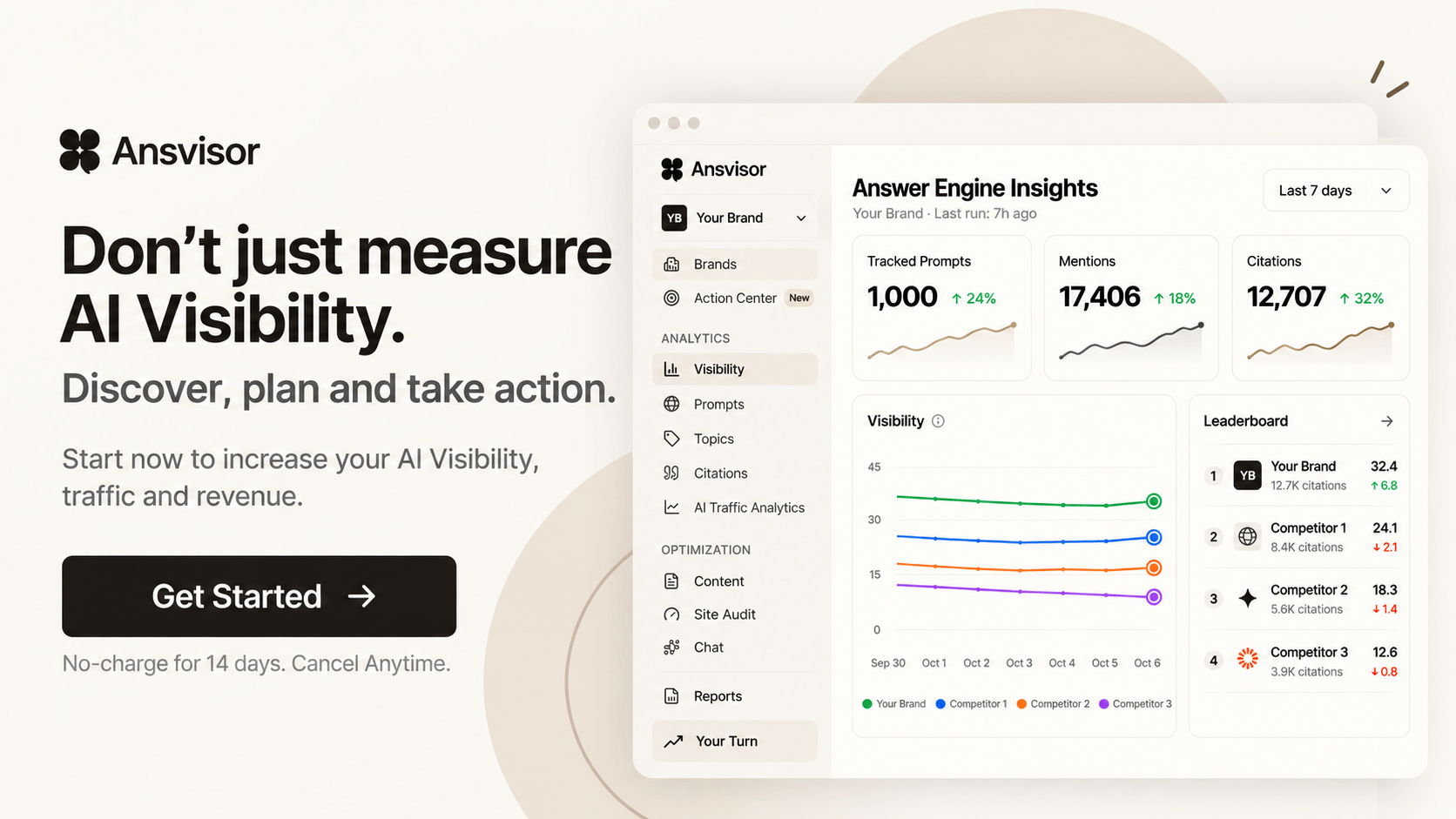
Everything You Need to Improve Your AI Visibility
Track how your brand appears across AI platforms, understand what drives visibility, and turn insights into measurable actions.
Platform Features
Explore all features →Answer Engine Insights
Understand how AI platforms talk about your brand.
Prompt Intelligence
Discover and monitor the prompts shaping your AI visibility.
Citations Monitoring
Track which sources AI platforms cite and where your brand appears.
AI Traffic Analytics
Measure visits coming from ChatGPT, Gemini, Claude, and more.
Competitor Benchmarking
Compare AI visibility and uncover competitive gaps and opportunities.
Action Center
Turn AI Search signals into prioritized actions and executable tasks.
AI Visibility Trackers
Explore AI Visibility Platform →ChatGPT Visibility Tracker
Track brand mentions, citations, prompts, and visibility across ChatGPT.
Google AI Overviews Rank Tracker
Monitor where and how your brand appears in Google AI Overviews.
Google AI Mode Visibility Tracker
Track your brand's visibility across Google AI Mode experiences.
Gemini Visibility Tracker
Understand how your brand appears across Google Gemini responses.
Microsoft Copilot Visibility Tracker
Monitor your brand's presence across Microsoft Copilot answers.
Perplexity Visibility Tracker
Track brand mentions, citations, and visibility across Perplexity.
From AI Visibility insights to action.
Explore the complete Ansvisor platform for AI Search intelligence, optimization, and growth.
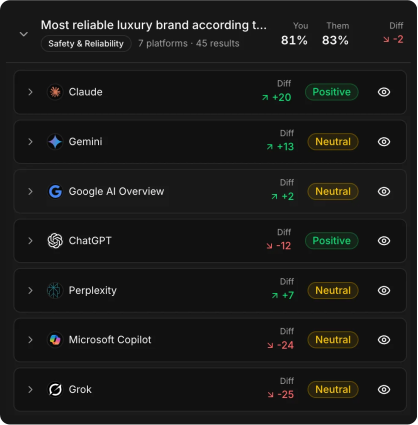
Win customers from all major AI platforms
Understand, measure, and optimize your AI visibility via Ansvisor.
✓ Add brand, domains and competitors
✓ Discover prompts and growth opportunities
✓ Track your AI visibility across major AI platforms
✓ Monitor citations, mentions, and competitors
✓ Measure AI traffic and customer discovery
✓ Receive AI recommendations based on AI insights
✓ Optimize authority, trust, and content quality
✓ Create content, automate analysis & action with AI agents
AI Visibility Terms
Continue exploring key AI visibility concepts.
AI Visibility
Measure and improve how often your brand appears in AI-generated answers.
Learn more →Answer Engine Optimization (AEO)
Strategies for increasing visibility in answer engines and AI summaries.
Learn more →Generative Engine Optimization (GEO)
Optimizing content for AI-powered discovery experiences.
Learn more →ChatGPT Search
Understand how OpenAI retrieves and synthesizes information.
Learn more →Google AI Overviews
AI-generated summaries that appear directly in Google Search.
Learn more →Perplexity Search
Explore how Perplexity cites and presents sources.
Learn more →AI Citations
References and sources used by AI systems to support answers.
Learn more →Citation Authority
Measure the quality and influence of cited sources.
Learn more →Retrievability
How easily AI systems can discover and reuse your content.
Learn more →New terms are added regularly.
Help us improve the page or suggest a new term →
Cihan Geyik
Co-founder at Ansvisor
Cihan Geyik is the co-founder of Ansvisor, an open-source AI Visibility platform for AI Search. With more than 15 years of experience in digital marketing and growth, he writes about AI visibility, AI search, AEO, GEO, citations, and answer engines. He focuses on helping brands understand and improve their presence across ChatGPT, Gemini, Perplexity, Google AI Overviews, and other AI-powered discovery platforms.
Get more Ansvisor insights in Google
Add Ansvisor as a Preferred Source to see more of our AI Search, AEO, GEO, and AI Visibility insights across Google.
Make Your Brand Visible in AI Answers.

INDUSTRIES


© 2026 Ansvisor. All rights reserved. Ansvisor is an open-source AI Search Intelligence Platform for AI Visibility. Ansvisor is a brand owned and operated by Empler AI Inc.


.svg)