.svg)









Not every AI prompt has the same commercial value. A brand can improve visibility across hundreds of informational questions and still fail to appear when a buyer asks which product to choose, which vendor to trust, how much a solution costs, or which alternative is best for a specific need.
The fastest path from AI Visibility to revenue is to identify the prompts closest to a buying decision, understand the Query Fan-Out behind them, and build the evidence AI systems need to mention, cite, and recommend your brand.
TL;DR
- Prioritize prompts with strong commercial intent instead of optimizing every tracked question equally.
- Look for comparisons, alternatives, pricing, reviews, implementation, migration, availability, and vendor-selection prompts.
- Use visibility gaps to find prompts where competitors are already mentioned or cited but your brand is absent.
- Inspect Query Fan-Out to discover the supporting questions AI systems use before making recommendations.
- Create content and third-party evidence that answers buyer objections around trust, security, ROI, fit, and implementation.
- Use Ansvisor to connect prompt discovery, citations, team actions, AI traffic, and measurable business outcomes.
Most AI Visibility strategies begin with coverage: how many prompts are tracked, how often the brand appears, and whether the overall visibility score is rising.
Those metrics matter, but C-level leaders usually ask a different question:
Which AI search opportunities are most likely to influence pipeline, conversions, and revenue?
A prompt about a broad industry definition may improve awareness. A prompt asking for the best vendor for a specific use case may influence a purchase within days. Treating those prompts as equal hides the difference between visibility that looks good in a report and visibility that changes buying decisions.
What Is Revenue-Weighted AI Visibility?
Revenue-weighted AI Visibility is the practice of prioritizing prompts based on their potential influence on a commercial outcome. It does not ignore awareness or educational prompts. It recognizes that teams with limited resources should first win the conversations closest to evaluation and purchase.
The objective is not to become visible everywhere at once. The objective is to identify the prompt clusters where better mentions and citations can shorten consideration, reduce buyer uncertainty, and create qualified traffic.
The Core Principle
Do not optimize every AI prompt equally. Win the prompts that influence buying decisions first.
How Prompts Change Across the Buying Journey
Buyers do not ask the same questions at the beginning and end of their research. Their language becomes more specific as they move closer to a decision. Prompt discovery should map the complete journey, not just a list of category terms.
| Stage | Typical prompt pattern | Commercial value | Primary content need |
|---|---|---|---|
| Problem awareness | What is..., why does..., how does... | Low to medium | Definitions, education, diagnosis, and category clarity |
| Solution exploration | How to solve..., tools for..., strategies for... | Medium | Frameworks, workflows, use cases, and implementation guidance |
| Consideration | Best..., top..., recommended..., software for... | High | Best-of guides, category pages, evaluation criteria, and expert comparisons |
| Evaluation | X vs Y, alternatives to..., reviews, pros and cons | Very high | Comparison pages, alternatives, proof, reviews, and objection handling |
| Decision | Pricing, demo, free trial, implementation, migration, enterprise, security | Highest | Pricing clarity, technical details, trust signals, deployment, onboarding, and ROI |
High-Intent Prompt Types to Prioritize
Best and top prompts
Examples include “best AI Visibility software,” “top enterprise GEO platforms,” or “best product for a specific need.” These prompts often trigger comparisons, citations, and recommendations.
Comparison prompts
Prompts containing “vs,” “compare,” “pros and cons,” or “which is better” indicate that the buyer is actively narrowing the shortlist.
Alternative prompts
“Alternatives to” and “competitors of” prompts reveal dissatisfaction, budget constraints, missing features, or migration intent.
Pricing and value prompts
Questions about cost, ROI, total cost of ownership, plans, and free trials often appear immediately before a commercial action.
Implementation prompts
Questions about setup, integrations, migration, security, compliance, and time to value indicate serious evaluation.
Urgent and seasonal prompts
Last-minute, near-location, same-day, seasonal, event-based, or deadline-driven queries can compress the buying journey dramatically.
How to Find Revenue-Impacting Prompts in Ansvisor
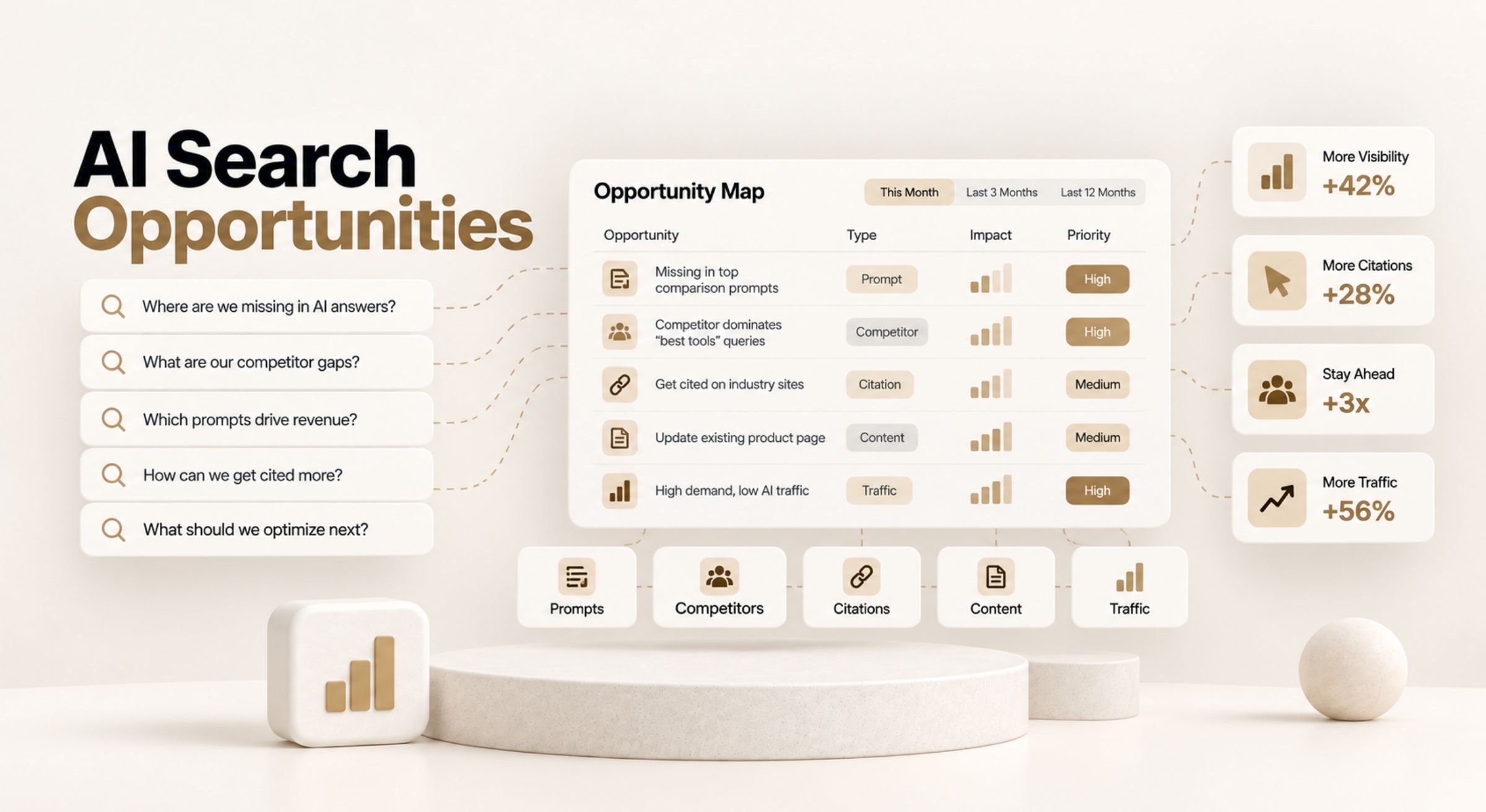
Ansvisor helps teams move from broad prompt monitoring to revenue-focused opportunity discovery. The workflow begins with the market, then narrows toward prompts where stronger visibility can influence a buying decision.
1. Start With Topics and Prompt Suggestions
After a brand enters its domain, Ansvisor identifies relevant topics and generates prompt suggestions around the business, product, audience, and competitive landscape. Teams can prioritize topics closer to commercial intent, such as pricing, alternatives, vendor selection, use cases, implementation, category comparisons, security, and enterprise readiness.
2. Combine Search Demand With Commercial Intent
Ansvisor adds estimated demand informed by Google Search data to prompt suggestions. Demand helps reveal market interest, but it should never be the only factor. A lower-volume prompt about pricing, migration, or a competitor alternative may create a stronger sales opportunity than a high-volume educational query.
3. Find Prompts Where Competitors Win and You Are Missing
- Competitors are repeatedly mentioned but your brand is absent.
- Competitor pages or third-party profiles earn citations while your target URL does not.
- Your brand is mentioned but not cited.
- Your target URL exists but does not appear in the AI answer.
- The prompt has meaningful demand and strong decision-stage intent.
These gaps are often more actionable than completely untested categories because AI systems already understand the prompt, retrieve sources, and include vendors. The missing task is to make your brand easier to retrieve, verify, cite, and recommend.
4. Inspect Query Fan-Out Before Creating Content
A buyer may ask one question, but the AI system can perform many supporting searches before generating the answer. Query Fan-Out reveals those hidden sub-queries.
| Supporting query | Buyer concern | Evidence required |
|---|---|---|
| Enterprise AI Visibility platform security | Risk and compliance | Security documentation, data controls, deployment options, and architecture |
| AI Visibility software pricing | Budget and value | Transparent pricing, plan limits, ROI context, and trial information |
| Open-source GEO platform | Control and transparency | Repository, license, self-hosting, documentation, and community activity |
| Best AI Visibility platform for teams | Workflow fit | Collaboration, statuses, notes, target URLs, roles, and reporting |
| AI Visibility software case studies | Proof and credibility | Results, methodology, examples, customer evidence, and independent validation |
The fan-out often exposes the real reasons a buyer hesitates. A generic “best tools” article may not be enough. The brand may need a security page, migration guide, pricing explanation, comparison page, case study, integration documentation, third-party review, or transparent methodology.
A Revenue Prompt Priority Framework
Teams can use a practical scoring model to compare opportunities. This is not a universal industry standard. It is a prioritization framework for deciding where to act first.
Revenue Prompt Priority
A strong opportunity does not need the highest score in every category. A highly relevant decision-stage prompt with a clear competitor gap may deserve action even when estimated volume is modest.
“The goal is not to win every AI prompt. The goal is to win the prompts that shape buying decisions—and build the evidence that turns visibility into trust, citations, and revenue.”— Cihan Geyik, Co-founder of Ansvisor
How to Find Fast-Moving and Seasonal Opportunities
Some buying decisions happen slowly. Others happen within hours or days. Fast-moving prompts are especially valuable because the user has a defined need, deadline, or narrow set of constraints.
Urgent needs
Look for modifiers such as “today,” “same day,” “near me,” “available now,” “last minute,” “fastest,” or “immediate.”
Seasonal demand
Track recurring periods such as Black Friday, tax season, back to school, summer travel, Ramadan, Christmas, or industry-specific renewal cycles.
Event-driven decisions
Monitor launches, conferences, policy deadlines, market changes, product releases, and major industry events.
Replacement and migration
Watch for dissatisfaction signals such as alternatives, migration, switching, cancellation, replacement, or better-value queries.
Find the AI Prompts Most Likely to Influence Revenue
Use Ansvisor to discover commercial prompt gaps, inspect Query Fan-Out, compare competitors, prioritize actions, and monitor whether your brand earns more mentions, citations, and AI-referred traffic.