
SEO, AEO, and GEO are increasingly used to describe how brands improve visibility across traditional search results, answer-driven experiences, and generative AI. But these are not three completely separate disciplines—and the boundaries between AEO and GEO are especially easy to oversimplify.
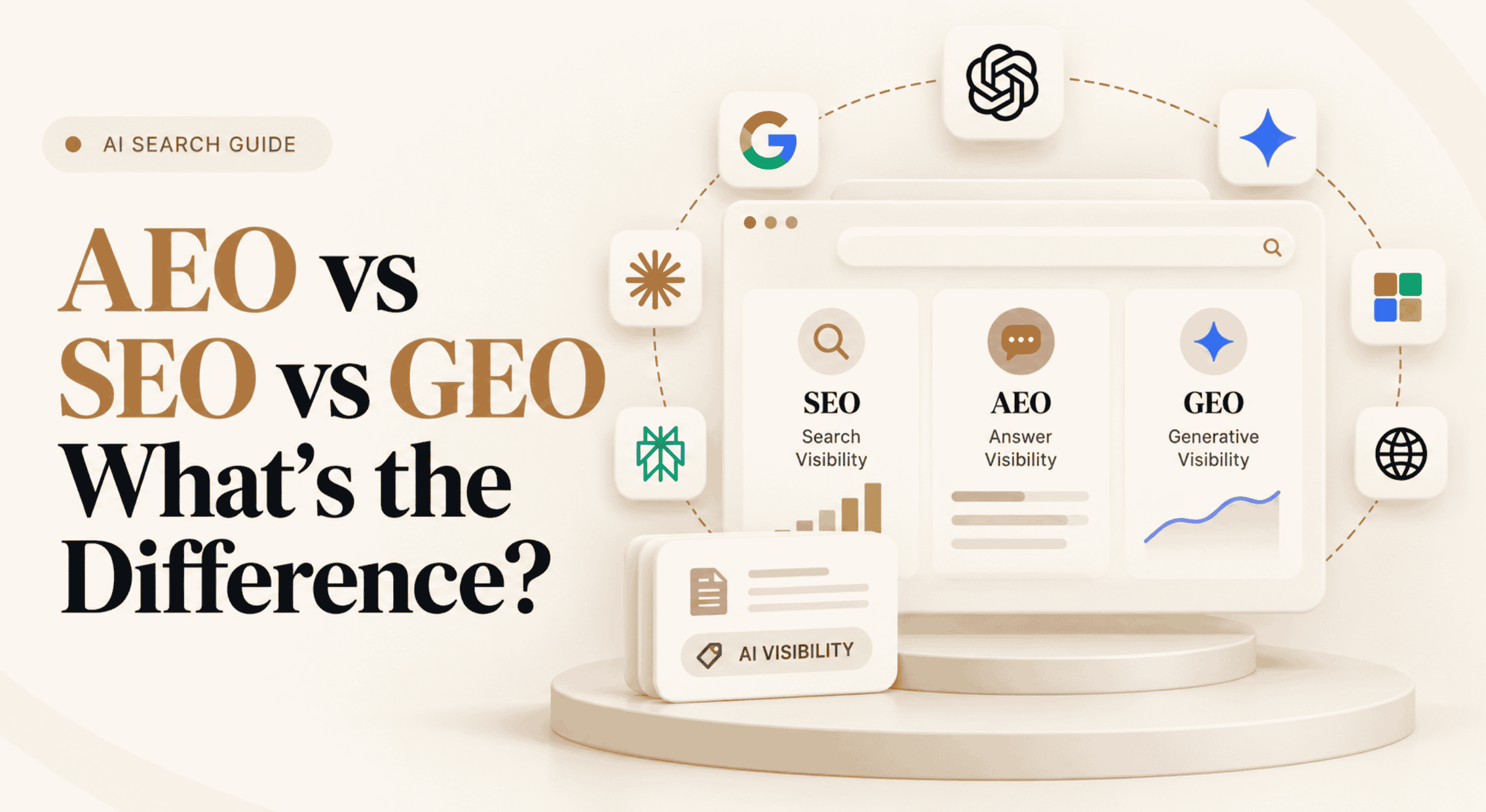
The most useful way to understand the difference is by looking at their primary emphasis: SEO focuses broadly on search visibility, AEO emphasizes visibility in answer-driven experiences, and GEO emphasizes visibility within responses generated by generative AI systems.
SEO (Search Engine Optimization) improves visibility across search engines. AEO (Answer Engine Optimization) emphasizes making content useful and discoverable within answer-driven experiences. GEO (Generative Engine Optimization) emphasizes brand and content visibility within responses generated by generative AI systems. In practice, AEO and GEO overlap significantly, and many established SEO practices support both. The difference is primarily one of emphasis—not a clean separation between platforms.
The practice of improving a website's presence in organic search by making content discoverable, relevant, useful, technically accessible, and authoritative for the searches a business wants to reach.
An optimization approach focused on improving how content and brands can be understood, retrieved, and surfaced in answer-oriented discovery experiences where users receive direct responses rather than only lists of links.
An optimization approach focused on improving the visibility of content and brands within responses generated by generative AI systems that synthesize information to answer user questions.
There is no universally accepted industry standard that assigns AEO and GEO to completely different platforms. Google's 2026 guidance discusses both “Answer Engine Optimization” and “Generative Engine Optimization” as terminology used around visibility in AI search experiences, while continuing to position established SEO practices as relevant to its generative AI search features.
See: Google Search Central's Generative AI optimization guidance.
The clearest difference is the discovery experience being emphasized. SEO developed around search engines and organic search results. AEO puts more emphasis on systems that directly answer questions. GEO narrows the lens toward answers synthesized and generated using generative AI.
AEO and GEO are often presented as if they belong to two separate generations of technology. In reality, the distinction is much less rigid.
AEO is the broader answer-oriented concept. It emphasizes optimizing information for experiences where the user receives an answer rather than relying exclusively on a traditional list of search results.
GEO places more explicit emphasis on generative AI. It focuses on how brands, content, entities, and sources appear within responses synthesized by generative systems.
A generative AI system can also be an answer engine. An answer engine can use generative AI. That means the same experience can reasonably fall within both AEO and GEO.
For this reason, it is misleading to define AEO as optimization for one fixed group of platforms and GEO as optimization for another fixed group.
No. That distinction is too simplistic.
Google AI Overviews, for example, provide synthesized answers directly in search and use generative AI. They therefore have characteristics associated with both answer-oriented discovery and generative search.
Google AI Mode goes even further toward a conversational, generative search experience. Meanwhile, ChatGPT, Gemini, Claude, and Perplexity are generative AI systems that also act as answer engines when users ask questions, research products, compare options, or seek recommendations.
Instead of assigning each platform to a single acronym, marketers can focus on the common business question: Can the right audience discover, understand, and consider our brand when they search or ask AI systems relevant questions?
No. AEO should not be treated as a replacement for SEO.
Search engines still need to discover, crawl, understand, and evaluate web content. Many of the fundamentals associated with strong SEO—technical accessibility, useful content, clear site structure, internal linking, authority, and a strong user experience—also support visibility across newer search experiences.
This is especially important for Google. Its official guidance for AI features states that existing SEO best practices remain relevant for appearing in AI Overviews and AI Mode and that there are no additional technical requirements or special schema markup required specifically for these AI features.
Google Search Central states that the same foundational SEO best practices apply to its AI features. Pages must still meet normal Search eligibility requirements, and Google does not require special AI-specific markup or additional machine-readable files to appear in AI Overviews or AI Mode.
These layers are better understood as complementary than mutually exclusive. A technically inaccessible page is unlikely to benefit from sophisticated AI Search tactics. Likewise, ranking well for traditional keywords does not automatically mean a brand will be mentioned, recommended, or cited for important AI prompts.
As discovery expands beyond traditional search results, measurement also needs to expand. Ansvisor helps teams understand AI visibility through prompts, mentions, citations, competitors, sources, AI traffic, and other signals across the AI Search journey.
Explore the AI Search Intelligence Platform, or review Ansvisor's definitions of Answer Engine Optimization (AEO) and Generative Engine Optimization (GEO).
The biggest difference between GEO and traditional SEO is not that one optimizes websites and the other optimizes AI. Both depend heavily on useful, accessible, trustworthy web information. The difference is primarily in the experience where visibility is being measured.
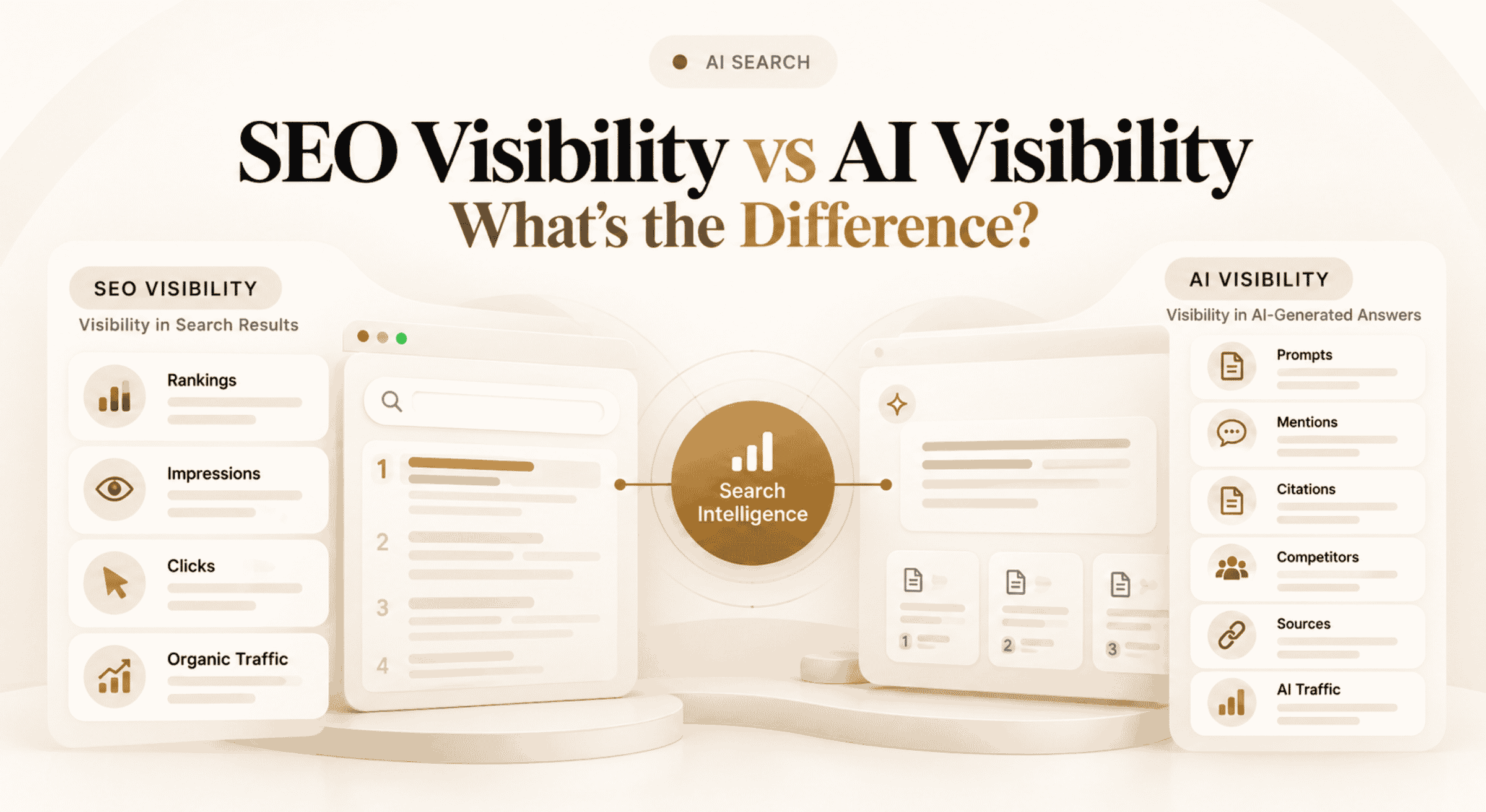
Traditional SEO commonly measures performance through search rankings, impressions, clicks, organic traffic, and conversions. GEO expands the measurement layer into generative responses, where a brand may be mentioned, recommended, compared, or supported by cited sources without occupying a conventional numbered search position.
These measurements can complement each other. A page that performs well in traditional search may become a useful source for AI systems, but strong rankings alone do not guarantee that a brand will be mentioned or cited in a generated response.
For most businesses, the practical question is not whether to choose SEO, AEO, or GEO. It is how to build a discovery strategy that works across traditional search and AI-powered answer experiences.
A strong foundation starts with making information technically accessible, useful, clear, authoritative, and easy to understand. Those fundamentals can support traditional organic search while also improving the conditions under which answer and generative systems can discover and interpret information.
Technical accessibility still matters. Search engines and AI-powered search experiences need to access and understand the information you publish before that information can become useful in discovery.
This includes fundamentals such as crawlability, indexability where relevant, internal linking, descriptive page structure, useful content, clear entities, accessible text, and a website experience that helps people understand the subject.
Keyword demand remains useful, but AI-driven discovery makes natural-language questions, comparisons, follow-ups, use cases, and decision criteria increasingly important inputs for content strategy.
Instead of optimizing only around a short keyword, teams can investigate the broader set of questions surrounding a topic: what users want to know, what they compare, what objections they have, which alternatives they consider, and what information they need before making a decision.
Ansvisor's Prompt Monitoring & Volumes helps teams investigate and monitor the prompts shaping AI Search demand.
Clear writing is useful for people and machines alike. Important definitions, facts, comparisons, product information, methodology, authorship, and supporting evidence should not be unnecessarily difficult to locate or interpret.
This does not mean writing every page as a collection of robotic question-and-answer blocks. It means reducing ambiguity and making the page genuinely useful for the intent it serves.
AI-generated answers can draw information from multiple sources. That makes the broader information ecosystem around a brand important—not only the content published on the brand's own website.
Relevant third-party coverage, authoritative references, original information, strong topical expertise, consistent entity information, and useful resources can all contribute to a more credible web presence.
Traditional rank tracking alone cannot show the full AI Search picture. Teams also need to understand whether their brand appears in generated answers and which domains and URLs are being used as observable sources.
With Citation Monitoring, teams can analyze citation patterns, cited domains, exact URLs, and source opportunities across monitored AI answers.
AI visibility becomes more useful when viewed comparatively. If your brand is absent from an important prompt, which competitors appear instead? Are they being recommended, compared, mentioned, or cited? Which sources are associated with their visibility?
Ansvisor's Competitor Tracking & Benchmarking helps teams compare brand performance with competitors across AI-generated answers and relevant visibility signals.
Imagine a software company wants to become more discoverable for people researching AI Search analytics platforms.
Notice that the underlying content strategy is not split into three completely independent programs. The same useful page can contribute to traditional search visibility, answer readiness, and generative visibility.
There is no universal checklist that guarantees inclusion in an AI-generated answer. Generative systems can change their responses, retrieval behavior, source selection, and models over time. Optimization should therefore focus on improving the quality and discoverability of information while measuring actual visibility.
Make important public information technically accessible to the search and AI systems you want to reach, subject to your own crawling and content-access policies.
Explain important concepts and questions clearly instead of forcing users or systems to infer the core answer from vague marketing language.
Cover the questions, comparisons, entities, problems, and decision criteria surrounding a topic rather than optimizing a page around a single phrase.
Add information worth using: original analysis, experience, data, methodology, examples, product knowledge, or expert insight.
Strengthen trust through credible authorship, references, third-party recognition, consistent entities, and demonstrated expertise.
Track prompts, mentions, citations, competitors, sources, visibility trends, and identifiable AI traffic instead of assuming optimization worked.
Google explicitly states that there are no additional technical requirements, special schema markup, or special AI text files required to appear in its AI Overviews or AI Mode. Established search fundamentals remain relevant. Other generative systems have their own architectures and policies, so no single tactic can guarantee visibility across every AI platform.
Measurement is one of the areas where the distinction becomes more practical. Traditional search provides established performance signals, while AI Search introduces additional visibility signals that need to be observed across generated answers.
AI visibility provides a practical measurement layer across AEO and GEO. Instead of debating which acronym owns a particular platform, teams can measure whether their brand appears for the questions and prompts that matter.
Useful signals can include brand mentions, citations, competitor appearances, source domains, exact cited URLs, prompt coverage, platform coverage, answer context, visibility changes, and identifiable AI-referred website traffic.
Ansvisor's Answer Engine Insights brings these signals together so teams can analyze how their brands appear across AI-generated answers.
For most organizations, the answer is not to choose one acronym.
If customers use traditional search engines, SEO remains important. If they increasingly discover information through direct answers and AI-generated experiences, the measurement and optimization strategy should expand accordingly.
A practical approach is to treat SEO as a foundation and add answer and generative visibility as additional layers of the discovery strategy.
SEO: Can people discover us through search?
AEO: Is our information useful and visible when systems answer relevant questions?
GEO: Does our brand and content earn visibility within relevant generative AI responses?
The underlying goal is the same: make your brand easier to discover, understand, trust, and consider wherever customers search, ask, compare, and decide.
SEO broadly focuses on improving organic search visibility, while AEO emphasizes visibility and usefulness within answer-driven experiences. They overlap significantly because strong answer-oriented content still benefits from SEO fundamentals such as accessibility, relevance, clear structure, useful information, and authority.
SEO traditionally measures visibility through search results, rankings, impressions, clicks, and organic traffic. GEO focuses more specifically on visibility within generative AI responses, where additional signals can include prompts, mentions, citations, sources, recommendations, competitors, and answer context.
AEO emphasizes optimization for answer-driven discovery, while GEO places more specific emphasis on responses generated by generative AI systems. The distinction is not absolute. Modern AI experiences can function as both answer engines and generative engines, so AEO and GEO frequently overlap in practice.
ChatGPT is clearly a generative AI system, making it relevant to GEO. It also functions as an answer engine for many discovery, research, comparison, and recommendation journeys, so AEO principles can also be relevant. It is therefore misleading to treat ChatGPT as belonging exclusively to only one optimization acronym.
Google AI Overviews can reasonably be discussed in both contexts. They provide direct, synthesized answers within Google Search and are powered by generative AI. Google itself does not require marketers to choose between AEO and GEO terminology to optimize for them; its guidance emphasizes established SEO best practices for its AI search features.
Google AI Mode is a conversational, generative search experience, making GEO highly relevant. Because it also directly answers user questions as part of a search journey, it overlaps with the broader concept of AEO as well.
No. GEO expands optimization and measurement into generative AI experiences rather than eliminating the need for SEO. Technical accessibility, useful content, authority, entities, site structure, and other search fundamentals continue to matter.
There is no universal AEO or GEO schema that guarantees visibility in AI-generated answers. Google specifically states that no special schema markup is required for appearing in AI Overviews or AI Mode. Structured data can still be useful when it accurately represents visible page content and follows the relevant search engine guidelines.
SEO, AEO, and GEO are useful terms because they describe changes in how people discover information. But treating them as three isolated disciplines can create more confusion than clarity.
SEO remains the foundation for organic search discoverability. AEO emphasizes the growing importance of direct answers and question-driven experiences. GEO focuses attention on the generative systems that synthesize information into new responses.
The boundaries increasingly overlap.
The more durable strategy is therefore to create accessible, useful, authoritative information and then measure how that information—and the brand behind it—performs across both traditional search and AI-powered discovery.
Ansvisor is an AI Search Intelligence Platform for understanding how brands appear across AI-generated answers through prompts, mentions, citations, competitors, sources, AI traffic, content intelligence, and actionable opportunities.


Co-founder at Ansvisor
Cihan Geyik is the co-founder of Ansvisor, an open-source, cloud-ready AI Visibility platform for AI Search. With more than 15 years of experience in digital marketing and growth, he writes about AI visibility, AI search, AEO, GEO, citations, and answer engines. He focuses on helping brands understand and improve their presence across ChatGPT, Gemini, Perplexity, Google AI Overviews, and other AI-powered discovery platforms.



© 2026 Ansvisor. All rights reserved. Ansvisor is an open-source AI Search Intelligence Platform for AI Visibility.


.svg)