



GEO (Generative Engine Optimization)
GEO began as an academic idea. In 2023, a group of researchers showed that small changes to a web page could change how often a generative engine used it in an answer. Generative engine optimization (GEO) is now the name for that work across ChatGPT, Gemini, Perplexity and Google’s AI features.
The work itself is concrete: be one of the few sources an engine reads, quotes and links, and be named when the answer lists options.
What Is Generative Engine Optimization (GEO)?
GEO is the work of shaping content, technical access and outside coverage so AI systems pick your pages when they build an answer. Success shows up as citations, brand mentions and recommendations inside the generated text.
The term comes from the paper GEO: Generative Engine Optimization by Pranjal Aggarwal and colleagues. It was first posted in November 2023 and accepted to KDD 2024.
The authors scored visibility by how many words of an answer drew on a source, weighted by position, plus a subjective impression score. Marketers have since stretched the term to the whole practice: tracking, content changes and earning citations on other sites.
GEO sits next to answer engine optimization (AEO) and feeds a brand’s overall AI visibility.
What Does GEO Stand For?
In search marketing, GEO stands for generative engine optimization. A generative engine is any system that writes an answer from retrieved sources, where a classic search engine only lists them.
The acronym has older meanings. Geo-targeting, geographic SEO and "geo search" are about location, not AI answers. A page about GEO that talks about maps or local packs is using one of those senses.
How Do Generative Engines Choose Sources?
The details differ by platform, but the path from question to answer is similar.
Google’s documentation on AI features says AI Overviews and AI Mode may run several related searches across subtopics to build one response. That step is called query fan-out. Your page can be pulled in for a sub-question the user never typed.
Engines cite different numbers of sources
The number of links per answer varies widely by platform. That changes how many source slots there are to win.
| Platform | Links per answer |
|---|---|
| Google AI Overviews | ~13.7 |
| Gemini | ~12.3 |
| ChatGPT | ~5.2 |
| Google AI Mode | ~4.8 |
| Microsoft Copilot | ~4.5 |
Source: Ansvisor tracking data, September 15 to October 14, 2026, across 103,427 AI answers and 746,702 citations.
On ChatGPT or Copilot, a handful of sources share the whole answer. On AI Overviews, more pages get a link, and the contest moves to which ones the text leans on.
What Did the GEO Research Find?
The original paper tested several ways of rewriting a source page and measured the effect on generated answers. The authors built a 10,000-query benchmark, GEO-bench, for the tests.
- Adding quotations, statistics and cited sources gave the largest gains, roughly 30 to 40% on the paper’s main visibility measure.
- Keyword stuffing didn’t help. On Perplexity, it performed about 10% worse than the unchanged page.
- Results varied by domain, so the authors call for domain-specific methods.
The practical reading: give engines something specific to quote, such as a number, a named source or a direct claim.
Generative Engine Optimization vs SEO
GEO and SEO share a foundation and keep score differently.
| SEO | GEO |
|---|---|
| Rankings in a list of links | Inclusion in a written answer |
| Keywords | Prompts and topics |
| Clicks from results | Mentions, citations and AI referrals |
| Backlinks | Citations and third-party mentions |
| Competitors on the results page | Brands and sources named in answers |
An engine can’t cite a page it can’t crawl or index. Google’s AI features draw on the same index as regular search, so technical SEO remains the entry ticket.
GEO vs AEO: What Is the Difference?
In daily work, very little. Both aim to get a brand used and named in AI answers.
AEO is the older marketing label, first used for featured snippets and voice answers. GEO came from the 2023 research and stresses systems that write new text. Many teams use GEO for content and citation work and AEO for the program as a whole.
GEO → Optimizing for generative engines
AI visibility → Measuring the result across both
Our breakdown of AEO vs SEO vs GEO compares the three side by side.
A GEO Example: One Market, Four Prompts
Prompts carry far more context than keywords. Here are four questions from the same market:
- "best CRM software"
- "best CRM software for a small B2B SaaS company"
- "compare CRM platforms for a 20-person sales team"
- "which CRM is easiest to connect to HubSpot forms and Slack?"
Each one can return a different set of brands and sources. A CRM vendor might own the first prompt and be missing from the last two, where buyers describe a real situation.
GEO work starts with that gap. Which prompts do you lose, and what do the winning answers cite?
How to Start With Generative Engine Optimization
GEO is a cycle, and the first pass sets the baseline for every later one. A sound first pass looks like this:
- Pick topics and prompts. List the questions buyers ask when they research, compare and decide.
- Measure current visibility. Record where you appear, where competitors appear and which prompts show the largest gaps.
- Study the cited sources. Note which sites and pages the winning answers rely on for each topic.
- Improve existing pages first. Add direct answers, numbers with sources, clear entity details and missing sub-topics.
- Create pages only for real gaps. One strong page per topic beats a page for every prompt variant.
- Build authority beyond your site. Earn coverage in the publications, review sites and communities your category’s answers cite.
- Re-measure on the same prompts. Compare visibility, citations and AI referral traffic with the baseline.
How Do You Measure GEO?
GEO platforms report the same few concepts under different names. Coverage, inclusion and share of voice get confused most often.
| Metric | Question it answers | How it’s calculated |
|---|---|---|
| Prompt coverage | Do we show up for this topic at all? | Prompts with at least one appearance ÷ tracked prompts |
| Inclusion rate | How often are we in the answer? | Answers that name or cite us ÷ all answers collected |
| Share of voice | How do we compare with rivals? | Our mentions ÷ all brand mentions in the same answers |
| Citation rate | How often are our pages the source? | Answers citing our URLs ÷ all answers collected |
Coverage shows breadth, inclusion shows frequency and share of voice shows your standing against competitors. A brand can reach 80% coverage and still hold a small share of voice when one rival is named in nearly every answer.
Split each metric by platform and country. Then read the trend over weeks, because single answers move between runs.
Read the four together. A visibility gain with no new citations or visits means something different from a gain across all of them.
Common GEO Mistakes
- Stuffing keywords. The original research found it lowered visibility on Perplexity.
- Judging GEO by one answer, when the next run of the same prompt can cite different sources.
- Tracking one platform and assuming the others behave the same way.
- Measuring only traffic, when many answers shape a decision without a click.
- Ignoring the review sites, forums and videos that engines already cite in your category.
GEO Tools and How Ansvisor Helps
GEO tools run your prompts on AI platforms on a schedule and report mentions, citations and competitors. Some add content recommendations or crawler data. We compared the main options in our review of GEO tools we tested side by side.
Ansvisor tracks ChatGPT, Google AI Overviews, Google AI Mode, Gemini, Copilot and Perplexity, with Claude on Enterprise plans. Citations Monitoring shows which of your URLs each engine cites and which competitor pages win when yours don’t. Query Fan-Out shows the sub-questions behind each prompt.
Ansvisor is open source, so you can self-host it or use the cloud version. For the full playbook, read our generative engine optimization guide, or start a 14-day free trial.
Let AI Search work for you
Each prompt you win brings more mentions, more citations and more buyers. Ansvisor keeps finding the next one.
FAQ
What is generative engine optimization (GEO)?

Generative engine optimization is the practice of improving how often AI engines use your content as a source and name your brand in their answers. It covers content, crawler access and coverage on third-party sites.
What does GEO stand for?
In search marketing, GEO stands for generative engine optimization. The term comes from a research paper first posted in 2023 and published at KDD 2024. In other fields, GEO can refer to geography or geo-targeting.
What is the difference between GEO and AEO?
In daily work there is little difference. GEO comes from research on generative engines, and AEO from marketing around direct answers. Both aim to get a brand cited and mentioned in AI answers, and they share the same metrics.
What is the difference between coverage, inclusion and share of voice in GEO?
Prompt coverage is the share of tracked prompts where you appear at least once. Inclusion rate is the share of all answers that name or cite you. Share of voice is your part of all brand mentions in those answers.
What are generative engine optimization tools?
GEO tools run your prompts on AI platforms on a schedule and report mentions, citations and competitors. Some add content recommendations or crawler data. Ansvisor is an open-source option that you can also self-host.
Everything You Need to Improve Your AI Visibility
Track how your brand appears across AI platforms, understand what drives visibility, and turn insights into measurable actions.
Platform Features
Explore all features →Answer Engine Insights
Understand how AI platforms talk about your brand.
Prompt Intelligence
Discover and monitor the prompts shaping your AI visibility.
Citations Monitoring
Track which sources AI platforms cite and where your brand appears.
AI Traffic Analytics
Measure visits coming from ChatGPT, Gemini, Claude, and more.
Competitor Benchmarking
Compare AI visibility and uncover competitive gaps and opportunities.
Action Center
Turn AI Search signals into prioritized actions and executable tasks.
AI Visibility Trackers
Explore AI Visibility Platform →ChatGPT Visibility Tracker
Track brand mentions, citations, prompts, and visibility across ChatGPT.
Google AI Overviews Rank Tracker
Monitor where and how your brand appears in Google AI Overviews.
Google AI Mode Visibility Tracker
Track your brand's visibility across Google AI Mode experiences.
Gemini Visibility Tracker
Understand how your brand appears across Google Gemini responses.
Microsoft Copilot Visibility Tracker
Monitor your brand's presence across Microsoft Copilot answers.
Perplexity Visibility Tracker
Track brand mentions, citations, and visibility across Perplexity.
From AI Visibility insights to action.
Explore the complete Ansvisor platform for AI Search intelligence, optimization, and growth.
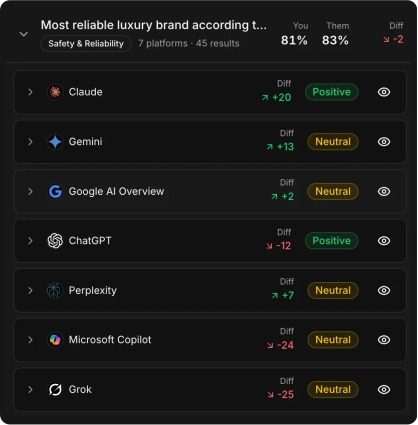
Win customers from all major AI platforms
Understand, measure, and optimize your AI visibility via Ansvisor.
✓ Add brand, domains and competitors
✓ Discover prompts and growth opportunities
✓ Track your AI visibility across major AI platforms
✓ Monitor citations, mentions, and competitors
✓ Measure AI traffic and customer discovery
✓ Receive AI recommendations based on AI insights
✓ Optimize authority, trust, and content quality
✓ Create content, automate analysis & action with AI agents
AI Visibility Terms
Continue exploring key AI visibility concepts.
AI Visibility
Measure and improve how often your brand appears in AI-generated answers.
Learn more →Answer Engine Optimization (AEO)
Strategies for increasing visibility in answer engines and AI summaries.
Learn more →Generative Engine Optimization (GEO)
Optimizing content for AI-powered discovery experiences.
Learn more →ChatGPT Search
Understand how OpenAI retrieves and synthesizes information.
Learn more →Google AI Overviews
AI-generated summaries that appear directly in Google Search.
Learn more →Perplexity Search
Explore how Perplexity cites and presents sources.
Learn more →AI Citations
References and sources used by AI systems to support answers.
Learn more →Citation Authority
Measure the quality and influence of cited sources.
Learn more →Retrievability
How easily AI systems can discover and reuse your content.
Learn more →New terms are added regularly.
Help us improve the page or suggest a new term →
Cihan Geyik
Co-founder at Ansvisor
Cihan Geyik is the co-founder of Ansvisor, an open-source AI Visibility platform for AI Search. With more than 15 years of experience in digital marketing and growth, he writes about AI visibility, AI search, AEO, GEO, citations, and answer engines. He focuses on helping brands understand and improve their presence across ChatGPT, Gemini, Perplexity, Google AI Overviews, and other AI-powered discovery platforms.
Get more Ansvisor insights in Google
Add Ansvisor as a Preferred Source to see more of our AI Search, AEO, GEO, and AI Visibility insights across Google.
Make Your Brand Visible in AI Answers.

INDUSTRIES


© 2026 Ansvisor. All rights reserved. Ansvisor is an open-source AI Search Intelligence Platform for AI Visibility. Ansvisor is a brand owned and operated by Empler AI Inc.