
Search visibility used to be measured primarily through rankings, impressions, clicks, organic traffic, and the pages appearing across search engine results.
That measurement layer still matters. But customers can now discover, compare, and evaluate brands through ChatGPT, Gemini, Claude, Perplexity, Google AI Overviews, Google AI Mode, Microsoft Copilot, and other AI-powered experiences before—or sometimes without—clicking a traditional search result.
This creates an additional visibility layer. SEO visibility helps explain how visible your website is across traditional search. AI Visibility helps explain how your brand, products, content, and sources appear within AI-generated answers and AI-powered discovery experiences.
The two are connected, but they are not interchangeable. Understanding both gives marketing and search teams a broader view of how people discover a brand.
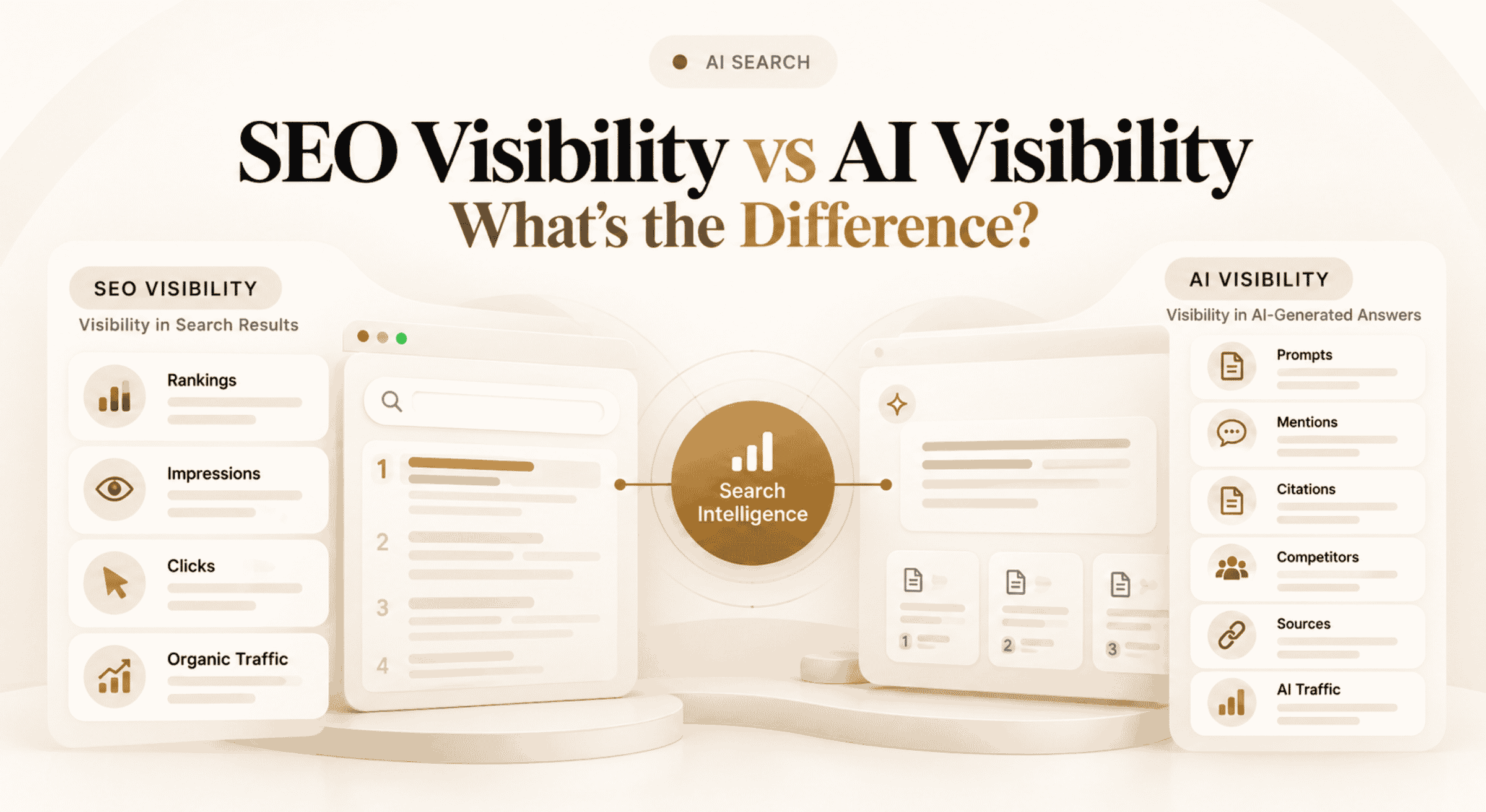
SEO visibility measures how prominently a website appears across traditional search results using signals such as rankings, impressions, clicks, and organic traffic. AI visibility measures how a brand appears across AI-generated answers using signals such as prompt coverage, brand mentions, citations, competitors, sources, Share of Voice, and answer-level visibility. AI visibility does not replace SEO visibility. Together, they measure two increasingly important layers of digital discovery.
SEO visibility describes how prominently a website or its pages appear across organic search results for the queries that matter to the business.
Traditionally, search teams measure this through keyword rankings, search impressions, clicks, click-through rate, organic landing pages, and traffic. SEO platforms may also calculate their own visibility scores using ranking positions, estimated search demand, click models, or other proprietary methodologies.
SEO visibility answers a question such as: How discoverable is our website when people search for the topics, products, services, and problems that matter to our business?
The unit being measured is often a webpage and its position within a search result. If a page moves from position 12 to position 3 for an important query, its traditional search visibility has generally improved.
Where individual pages appear for relevant search queries.
How often pages are shown across eligible search results.
How many visits begin after users click an organic search result.
The relationship between search impressions and organic clicks.
Visits attributed to unpaid search engine results.
The pages, features, and queries where a website earns organic exposure.
AI visibility measures how a brand, product, website, content, or other entity appears across AI-powered search and answer experiences.
This sits within the broader evolution of AI Search, where users increasingly receive generated responses rather than interacting only with a conventional list of search results.
Instead of asking only where a webpage ranks, AI visibility asks whether the brand appears in the answer, how it is represented, whether competitors appear instead, which sources are cited, which prompts trigger visibility, and how those patterns change across AI platforms and over time.
AI visibility answers a question such as: How visible is our brand when people use AI systems to discover, research, compare, and evaluate the products, services, and topics relevant to us?
The questions and intents where the brand gains or lacks visibility.
Whether and how frequently the brand appears across monitored AI-generated answers.
Whether owned or relevant third-party URLs are cited or surfaced as sources.
Which competing brands appear for the same prompts and customer journeys.
The domains and exact URLs influencing or appearing within AI-generated answers.
Your relative visibility compared with competitors across a defined measurement set.
The simplest distinction is the environment being measured and the form in which visibility appears.
Traditional SEO measurement focuses primarily on how webpages perform across search results and whether that visibility creates impressions, clicks, and organic traffic.
AI visibility measurement focuses on how brands and sources are represented within generated responses across relevant prompts and AI-powered discovery experiences.
The important distinction: SEO visibility is usually page-centric and ranking-oriented. AI visibility is often brand-, entity-, answer-, prompt-, and source-oriented. Neither perspective provides the complete picture by itself.
Consider a software company targeting a commercial query such as “best project management tools for startups.”
The company's comparison page could rank in the organic search results. SEO measurement would examine its ranking position, impressions, clicks, CTR, traffic, and possibly conversions.
A user could ask the same or a similar question in an AI assistant. The generated answer might mention several products, recommend particular brands, cite a publisher's comparison, reference community discussions, or use the company's own content as a source.
AI visibility measurement therefore asks different questions: Was the company mentioned? Which competitors appeared? Was the company website cited? Which third-party sources were used? How did the answer change when the prompt changed?
The customer intent can be similar while the discovery experience—and therefore the measurement framework—is different.
Yes. Strong traditional search performance and strong AI visibility can overlap, but one does not automatically guarantee the other.
A webpage can perform well in organic search while the brand receives limited representation across the AI prompts being monitored. An AI answer may rely on several sources, mention competing brands, cite a third-party publisher, or synthesize information without giving the company's own page the same prominence it receives in traditional search.
The reverse can also occur. A brand may appear prominently in AI-generated recommendations because authoritative third-party sources discuss it even when the brand's own website is not the highest-ranking organic result for that specific query.
Organic rankings remain valuable, but they are not a complete proxy for how a brand is represented inside generated answers. This is why teams increasingly need both traditional search measurement and AI visibility monitoring.
Citations introduce another important distinction between SEO visibility and AI visibility. In traditional search, the website appearing in the result is itself the destination.
In AI Search, the relationship can be more complex. An AI answer may mention your brand while citing another website. It may cite your content without prominently recommending your brand. Or it may rely on third-party publishers, communities, review sites, videos, competitor content, and other sources when constructing an answer.
This makes AI Citation Monitoring an important part of AI visibility analysis. Teams can investigate which domains and URLs appear across relevant answers, where competitors earn citation coverage, and which external sources repeatedly influence visibility.
The metrics are different because the interfaces and user journeys are different.
These AI Search metrics should also be interpreted using a consistent methodology. Checking one prompt once does not establish meaningful market visibility. Teams need a defined set of prompts, platforms, competitors, markets, and time periods so changes can be compared consistently.
AI referral traffic creates a bridge between AI visibility and traditional website analytics.
When an AI platform sends an identifiable referral visit, teams can analyze which AI sources are driving traffic and which landing pages receive those visits. Ansvisor's AI Traffic Analytics is designed to measure AI referral visits alongside crawler activity and landing-page performance. :chatgpt-content-reference{index="0"}
But AI referral traffic should not be treated as a complete measurement of AI visibility. Users can discover a brand inside an answer without clicking immediately, and not every visibility event creates a measurable website session.
No. AI visibility should be treated as an additional measurement and optimization layer, not as evidence that traditional SEO no longer matters.
Search engines and AI systems both depend on accessible, understandable, useful information. Technical quality, strong content, authority, brand recognition, structured information, and a healthy web presence remain important foundations for digital discoverability.
What changes is the number of environments where that information can influence discovery. A customer may encounter your company through a conventional search result, an AI Overview, an AI assistant, a cited publisher, or several of these experiences during the same research journey.
SEO helps brands compete for visibility across traditional search. AI visibility adds measurement across generated answers and AI-powered discovery. Modern search intelligence increasingly needs to understand both.
Measuring both layers allows teams to see discovery gaps that would remain invisible when analyzing only one channel.
The brand performs well across traditional search and is also consistently represented across relevant AI answers.
Search rankings are healthy, but important AI prompts surface competitors or other sources instead.
The brand gains AI visibility through mentions, citations, or third-party authority despite weaker direct organic rankings.
These differences can reveal whether the next opportunity lies in traditional SEO, content, citations, third-party authority, prompt coverage, competitive positioning, technical improvements, or another part of the discovery ecosystem.
The goal is not simply to create another dashboard. Teams need to understand what changed, where the gap exists, and what should happen next.
Ansvisor's AI Search Intelligence Platform is designed around this broader Analytics → Opportunities → Actions workflow rather than treating AI visibility as an isolated reporting metric. :chatgpt-content-reference{index="1"}
The most useful approach is not to collapse SEO and AI visibility into one metric. Instead, measure each discovery layer with the signals appropriate to it, then analyze where they reinforce or diverge from each other.
Start with the topics, products, problems, and customer journeys that matter to the business. From there, build a traditional search measurement set and an AI Search measurement set around the same commercial and informational themes.
Identify the queries and landing pages that already drive organic discovery. Track rankings, impressions, clicks, CTR, organic traffic, and conversions to understand where the website currently earns traditional search visibility.
This baseline is important because it shows which topics already have search demand and where the business has established organic authority.
Keywords and prompts are related, but they should not be treated as identical measurement units. AI interactions can be longer, conversational, comparative, and more specific than conventional search queries.
A useful prompt set can include category discovery, problems, use cases, alternatives, comparisons, recommendations, product questions, and buying decisions.
A cybersecurity company might track a traditional search query such as “cloud security software”.
Its AI Search measurement set could also include prompts such as “What are the best cloud security platforms for mid-market companies?”, “Compare cloud security tools for AWS environments”, and “Which cloud security platforms are alternatives to [competitor]?”
The underlying customer need is related, but the visibility opportunity can look very different across a SERP and an AI-generated answer.
Prompt monitoring becomes particularly useful at this stage because teams need a repeatable set of questions rather than occasional manual checks. Ansvisor's Prompt Monitoring & Volumes is designed to help organize and monitor the prompts associated with AI Search demand.
For each relevant prompt, determine whether your brand appears and which competitors are surfaced alongside—or instead of—you.
Relative visibility is often more informative than an isolated brand score. A visibility percentage has different strategic implications when your closest competitor appears half as often versus twice as often.
Competitor Tracking & Benchmarking can help teams compare these patterns across AI-generated answers and identify areas where competing brands have stronger visibility.
When competitors consistently appear for important prompts, look beyond the brand names. Investigate the domains and URLs associated with those answers.
Recurring sources can reveal why the competitive landscape looks different in AI Search. The opportunity may involve your own content, third-party authority, comparison pages, documentation, reviews, community discussions, or another source category influencing AI-generated responses.
Once both datasets exist, compare performance by topic or customer journey rather than looking at SEO and AI Search as unrelated channels.
The most actionable insights often appear where SEO visibility and AI visibility do not move together.
Your content performs in traditional search, but your brand rarely appears across relevant AI prompts.
AI answers recognize the brand, but your website is rarely surfaced as a supporting source.
Competing brands or their content receive citations across prompts where your sources are absent.
External sources shaping AI answers discuss competitors more frequently or more clearly than they discuss your brand.
Your brand appears for some topics but disappears when customers move into comparison, alternatives, or purchase-oriented questions.
The brand is visible in one AI experience but substantially less visible across another platform relevant to customers.
These gaps are more useful than simply asking whether an overall visibility score increased. They begin to explain where the problem exists and what type of investigation should happen next.
SEO and AI visibility overlap because both depend on the broader information ecosystem of the web. Improving accessible, useful, well-structured, authoritative content can therefore support discoverability across more than one environment.
But teams should avoid assuming that a specific SEO tactic automatically produces a mention or citation in an AI answer. AI systems and search features can use different retrieval, ranking, synthesis, and presentation processes, and those systems continue to evolve.
Strong technical accessibility, useful content, clear entities, authoritative information, internal structure, and external reputation can strengthen the information available about a brand. None of these individually guarantees that a particular AI system will mention or cite the brand for a particular prompt.
Important content should be accessible to the search engines and relevant crawlers the organization intends to support. Blocking access, hiding important information behind inaccessible interfaces, or creating weak technical foundations can reduce discoverability.
Pages should answer meaningful customer questions clearly and provide useful information about products, categories, problems, comparisons, processes, and other topics relevant to the business.
AI visibility can also be shaped by the broader source ecosystem around a company. Publishers, communities, review sites, directories, research, documentation, and other third-party references can all contribute to how a brand is represented online.
Yes. Teams should not assume that visibility observed in one AI system will automatically reproduce across every other AI experience.
Different systems can return different brands, citations, sources, wording, and recommendations for related prompts. Results can also change over time and with prompt wording, context, market, or other variables.
This is why AI visibility measurement should define which platforms matter to the business instead of treating “AI” as one universal answer engine.
Track relevant prompts, brand appearances, competitors, sources, and citations where available.
Compare how the brand is represented across Gemini responses relevant to customer journeys.
Monitor brand presence and competitive context across relevant Claude answers.
Analyze brand presence alongside the sources surfaced across research-oriented answers.
Measure generative visibility that can appear alongside or extend conventional Google Search experiences.
Include Copilot where it forms part of the audience's AI-powered research journey.
Any organization that depends on organic discovery can benefit from understanding whether customer behavior is expanding from conventional search into AI-powered research.
Track how products appear in category, alternatives, comparison, and recommendation journeys.
Understand visibility when customers research products, categories, features, and purchase decisions.
Extend organic search reporting with AI visibility, citations, competitors, and emerging discovery signals.
Understand how large brands and product portfolios are represented across multiple discovery environments.
Identify where existing content earns search demand but fails to translate into AI visibility or citations.
Add AI-powered discovery to the broader view of brand presence, competition, traffic, and growth.
Adding AI visibility metrics creates value only when teams can determine what those signals mean and what should happen next.
A drop in AI visibility could point to lost citations, changing competitor coverage, weaker prompt coverage, or shifts in the source ecosystem. Strong SEO rankings combined with weak AI visibility could reveal an answer-level opportunity that conventional rank tracking would not expose.
This is where the workflow moves beyond monitoring.
Ansvisor's AI Search Action Center is designed around this transition from signals to actions and tasks, helping teams move beyond simply observing AI Search performance.
SEO visibility describes how prominently a website appears across organic search results for relevant queries. It can be evaluated using rankings, impressions, clicks, CTR, organic traffic, landing-page performance, and other search metrics.
AI visibility describes how a brand, product, website, or other entity appears across AI-generated answers and AI-powered search experiences. Measurement can include prompts, brand mentions, citations, sources, competitors, Share of Voice, platform coverage, and historical visibility.
SEO visibility primarily measures webpage presence and performance across traditional search results. AI visibility measures brand and source presence within generated answers. SEO commonly uses rankings, impressions, clicks, and organic traffic, while AI visibility can use prompts, mentions, citations, competitors, sources, and Share of Voice.
No. Strong SEO can create valuable foundations for discoverability, but high organic rankings do not guarantee that a brand will be mentioned or cited for a particular AI prompt. AI answers may use multiple sources and can represent brands differently from conventional search results.
No. AI visibility adds another discovery layer to traditional search measurement. SEO remains important for organic rankings, search traffic, technical accessibility, content discovery, and website performance. Organizations increasingly need to understand both search and AI-powered discovery.
Define a consistent set of prompts, competitors, platforms, markets, and time periods. Then measure signals such as brand mentions, prompt coverage, citations, cited sources, competitor visibility, Share of Voice, and historical changes. Where possible, connect these signals with identifiable AI referral traffic and business outcomes.
Yes. AI-generated answers can use multiple sources and may mention a brand because of its own content, third-party references, reviews, publishers, communities, documentation, or other information available across the web. Traditional rankings and AI visibility can therefore diverge.
No. AI referral traffic measures identifiable visits reaching a website from AI platforms. AI visibility measures whether and how a brand appears during AI-powered discovery. A user can see or learn about a brand in an AI answer without clicking through to its website.
They can be reported within the same search intelligence framework, but the underlying metrics should remain distinguishable. Combining both helps teams understand where traditional search performance and AI-powered discovery reinforce each other or reveal different gaps.
Search is no longer limited to a list of links. Customers can move between traditional search results, AI-generated summaries, conversational assistants, cited sources, publisher pages, communities, and company websites during the same research journey.
That makes SEO visibility and AI visibility complementary rather than mutually exclusive. SEO tells you how your website performs across traditional organic search. AI visibility adds insight into how your brand, competitors, citations, and sources appear across AI-generated discovery.
The opportunity is to measure both, identify where the two layers diverge, understand why, and turn those signals into work that can improve overall discoverability.
Ansvisor brings prompts, AI visibility, citations, competitors, sources, AI traffic, content intelligence, and other AI Search signals into one AI Search Intelligence Platform.
The goal is to move from Analytics → Opportunities → Actions so teams can understand not only what changed, but where the opportunity is and what should happen next.


Co-founder at Ansvisor
Cihan Geyik is the co-founder of Ansvisor, an open-source, cloud-ready AI Visibility platform for AI Search. With more than 15 years of experience in digital marketing and growth, he writes about AI visibility, AI search, AEO, GEO, citations, and answer engines. He focuses on helping brands understand and improve their presence across ChatGPT, Gemini, Perplexity, Google AI Overviews, and other AI-powered discovery platforms.



© 2026 Ansvisor. All rights reserved. Ansvisor is an open-source AI Search Intelligence Platform for AI Visibility.


.svg)