
How to Measure AI Visibility: KPIs, Metrics & Benchmarks

AI Visibility KPIs are metrics used to measure a brand’s presence in AI-generated answers. They track mentions, citations, Share of Voice, sentiment, and AI-driven traffic across platforms such as ChatGPT, Gemini, Claude, Perplexity, and Google AI Overviews.
Cihan Geyik - Cofounder at Ansvisor
6 min read
June 2, 2026
Explore with AI
In This Article

TL;DR

AI search has created a new visibility layer that traditional SEO tools were never designed to measure.

A brand can be recommended by ChatGPT, cited in Google AI Overviews, or discussed by Perplexity without generating a single click.

That is why organizations are increasingly tracking AI Visibility KPIs such as Mention Rate, Citation Rate, Share of Voice, Sentiment, Discovery Index, and AI-Referred Traffic.

These metrics help marketing, SEO, AEO, GEO, content, and growth teams understand how AI systems discover, interpret, and recommend their brands.

Key Takeaway

AI Visibility KPIs measure how often AI systems mention, cite, recommend, and drive traffic to a brand. Core metrics include mentions, citations, Share of Voice, sentiment, and AI-referred traffic.

Why Traditional SEO Metrics Are No Longer Enough

Traditional search metrics were built around clicks.

AI search is built around answers.

When users ask:

  • What is the best CRM for startups?
  • Which AI visibility platform should I use?
  • What are the best AEO tools?
  • Which alternative should I consider?

AI engines often generate complete responses without requiring users to visit multiple websites.

As a result, brands can influence decisions long before a website visit occurs.

This creates a measurement gap that traditional SEO tools cannot fully capture.

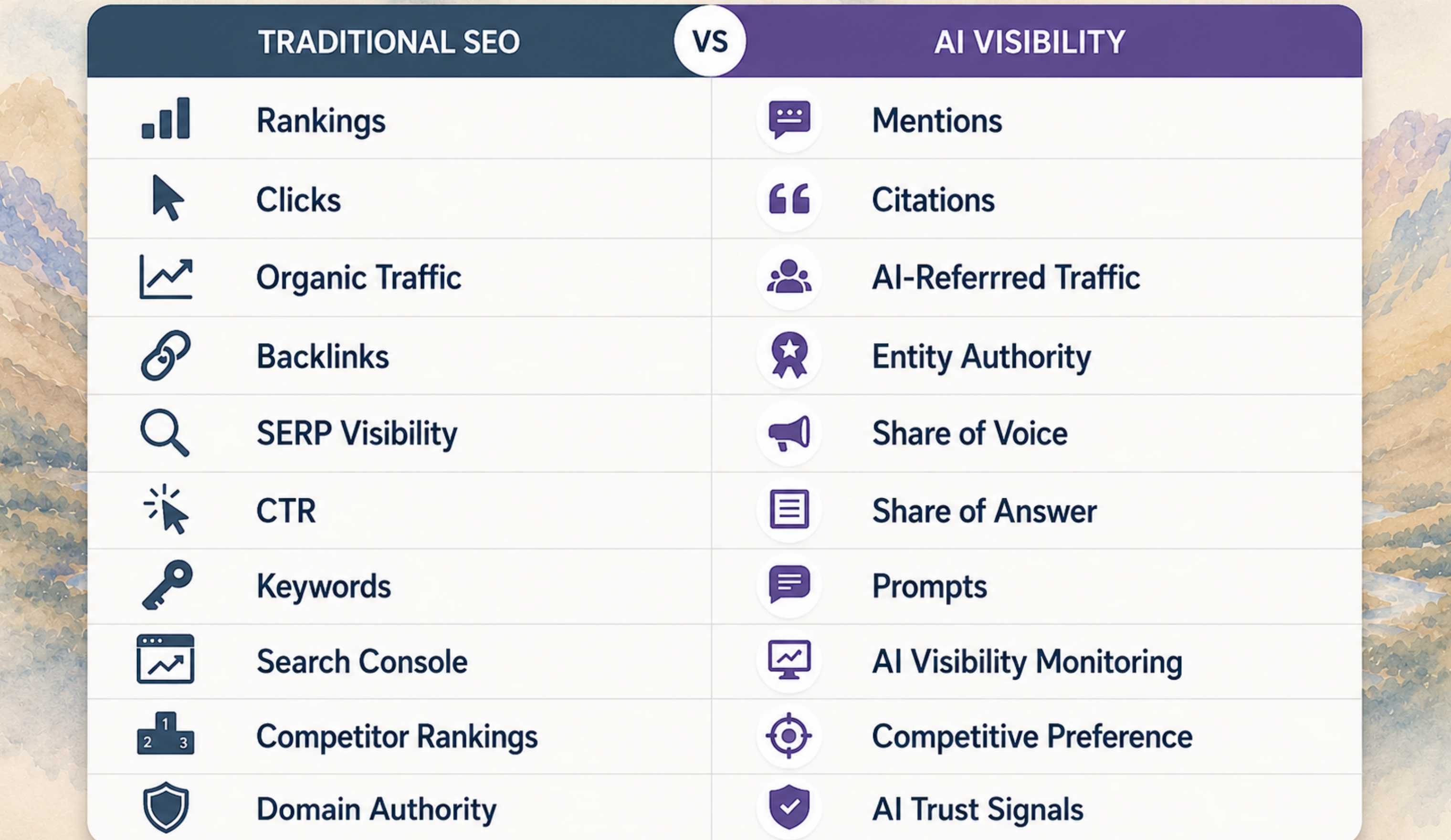
Traditional SEO vs AI Visibility Comparison

Why AI Visibility KPIs Matter

For years, digital marketing success was measured through rankings, impressions, clicks, and backlinks.

Those metrics still matter.

However, AI-generated answers have introduced a new discovery layer.

When a user asks:

  • What is the best CRM for startups?
  • Which project management software should I use?
  • What are the top AI visibility tools?
  • Which alternative should I choose?

AI systems often provide direct recommendations without requiring users to visit a traditional search results page.

This creates a measurement gap.

Your brand may influence buying decisions inside AI-generated answers while receiving little or no attributable traffic.

AI visibility KPIs help close that gap.

What Are AI Visibility KPIs?

AI Visibility KPIs are metrics used to evaluate how AI systems discover, interpret, cite, and recommend your brand.

Unlike traditional SEO metrics, these KPIs focus on conversational visibility.

They answer questions such as:

  • Does AI know my brand exists?
  • Does AI recommend my product?
  • How often am I cited?
  • Which competitors are winning visibility?
  • How does AI describe my company?
  • Which AI platforms provide the strongest visibility?
  • Which prompts generate the most exposure?
  • Is AI visibility creating business outcomes?
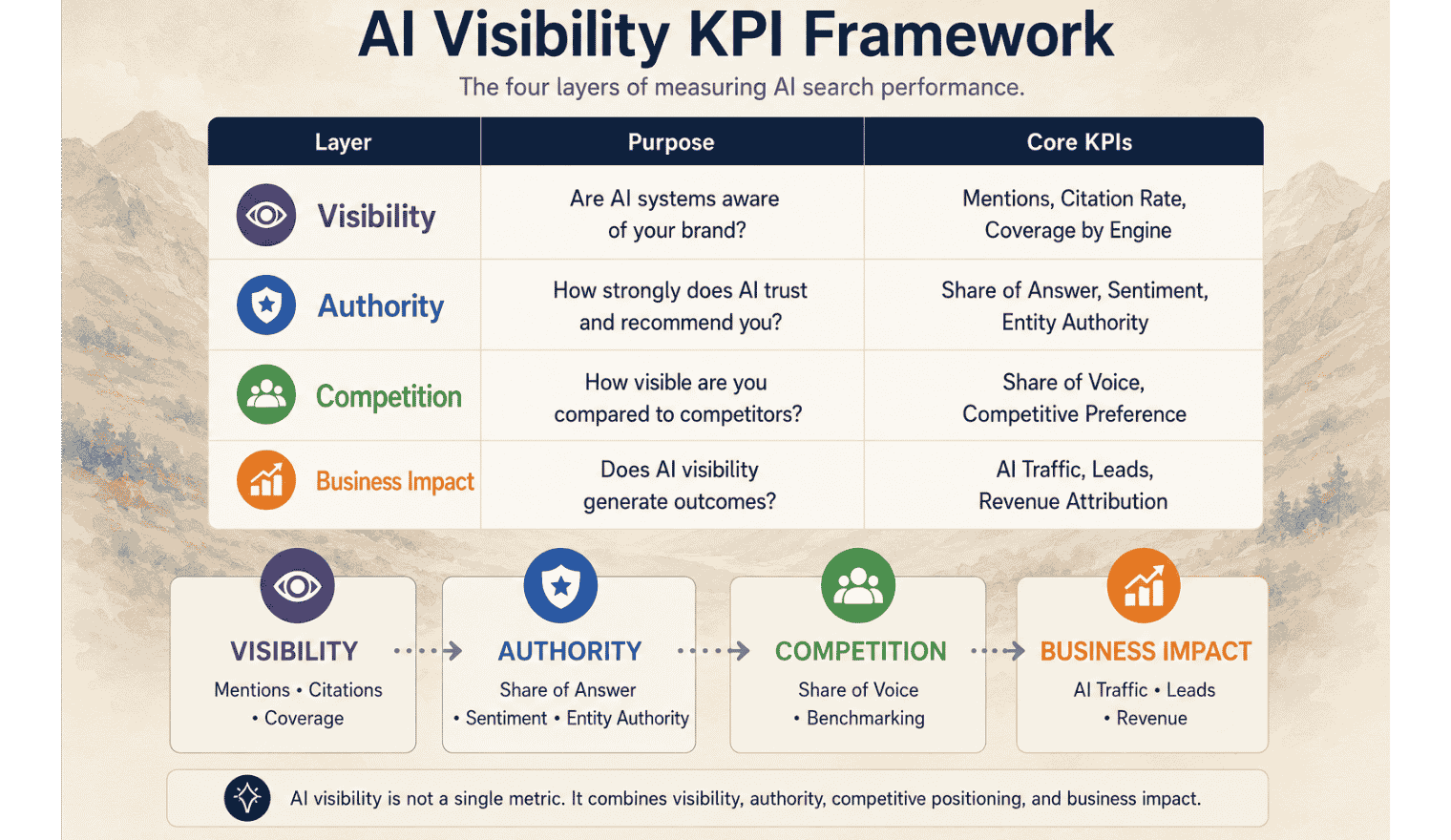
This image shows AI Visibility KPI Framework. It includes four layers of measuring AI search performance. They are Visibility, Authority, Competition and Business Impact. AI Visibility is not a single metric. It combines of layers.

AI visibility is not a single metric.

It combines visibility, authority, competitive positioning, and business impact.

The framework below groups the most important AI visibility KPIs into four layers...

The Most Important AI Visibility KPIs

1. Mention Rate

Mention Rate measures how often your brand appears inside AI-generated answers.

This is the foundational AI visibility metric.

If AI systems rarely mention your company, users may never discover your brand during the research process.

Why Mention Rate Matters

A high mention rate usually indicates:

  • Strong entity recognition
  • High topical authority
  • Broad market awareness
  • Consistent AI visibility

A low mention rate often suggests that AI systems do not strongly associate your brand with important industry topics.

2. Citation Rate

Citation Rate measures how often AI engines use your content as a source.

A citation is different from a mention.

An AI platform may cite your article without mentioning your brand, or mention your brand without citing your website.

Why Citation Rate Matters

Citations indicate:

  • Content authority
  • Source trustworthiness
  • Information reliability
  • Knowledge contribution

High citation rates often signal that your content is influencing AI-generated answers.

3. Share of Voice (SoV)

Share of Voice measures your visibility relative to competitors.

Instead of measuring search rankings, AI Share of Voice measures conversational ownership.

Example

If AI responses across a prompt set contain:

  • 40 mentions of Brand A
  • 30 mentions of Brand B
  • 20 mentions of Brand C
  • 10 mentions of Brand D

Brand A owns 40% AI Share of Voice.

Why Share of Voice Matters

Share of Voice helps organizations understand:

  • Competitive positioning
  • Market visibility
  • Category leadership
  • Visibility trends over time

4. Share of Answer

Share of Answer measures how much attention your brand receives inside a response.

Being listed among ten alternatives is different from being extensively explained and recommended.

High Share of Answer Signals

A strong Share of Answer often includes:

  • Detailed explanations
  • Use cases
  • Product strengths
  • Contextual recommendations

The larger your Share of Answer, the more influence your brand typically has on user decisions.

5. Sentiment

Sentiment measures the tone associated with your brand.

AI systems learn from publicly available information, including:

  • Reviews
  • News coverage
  • Forums
  • Social discussions
  • Industry publications

Why Sentiment Matters

Positive sentiment can increase:

  • Recommendation likelihood
  • Trust signals
  • AI confidence

Negative sentiment can reduce visibility and recommendation frequency.

6. Discovery Index

Discovery Index measures how often AI introduces your brand for non-branded queries.

This KPI is particularly valuable for growth-focused organizations.

Example Queries

  • Best CRM software
  • Top accounting tools
  • Best AI visibility platforms
  • Marketing automation software

When users do not know your brand yet, Discovery Index measures your ability to be discovered.

7. Cross-Model Consistency

Not all AI systems behave the same way.

A brand may perform well in ChatGPT but poorly in Gemini.

Another may dominate Perplexity while remaining invisible in Claude.

Cross-Model Consistency measures how stable your visibility is across multiple AI platforms.

Platforms to Monitor

  • ChatGPT
  • Google AI Overviews
  • Google AI Mode
  • Gemini
  • Claude
  • Perplexity
  • Grok
  • Microsoft Copilot

Strong brands typically maintain visibility across multiple models.

8. AI-Referred Traffic

AI visibility should ultimately contribute to business outcomes.

AI-Referred Traffic measures visits generated by:

  • ChatGPT citations
  • Perplexity links
  • Gemini references
  • AI Overviews
  • AI Mode

Why It Matters

Traffic metrics help connect AI visibility efforts to:

  • Leads
  • Signups
  • Revenue
  • Conversions

This transforms AI visibility from a branding initiative into a measurable growth channel.

How Ansvisor Measures AI Visibility KPIs

Ansvisor helps organizations monitor and improve AI visibility across major answer engines.

Teams can track:

  • Mention Rate
  • Citation Rate
  • Share of Voice
  • Competitive Visibility
  • Sentiment
  • Discovery Opportunities
  • Prompt-Level Performance
  • AI-Referred Traffic

across:

  • ChatGPT
  • Gemini
  • Claude
  • Perplexity
  • Google AI Overviews
  • Google AI Mode
  • Grok
  • Microsoft Copilot

Instead of manually testing prompts, Ansvisor continuously monitors AI-generated answers and provides visibility analytics, benchmarking, and optimization recommendations.

How to Build an AI Visibility Dashboard

An effective AI visibility dashboard should combine visibility, competitive intelligence, and business impact.

Key components include:

Visibility Metrics

  • Mention Rate
  • Citation Rate
  • Share of Voice

Competitive Metrics

  • Competitor Mentions
  • Competitive Preference
  • Share of Answer

Quality Metrics

  • Sentiment
  • Narrative Alignment
  • Contextual Relevance

Business Metrics

  • AI-Referred Traffic
  • Conversion Rate
  • Revenue Attribution

Together, these metrics provide a complete view of AI search performance.

How Often Should AI Visibility Be Measured?

Weekly Track:

  • Mentions
  • Citations
  • Prompt performance
  • Visibility changes

Monthly Review:

  • Share of Voice
  • Competitor changes
  • Discovery opportunities

Quarterly Analyze:

  • Revenue impact
  • AI Traffic contribution
  • Strategic visibility growth

A consistent reporting cycle helps teams identify trends before competitors gain visibility advantages.

Common AI Visibility Measurement Mistakes

Focusing Only on Rankings

AI search performance is not determined solely by search rankings.

Many highly cited brands are not always top-ranking pages.

Ignoring Competitors

Visibility is relative.

Your growth may look positive while competitors are growing faster.

Tracking Only One AI Platform

Performance varies significantly across models.

Always measure visibility across multiple AI systems.

Measuring Mentions Without Quality

A mention alone does not indicate influence.

Recommendation quality and Share of Answer matter just as much.

FAQ

What is an AI visibility KPI?

An AI visibility KPI is a metric that measures how often and how effectively a brand appears in AI-generated answers across platforms such as ChatGPT, Gemini, Claude, and Perplexity.

What is the difference between a mention and a citation?

A mention occurs when an AI system references your brand. A citation occurs when the AI uses your content or website as a source when generating an answer.

Which AI visibility KPI is most important?

Mention Rate is often the starting point, but Share of Voice, Citation Rate, and Share of Answer provide a more complete view of AI search performance.

How do I measure AI Share of Voice?

AI Share of Voice is calculated by comparing your brand mentions against total competitor mentions across a predefined set of prompts.

Why does sentiment matter for AI visibility?

AI systems learn from public information. Positive sentiment increases trust signals and can improve recommendation frequency across AI platforms.

What is Discovery Index?

Discovery Index measures how often AI introduces your brand for non-branded category searches and informational prompts.

Can AI visibility generate traffic?

Yes. AI citations and recommendations can drive qualified visitors from platforms such as ChatGPT, Perplexity, Gemini, and Google AI Overviews.

How often should AI visibility be monitored?

Most organizations should review visibility weekly, analyze trends monthly, and evaluate business impact quarterly.

Start Free Trial

Conclusion

AI visibility is becoming one of the most important competitive advantages in digital marketing.

As users increasingly rely on AI-generated answers, brands need new measurement frameworks that extend beyond rankings and clicks.

Tracking AI Visibility KPIs such as Mention Rate, Citation Rate, Share of Voice, Discovery Index, Sentiment, and AI-Referred Traffic helps organizations understand how AI systems perceive and recommend them.

The brands that measure AI visibility today will be the brands that dominate AI-driven discovery tomorrow.

"The biggest mistake brands make is measuring what AI sends them instead of measuring what AI says about them. Visibility begins long before the click."
— Cihan Geyik, Co-Founder of Ansvisor

Related Blog Posts

Explore All
Summarize with ChatGPT
Summarize with Claude
Summarize with Google
Summarize with Perplexity
Summarize with Grok