
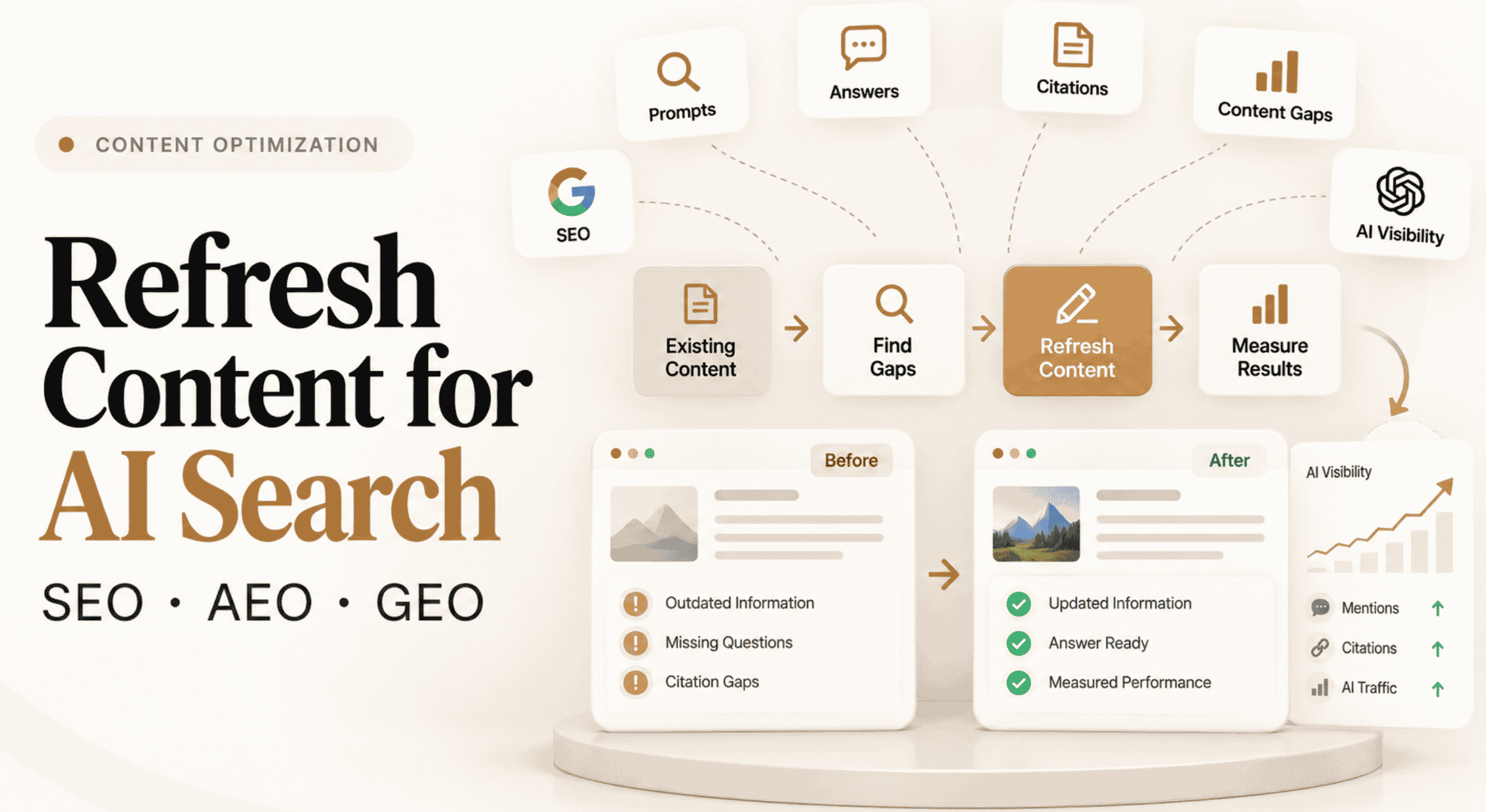
Content refreshes have traditionally focused on improving organic search performance: updating outdated information, expanding topic coverage, strengthening internal links, improving search intent alignment, and protecting or recovering rankings.
AI Search adds another discovery layer. Content can now influence how brands, products, concepts, and sources are represented across AI-generated answers—not only how individual webpages appear in traditional search results.
That does not mean rewriting every page for AI or abandoning SEO. A stronger approach is to refresh useful content so it works across both traditional search and AI-powered discovery, while improving clarity, evidence, structure, authority, and answer readiness.
To refresh content for AI Search, AEO, and GEO, start with pages that already have authority, rankings, traffic, citations, or strong topical relevance. Identify what has become outdated or incomplete, compare the page with current customer questions and competitor coverage, strengthen direct answers and supporting evidence, improve structure and entity clarity, add useful first-party information where possible, and update internal links. Then measure both traditional SEO performance and AI Search signals such as prompts, mentions, citations, competitors, and AI-referred traffic. No individual optimization guarantees inclusion or citation in an AI-generated answer.
An AI Search content refresh is the process of improving an existing page so it remains accurate, useful, competitive, and understandable across modern discovery experiences, including traditional search engines and AI-generated answers.
The objective is not to manipulate an AI system into citing a page. It is to improve the information available on the page and make its most valuable ideas easier to understand, verify, contextualize, and use.
A content refresh for AI Search updates an existing page's accuracy, usefulness, structure, topical coverage, evidence, and answer readiness while preserving valuable SEO signals and creating stronger information for both traditional search and AI-powered discovery.
SEO, Answer Engine Optimization (AEO), and Generative Engine Optimization (GEO) overlap significantly. They should not be treated as three completely separate content strategies.
SEO provides the broader search foundation. AEO places additional emphasis on making information useful in answer-driven experiences, while GEO emphasizes visibility and representation within generative AI responses.
For content teams, the practical result is usually one stronger page rather than three different versions of the same page.
Refresh content to improve or protect its usefulness and discoverability across traditional search.
Strengthen how clearly the page explains entities, questions, facts, relationships, comparisons, and supporting information.
The goal is not SEO content plus a separate AI version. The goal is better content that can perform across multiple discovery environments.
Not every old page needs to be refreshed. Age alone is not a sufficient reason to rewrite content.
Prioritize pages where there is evidence of an opportunity, decline, information gap, or meaningful change in the market.
A content refresh should begin with diagnosis rather than rewriting. Before changing the page, understand what is already working, what is missing, and which outcomes you want to improve.
Before editing a page, record its current performance. Without a baseline, teams can publish major changes and later struggle to determine whether the refresh actually helped.
Traditional SEO metrics can include rankings, impressions, clicks, CTR, organic traffic, backlinks, conversions, and the queries already generating visibility.
AI Search adds another set of observable signals. Depending on the topic and measurement setup, these can include prompt visibility, brand mentions, citations, cited URLs, competitors, Share of Voice, platform coverage, and identifiable AI referral traffic.
Ansvisor's Answer Engine Insights can help teams analyze AI Search visibility, mentions, citations, and competitive performance alongside the prompts being monitored.
The simplest content refresh opportunity is often factual maintenance. A page that was useful when published can become weaker as products, markets, terminology, interfaces, prices, examples, and customer expectations change.
Review the page section by section and identify anything that could make a reader question whether the content is still current.
A refresh should not make an old article merely longer. Remove information that is no longer useful, update what has changed, and add material only when it improves the page's ability to answer the underlying customer need.
Search intent can evolve. A page that matched the market two years ago may no longer match what users expect today.
AI Search makes this especially visible because users can express detailed needs through conversational prompts rather than compressing every question into a short keyword.
A traditional keyword such as “AI visibility tools” represents a broad category.
Related AI Search prompts might reveal more specific needs:
These questions reveal dimensions that a broad keyword alone may not expose.
Ansvisor's Prompt Monitoring & Volumes can help teams organize and monitor the questions relevant to their market rather than evaluating content only through traditional keyword lists.
Once you understand the questions customers are asking, compare them with what the existing page actually answers.
A prompt gap does not automatically mean every question deserves its own heading or paragraph. Some questions may be irrelevant to the page, better answered elsewhere, or too similar to information already covered.
The objective is to find meaningful gaps where the page fails to address an important part of the topic.
Pages often bury their most useful answer beneath long introductions, vague language, or unnecessary context.
When a question has a clear answer, provide that answer clearly. Then explain the nuance, evidence, examples, limitations, and next steps the reader needs.
Weak: “There are many factors to consider when thinking about whether content should be refreshed for modern search experiences.”
Stronger: “Refresh content when important information is outdated, customer intent has changed, competitors provide better coverage, or search and AI visibility signals reveal a meaningful gap.”
Direct writing benefits human readers first. It also creates clearer passages for systems that need to interpret what a page says about a topic.
Content should make it easy to understand who or what is being discussed and how the important concepts relate to each other.
Avoid relying on vague references when a specific entity, product, feature, organization, methodology, or concept can be named clearly.
Definitions can be particularly useful for complex or emerging topics. For example, AEO and GEO are related optimization concepts with significant overlap, but readers may still need clear definitions to understand how each term is being used.
A content refresh should create a better information resource, not simply reorganize what every competing page already says.
Look for opportunities to add information your organization can genuinely contribute: original examples, product data, expert explanations, screenshots, methodologies, customer observations, experiments, benchmarks, workflows, or first-party research where available.
Do not add unsupported statistics or invented authority signals. If you cannot verify a claim, remove it, qualify it, or replace it with information you can support.
AI Search visibility is not only about whether your brand is mentioned. The sources used around commercially important questions can reveal another layer of opportunity.
Review which domains and exact URLs are repeatedly cited for prompts related to the page. Then compare those sources with your own content.
Ansvisor's Citations Monitoring can help teams inspect cited sources and URLs across monitored AI Search prompts.
A citation gap is a signal for investigation, not proof that a specific page change will cause an AI system to cite your website. Source selection depends on the system, query, available information, and other factors outside a publisher's direct control.
Good information can still be difficult to use when it is buried inside long paragraphs, vague headings, repetitive sections, or an unclear page structure.
A content refresh is an opportunity to make the page easier to scan and understand without turning it into a collection of disconnected snippets.
Organize the page around the natural questions and decisions a reader has about the topic. Use descriptive headings, concise explanations, lists where they genuinely improve clarity, and deeper supporting sections where nuance is necessary.
Answer readiness does not mean reducing every topic to a one-sentence answer. Start clearly, then provide the depth, evidence, examples, limitations, and context required to make the answer genuinely useful.
Existing content often accumulates internal-link gaps as a website grows. New product pages, research, guides, glossary definitions, and related resources may have been published after the original article.
Review both links pointing from the page and relevant pages that could link back to it. Internal links should help readers move naturally between related concepts rather than functioning as a collection of keyword-rich anchors.
Content quality matters only if the page can be accessed and understood correctly. A refresh should therefore include a basic technical review rather than focusing exclusively on the visible copy.
Check whether the page is indexable, whether important content is available in the rendered page, whether canonical signals are correct, whether structured data is appropriate and accurate, and whether accidental crawler restrictions create accessibility problems.
Ansvisor's AI Visibility Site Audit evaluates public URLs across technical and content-related signals that can affect AI Search readiness.
Technical readiness is an eligibility layer, not a visibility guarantee. Passing a technical or AI Search audit does not guarantee that a page will be mentioned, recommended, or cited by an AI system.
One of the biggest content-refresh mistakes is treating every existing element as something that needs to change.
If a page already ranks for valuable queries, earns backlinks, receives traffic, attracts conversions, or has established topical relevance, understand which parts are working before making major changes.
A refresh should improve weak areas without unnecessarily destroying strong ones.
In many cases, improving an established URL is more appropriate than creating a new page that targets substantially the same intent and competes with the existing resource.
Not every gap discovered during a refresh belongs on the page being updated.
Some questions may deserve a dedicated article. A comparison may belong on a separate commercial page. A recurring definition may fit better in a glossary. A product-specific question may belong in documentation or a feature page.
This is where content refreshing becomes part of a broader content intelligence workflow.
Ansvisor's Content Intelligence & Optimization is designed to help teams identify and prioritize content opportunities connected with AI Search visibility.
AI Search creates new optimization opportunities, but it also creates incentives for low-quality shortcuts. Many of these approaches can make content worse for the people the page is supposed to help.
A common content strategy problem is deciding whether an opportunity belongs inside an existing page or deserves a new URL.
The decision should be based primarily on intent and information architecture rather than keyword variation alone.
If an existing guide about AI citation tracking is missing an explanation of cited URLs, adding that section may strengthen the original guide.
But if research reveals substantial demand around AI citation gap analysis, including competitor source analysis, prioritization, workflows, and measurement, that may justify a dedicated resource rather than turning the original guide into an unfocused catch-all page.
Publishing the refreshed page is not the end of the workflow. The next step is validation.
Compare post-refresh performance with the baseline captured before editing. Allow enough time to distinguish meaningful trends from short-term volatility.
Where identifiable referral data is available, AI Traffic Analytics can help connect AI-referred visits with the wider visibility picture.
A successful refresh should be evaluated against its objective. A page refreshed to recover organic traffic should not be judged only by AI citations, and a page refreshed to address an AI visibility gap should not be judged only by one keyword position.
The strongest content-refresh workflow is continuous rather than calendar-driven.
Instead of updating every article once a year because it is old, teams can use performance changes to determine which pages actually require attention.
Ansvisor's Action Center extends this workflow by connecting AI Search and performance signals with prioritized Actions and Tasks.
This turns content optimization into a broader Analytics → Opportunities → Actions workflow instead of relying only on periodic manual audits.
An AI Search content refresh is the process of updating an existing page to improve its accuracy, usefulness, structure, topical coverage, evidence, and answer readiness across both traditional search and AI-powered discovery. It should preserve valuable SEO signals while improving the quality of the information available on the page.
Start by measuring current performance, updating outdated information, reviewing current customer questions and prompts, filling meaningful topic gaps, improving direct answers, strengthening entity clarity and evidence, analyzing citation gaps, refreshing internal links, checking technical accessibility, and measuring what changes after publication.
The areas overlap. SEO focuses broadly on search visibility and organic performance. AEO places additional emphasis on making information useful in answer-driven experiences, while GEO emphasizes visibility and representation in generative AI responses. In practice, teams can often address all three by creating one accurate, well-structured, authoritative, and useful resource rather than separate versions of the same page.
No. Prioritize pages where there is evidence of an opportunity or problem, such as outdated information, ranking decline, new customer questions, weak AI visibility, citation gaps, or stronger competitor coverage. Preserve sections and signals that already perform well.
FAQs can improve a page when they answer genuine questions that are useful to the audience. Adding generic or repetitive questions solely for AI optimization does not guarantee greater visibility or citations.
Not automatically. Content should be as detailed as necessary to satisfy the topic and user need. Adding words without adding useful information can make a page less clear rather than more authoritative.
Not mechanically. Prompts are valuable research signals because they reveal customer questions, comparisons, and decision criteria. Use them to identify meaningful content gaps, then answer those needs naturally within the page's structure and intent.
No. Improving accuracy, structure, evidence, authority, accessibility, and relevance can make a page a stronger information resource, but publishers cannot guarantee that a specific AI system will mention or cite it.
Refresh the existing page when the new information serves substantially the same intent. Create a separate resource when the opportunity represents a distinct customer need, requires substantial independent depth, or belongs to a different stage of the customer journey.
Compare performance with the baseline captured before the refresh. Depending on the objective, measure SEO signals such as rankings, impressions, clicks, traffic, and conversions alongside AI Search signals such as prompt visibility, mentions, citations, cited URLs, competitor visibility, Share of Voice, and identifiable AI-referred traffic.
The strongest content-refresh strategy is not about rewriting pages to sound as though they were created for an AI system.
It is about maintaining information that is accurate, current, clear, useful, well-supported, accessible, and aligned with the questions customers actually ask.
Traditional SEO remains part of that process. Rankings, search demand, internal links, crawlability, backlinks, clicks, and organic traffic continue to matter. AI Search adds another set of signals: prompts, mentions, citations, competitors, sources, Share of Voice, and AI-referred traffic.
The opportunity is to measure both discovery layers, identify where existing content is falling behind, prioritize the pages with the greatest potential, make meaningful improvements, and validate what happens next.
Measure → Diagnose → Refresh → Publish → Validate.
Ansvisor connects AI Search analytics, content opportunities, and execution through an AI Search Intelligence Platform built around Analytics → Opportunities → Actions.


Co-founder at Ansvisor
Cihan Geyik is the co-founder of Ansvisor, an open-source, cloud-ready AI Visibility platform for AI Search. With more than 15 years of experience in digital marketing and growth, he writes about AI visibility, AI search, AEO, GEO, citations, and answer engines. He focuses on helping brands understand and improve their presence across ChatGPT, Gemini, Perplexity, Google AI Overviews, and other AI-powered discovery platforms.



© 2026 Ansvisor. All rights reserved. Ansvisor is an open-source AI Search Intelligence Platform for AI Visibility.


.svg)