
Rank tracking has been a core part of SEO for years. Marketers define important keywords, monitor where pages appear in search results, compare positions with competitors, and measure how rankings translate into impressions, clicks, traffic, and conversions.
AI-powered discovery introduces a different measurement problem. When someone asks ChatGPT, Gemini, Claude, Perplexity, Google AI Overviews, Google AI Mode, or Microsoft Copilot a question, the result may be a generated answer containing multiple brands, recommendations, sources, citations, and comparisons rather than a conventional list of ranked URLs.
That is why AI Rank Tracking requires a broader set of signals than traditional SEO position tracking.
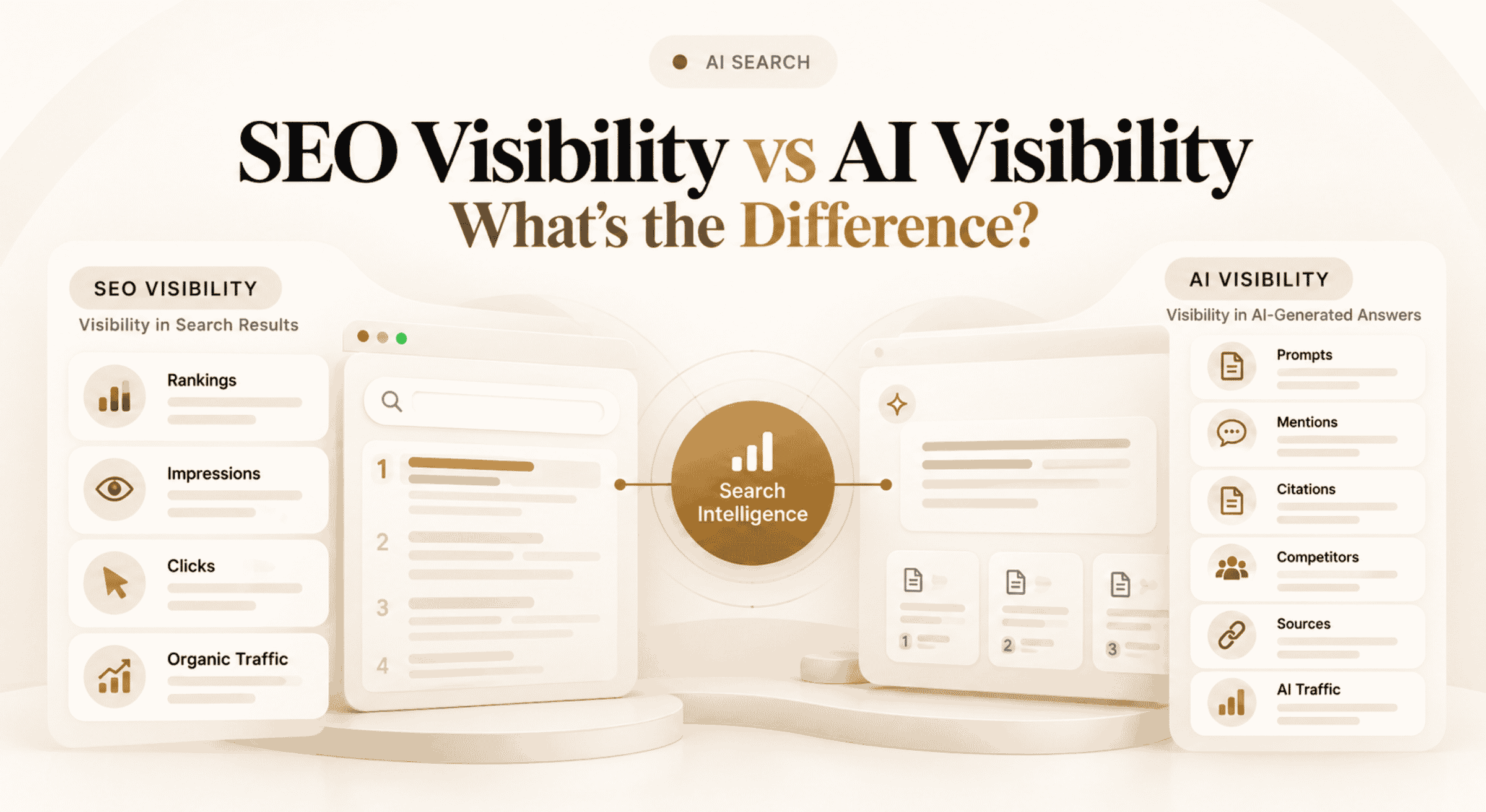
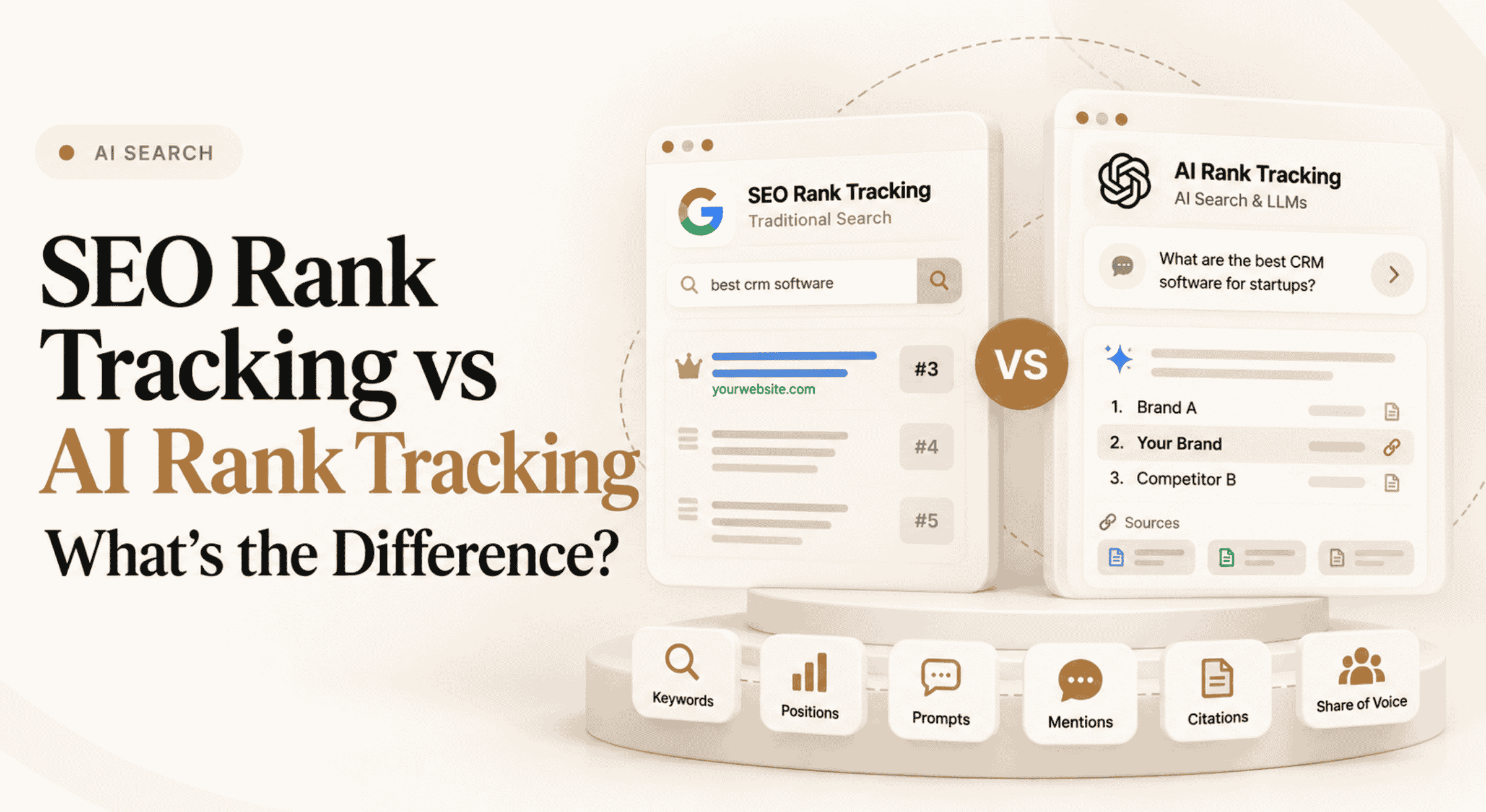
SEO rank tracking measures where webpages rank for keywords in traditional search results. AI rank tracking measures how brands, products, websites, and competitors appear across AI-generated answers for a repeatable set of prompts. Instead of relying on one fixed position, AI rank tracking can measure prompt visibility, mentions, citations, cited URLs, competitors, answer placement, Share of Voice, and historical changes. The two approaches are complementary: AI rank tracking adds a new measurement layer rather than replacing traditional SEO rank tracking.
SEO rank tracking is the ongoing process of monitoring where webpages appear in organic search results for a defined set of keywords.
A traditional rank tracker typically connects a keyword with a search engine, location, device, ranking position, and URL. Teams then monitor those positions over time to identify gains, losses, competitor movements, and opportunities.
SEO rank tracking answers a relatively structured question: “Where does my webpage rank for this keyword in a search engine?”
This model remains valuable because conventional search results continue to create discovery, website traffic, and business outcomes. AI Search does not make these metrics obsolete.
AI rank tracking is the ongoing process of measuring how a brand, product, website, or competitor appears across AI-generated search and answer experiences for a consistent set of prompts.
The key difference is that an AI-generated answer may not contain a stable numbered ranking. It can mention several brands in prose, recommend one product before another, cite multiple sources, use third-party information, or answer the question without linking to a brand's website at all.
An AI Rank Tracker is therefore the software used to repeatedly monitor these answers and measure the signals that describe a brand's presence within them.
AI rank tracking asks a broader question: “When people ask AI systems questions relevant to our market, where and how does our brand appear in the generated answer?”
The simplest distinction is the unit being measured.
Primarily connects a keyword → search result → webpage → position.
Primarily connects a prompt → generated answer → brand/source → visibility.
SEO rank tracking is primarily position-centric. AI rank tracking is broader because generated answers can contain brands, entities, recommendations, comparisons, and sources without creating a simple list of ten ranked links.
The word rank can make AI Search sound more deterministic than it actually is. Traditional search results often provide an observable ordered set of listings. A webpage might rank #3, move to #5, and later return to #2.
AI-generated answers can behave differently.
A brand might appear first in a recommendation list, be mentioned later in a paragraph, appear only as a citation, or be absent from one response while appearing in another related answer. The same prompt can also produce different wording or source combinations over time.
In traditional search, rank tracking might show that your comparison page ranks #4 for the keyword.
In an AI-generated answer, the same customer need might produce five recommended brands. Your company could be mentioned second, a competitor could receive the strongest recommendation, and a third-party publisher could be cited as the supporting source.
A single position number would not capture the full competitive picture.
This is why AI rank tracking is most useful when position is analyzed alongside visibility, mentions, citations, competitors, sources, and historical changes rather than being treated as one universal ranking metric.
Keywords remain central to traditional search measurement. AI Search introduces prompts as another important unit of analysis.
A keyword may be short and compressed, such as “best CRM software”. A prompt can express much more context:
These prompts can belong to the same topic while producing different brands, citations, sources, and recommendations. That makes prompt selection and organization an important part of AI rank tracking.
AI rank tracking becomes more useful when teams move beyond asking only whether the brand appeared.
Ansvisor's Answer Engine Insights brings together signals such as AI visibility, mentions, citations, sentiment, and competitive performance so teams can understand the broader answer environment rather than relying on a single rank.
A useful AI rank tracker should provide enough context to explain the visibility pattern, not merely produce a score.
Teams need a repeatable prompt set so changes can be evaluated over time. Without a stable measurement framework, it becomes difficult to distinguish meaningful movement from random variation.
Measure whether the brand appears across strategically important prompts and how much of the monitored prompt set produces brand visibility.
A mention and a citation are not the same signal. Track whether your website is cited, which exact URLs appear, and which third-party domains repeatedly support relevant answers.
AI Search is competitive. Knowing that your brand appears is much more useful when you also know which competitors appear for the same prompts and how their visibility changes.
Teams should be able to inspect the generated answer behind aggregate metrics. This provides context around how the brand was presented, which competitors appeared nearby, and which sources shaped the response.
One answer is a snapshot. Repeated measurement helps identify whether a visibility change persists, whether a competitor is gaining ground, or whether citations are being gained and lost over time.
Yes. Strong organic rankings and strong AI visibility can overlap, but one does not automatically guarantee the other.
A webpage can rank highly in traditional search while the associated brand receives limited visibility across important AI prompts. Conversely, a brand can appear prominently in AI-generated answers because authoritative third-party sources, reviews, publishers, communities, documentation, or other web content discuss it.
Your pages rank for important keywords, but competitors are mentioned or cited more frequently across related AI prompts.
Your brand appears in generated answers because the wider information ecosystem contains strong references to your company, even when your own pages do not hold the top organic positions.
This divergence is one reason organizations should avoid using traditional keyword rankings as a proxy for AI Search visibility.
No. AI rank tracking adds another measurement layer.
Traditional search still drives discovery and website traffic. Keyword positions, ranking pages, impressions, clicks, technical SEO, and organic performance remain important.
AI Search adds questions traditional rank tracking cannot fully answer:
SEO rank tracking measures how webpages compete across traditional search results. AI rank tracking measures how brands and sources compete for visibility inside generated answers. Organizations increasingly need both views to understand digital discovery.
Tracking becomes valuable when a change leads to investigation and a useful next step.
A visibility decline might be associated with lost citations, stronger competitor coverage, weak prompt coverage, a platform-specific change, or a shift in the sources appearing across important answers.
Instead of treating every movement as an automatic explanation, the change should be treated as a signal that can be investigated and prioritized.
Ansvisor's AI Search Action Center extends AI Search measurement into this operating workflow by connecting KPIs, Signals, Actions, Tasks, and History.
The objective is to move beyond passive rank monitoring and connect important AI Search changes with measurable work: Signals → Priorities → Actions → Results.
Rank tracking tells you something changed. Search intelligence should help you understand what changed, determine whether it matters, identify the opportunity, and decide what should happen next.
SEO rank tracking and AI rank tracking should not be forced into one universal ranking metric. They measure different discovery environments and should retain the signals that make each useful.
The stronger approach is to organize both around the same topics, products, customer problems, competitors, and buying journeys. This makes it possible to see where traditional search performance and AI Search visibility reinforce each other—and where they diverge.
Define the topics that matter commercially before building keyword or prompt lists. These might include product categories, use cases, customer problems, alternatives, comparisons, integrations, purchase criteria, or other areas connected with customer decisions.
A topic can then become the shared measurement layer connecting traditional keywords with AI Search prompts.
A traditional SEO keyword set might contain “project management software,” “best project management tools,” and “project management software for startups.”
The corresponding AI Search prompt set could include “What are the best project management tools for a startup?”, “Compare project management platforms for remote teams”, and “Which project management software is best for a 20-person SaaS company?”
The language differs, but both sets belong to the same underlying customer journey.
Track the keywords, ranking URLs, positions, search impressions, clicks, and organic traffic associated with each important topic.
This establishes where the website already has traditional search visibility and identifies topics where organic rankings are weak or improving.
Build a repeatable set of prompts around the same topics and monitor how your brand and competitors appear across relevant AI platforms.
Instead of recording only an AI position, capture the broader answer context: whether the brand appeared, which competitors appeared, whether the website was cited, which URLs were referenced, and how visibility changes over time.
Once both datasets exist, compare them at the topic level.
Some of the most valuable insights appear when traditional rankings and AI Search visibility tell different stories.
Traditional rank tracking is usually centered on your own ranking URLs. AI Search introduces a broader source layer.
An AI answer might mention your company but cite a publisher. It might recommend a competitor and cite that competitor's documentation. Or it might build a comparison using several third-party sources without citing your website at all.
This means teams should distinguish at least three different events:
Tracking these separately helps reveal whether the opportunity is primarily about brand recognition, owned content, third-party authority, competitor coverage, or another part of the information ecosystem.
Traditional competitor rank tracking commonly compares which domains occupy the highest positions for a keyword.
AI Search creates additional competitive questions. A competitor can be recommended even when its own website is not the primary cited source. Several competitors can appear within one answer. Different competitors can also dominate different prompt types within the same topic.
Your brand might perform strongly for general discovery prompts but disappear when users ask for alternatives, comparisons, or “best for” recommendations.
A competitor may therefore have weaker overall prompt coverage but stronger visibility during the customer journeys closest to a purchase decision.
This makes prompt-level competitor analysis more useful than relying only on one aggregate visibility score.
AI Share of Voice provides a relative view of brand visibility across a defined prompt set. Instead of asking only whether your brand appeared, it compares that presence with competing brands monitored across the same measurement framework.
This can be useful because an increase in your own mentions does not necessarily mean your competitive position improved. If competitors grew faster across the same prompts, your relative visibility may still have weakened.
Absolute visibility answers “Are we appearing?” Relative visibility helps answer “How are we performing against the competitors appearing for the same customer questions?”
Yes. A single combined AI visibility score can be useful for a high-level view, but teams should also retain platform-level data.
ChatGPT, Gemini, Claude, Perplexity, Google AI Overviews, Google AI Mode, and Microsoft Copilot should not be assumed to produce identical brand, competitor, or citation patterns.
A brand can have strong visibility in one environment and weaker coverage in another. Platform-level measurement helps identify these gaps instead of hiding them inside one aggregate score.
AI rank tracking should be repeated consistently enough to reveal trends without treating every individual answer variation as a strategic event.
The appropriate frequency depends on the size of the prompt set, market volatility, campaign activity, platform coverage, and how quickly the organization can act on new information.
More important than maximizing collection frequency is keeping the methodology sufficiently consistent. Teams should know which prompts, brands, competitors, platforms, countries, and other dimensions are included when comparing one period with another.
Individual AI responses can vary. Repeated measurement across a consistent framework makes it easier to identify persistent visibility gains, citation losses, competitor movements, and meaningful changes in prompt coverage.
AI rank tracking can be useful for organizations whose customers use AI-powered systems during research, comparison, evaluation, or purchase decisions.
Avoid choosing an AI rank tracker based only on the number of supported AI models or the number of prompts included in a plan.
The more important question is whether the platform provides enough context to understand visibility and turn the data into useful decisions.
Can you organize prompts around topics, customer journeys, products, markets, or other meaningful groups? Can the same prompt set be monitored consistently over time?
Can you inspect the underlying answer when a metric changes? Aggregate scores are easier to interpret when teams can review the responses behind them.
Can the platform distinguish your brand from competitors and compare their presence across the same prompts?
Can you inspect cited domains and exact URLs rather than only counting citations?
Can you compare visibility, mentions, citations, competitors, and other signals over time?
Can results be analyzed by the AI platforms and markets relevant to the business instead of being hidden entirely inside one aggregate metric?
What happens after the platform detects a visibility loss, competitor gain, citation gap, or emerging opportunity?
A useful AI rank tracker should answer more than “What is our score?” It should help teams understand which prompts changed, which competitors or sources are involved, why the change matters, and where deeper investigation is needed.
Rank tracking is a measurement function. Search intelligence goes further by connecting those measurements with competitive context, opportunities, and execution.
Consider a scenario where AI rank tracking detects declining visibility for a commercially important topic.
This is the difference between simply collecting AI rankings and building a broader AI Search operating workflow.
Ansvisor brings these signals together in an AI Search Intelligence Platform designed around Analytics → Opportunities → Actions.
SEO rank tracking measures where webpages appear for keywords in traditional search results. AI rank tracking measures how brands, products, websites, competitors, and sources appear across AI-generated answers for a repeatable set of prompts. AI measurement can include mentions, citations, cited URLs, answer placement, competitors, Share of Voice, and historical visibility.
AI rank tracking is the ongoing measurement of brand and source visibility across AI-generated search and answer experiences. It uses a consistent set of prompts to monitor signals such as brand mentions, citations, competitors, sources, answer placement, Share of Voice, and changes over time.
An AI rank tracker is software that repeatedly monitors prompts across AI-powered discovery experiences and measures how brands, products, competitors, websites, and cited sources appear within the generated answers.
No. SEO rank tracking is primarily focused on keyword positions and ranking webpages in traditional search results. AI rank tracking focuses on prompts and generated answers, where visibility can involve mentions, recommendations, citations, competitors, and sources rather than one fixed webpage position.
No. Traditional search continues to generate discovery, clicks, and website traffic. AI rank tracking adds another measurement layer for AI-powered discovery. Organizations can use both to understand how customers encounter their brand across different search experiences.
Yes. Organic rankings and AI visibility can overlap, but a high traditional search position does not guarantee that a brand will be mentioned or cited for related AI prompts. AI systems can use multiple owned and third-party sources when generating answers.
Yes. A brand may appear in AI-generated answers because of information available across its own website and the wider web, including publishers, reviews, communities, documentation, directories, research, and other third-party sources.
Useful metrics can include prompt visibility, brand mentions, citations, cited URLs, competitor visibility, Share of Voice, answer placement, platform coverage, source patterns, and historical changes. The most useful set depends on the organization's goals and measurement methodology.
AI rankings should be measured consistently enough to identify meaningful trends. The ideal frequency depends on the prompt set, market, platforms, campaign activity, and business needs. Consistency in prompts, competitors, platforms, and other measurement dimensions is more important than reacting to every individual answer variation.
AI-generated answers can vary in wording, brand inclusion, citations, and source selection. That is why AI rank tracking should emphasize repeated measurement and trends rather than treating one generated answer as a permanent ranking.
SEO rank tracking remains essential for understanding how webpages compete across traditional search results. Keywords, positions, URLs, impressions, clicks, and organic traffic continue to provide important information about search performance.
AI-powered discovery adds a different layer. Customers can now ask detailed questions and receive generated answers containing recommendations, brands, competitors, citations, and sources without following the traditional search-result journey.
Measuring that environment requires more than translating a Google ranking into an “AI position.”
Teams need to understand prompts, mentions, citations, competitors, sources, Share of Voice, platform differences, and historical changes—and connect those signals with the opportunities that matter to the business.
Use SEO rank tracking to understand how your webpages perform across traditional search results. Add AI rank tracking to understand how your brand and sources appear across AI-generated answers.
Ansvisor connects these AI Search signals with opportunity discovery and Action Center workflows so teams can move from measurement toward prioritized execution.


Co-founder at Ansvisor
Cihan Geyik is the co-founder of Ansvisor, an open-source, cloud-ready AI Visibility platform for AI Search. With more than 15 years of experience in digital marketing and growth, he writes about AI visibility, AI search, AEO, GEO, citations, and answer engines. He focuses on helping brands understand and improve their presence across ChatGPT, Gemini, Perplexity, Google AI Overviews, and other AI-powered discovery platforms.



© 2026 Ansvisor. All rights reserved. Ansvisor is an open-source AI Search Intelligence Platform for AI Visibility.


.svg)