
White label SEO software has traditionally helped agencies deliver rank tracking, audits, reporting, and other search services under their own brand. But the questions clients ask agencies are expanding beyond traditional search results.
Clients increasingly want to understand whether their brands appear in AI-generated answers, which competitors are being recommended, what sources are being cited, and whether platforms such as ChatGPT are contributing to website traffic. That creates a new requirement for agency technology stacks: traditional SEO capabilities may still matter, but AI Search visibility increasingly needs its own measurement layer.
The best white label AI SEO software for an agency depends on what you want to deliver. Some platforms specialize in traditional SEO reporting and rank tracking, while newer platforms focus on AI Search visibility, prompts, citations, competitors, and AI traffic. Agencies should compare the depth of white-label branding, multi-client workflows, AI Search coverage, reporting, integrations, and the ability to turn data into useful client actions—not simply choose the tool with the longest feature list.
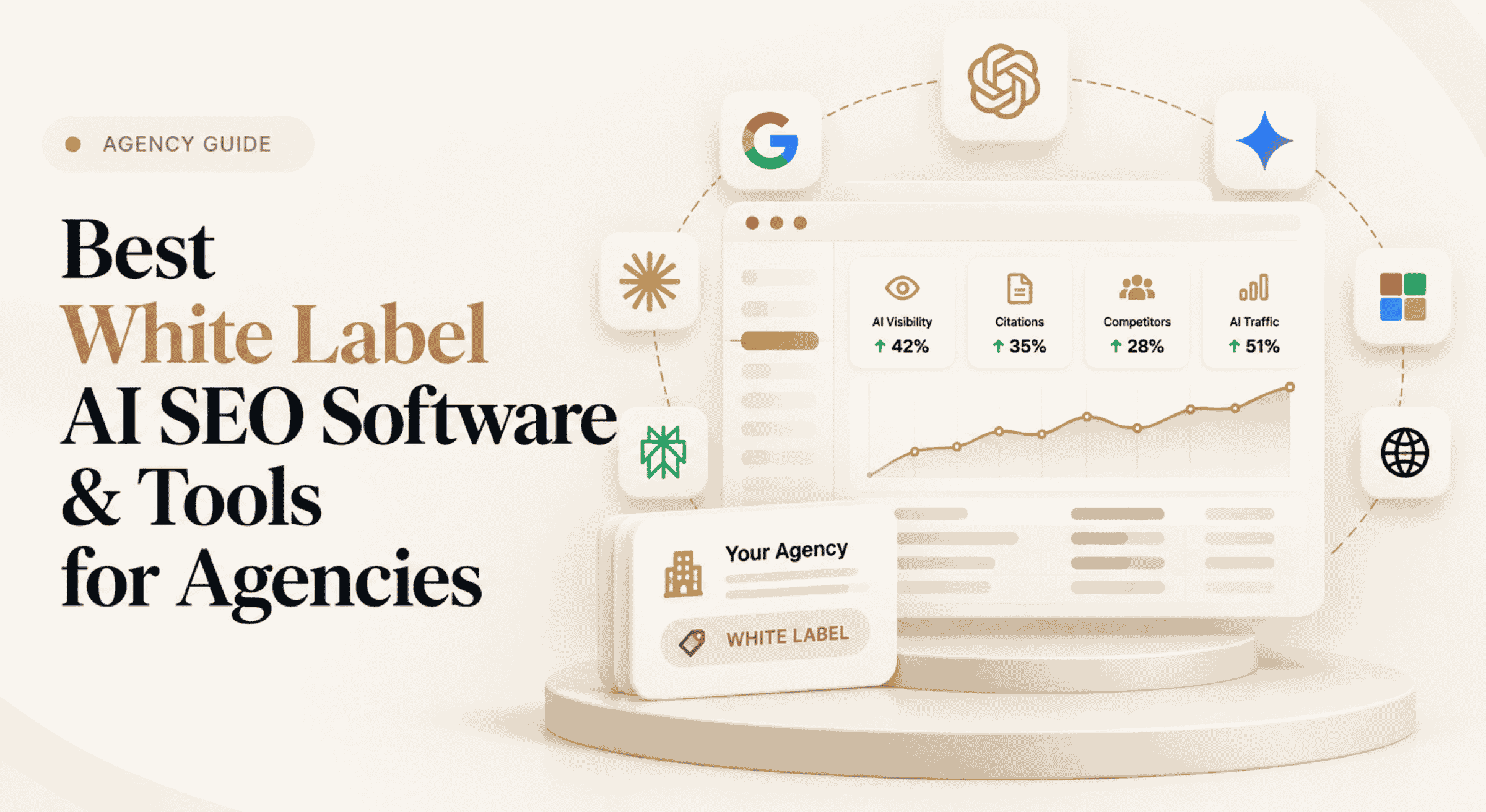
White label AI SEO software is software that agencies can use to deliver SEO and/or AI Search visibility services to clients while keeping the agency's own brand at the center of the client experience.
Depending on the platform, white-label functionality may range from adding an agency logo to exported reports to providing branded dashboards, custom domains, client portals, embedded analytics, or a largely rebranded software experience.
The distinction matters because a platform can be an excellent white label SEO tool without being a comprehensive AI Search intelligence platform—and the reverse can also be true. Agencies should first define the service they intend to sell and then choose the software architecture that supports it.
“White label” is often used broadly. Before comparing platforms, determine exactly what your clients will see.
Before buying, ask to see exactly what the client sees. A platform that supports a branded PDF is not necessarily equivalent to a platform offering a custom-domain client portal or a fully rebranded software experience.
Instead of ranking tools only by the number of features they advertise, agencies should evaluate whether each platform supports the actual service they want to deliver and whether that service can scale across multiple clients.
There is no single best platform for every agency. A traditional SEO agency, an AI Search consultancy, a local SEO agency, and an enterprise-focused agency can reasonably choose different tools because their client deliverables are different.
The following platforms represent several approaches to the category, from AI Search intelligence and white-label AI visibility to traditional SEO and client reporting.
Ansvisor is an AI Search Intelligence Platform designed to help teams understand and improve how brands appear across AI-powered discovery experiences. For agencies, the value is broader than showing a client a single visibility score: the platform connects AI Search monitoring with prompts, citations, competitors, traffic, content intelligence, site signals, and opportunities for improvement.
This makes Ansvisor particularly relevant for agencies building AI Search, AEO, GEO, or AI visibility services alongside their existing SEO offering.
The broader AI Search Intelligence Platform brings visibility, prompts, citations, competitors, AI traffic, content intelligence, and optimization workflows together so agencies can investigate not only what changed, but where the next opportunity may exist.
Agencies can also use AI prompt tracking to monitor client questions and demand patterns, while AI Citation Monitoring helps reveal the domains and exact URLs appearing in AI-generated answers.
LLM Pulse is focused specifically on AI Search visibility and offers a white-label experience aimed at agencies and SaaS companies. Its white-label offering includes branded client experiences and options for delivering AI visibility data under the agency's identity.
This makes it a relevant choice when the primary service being sold is AI visibility monitoring and the agency wants the underlying vendor to remain largely invisible to clients.
SE Ranking is an established SEO platform with agency-focused capabilities spanning rank tracking, website auditing, competitor research, reporting, and client management. Its agency offering includes white-label capabilities that can support branded client delivery.
It is particularly relevant for agencies whose core business still revolves around traditional SEO and that want to extend an existing SEO workflow rather than replace it with an AI-Search-specific platform.
AgencyAnalytics is built around agency reporting and client dashboards. It brings data from multiple marketing sources into customizable reports and dashboards and supports agency branding, making it useful when the main problem is consolidating performance data into a professional client-facing experience.
Its strength is reporting breadth rather than being a dedicated AI Search intelligence platform, so agencies may pair it with specialized SEO or AI visibility tools depending on the services they deliver.
Semrush is a broad digital marketing platform covering traditional SEO workflows such as keyword research, rank tracking, competitive research, backlink analysis, site auditing, content, and reporting.
For agencies, its main advantage is breadth. A team can manage many established SEO workflows from one ecosystem instead of assembling separate tools for keyword research, competitive intelligence, technical SEO, and reporting.
Semrush has also expanded into AI Search and brand visibility use cases. Agencies evaluating it should therefore look at the specific combination of traditional SEO, AI visibility, reporting, and client-facing capabilities included in the products and plans they are considering rather than assuming every capability is part of one package.
Ahrefs is widely used for SEO research, backlinks, keywords, competitive analysis, content discovery, and organic search performance. For agencies, these capabilities can support research-heavy workflows across multiple client strategies.
Ahrefs has also extended its product set into AI visibility through Brand Radar, creating a bridge between traditional search intelligence and the emerging need to understand brand presence across AI-generated experiences.
Agencies should distinguish these research and AI visibility capabilities from full white-label software delivery. If a deeply rebranded client portal, custom domain, or vendor-hidden experience is essential, verify the exact client-facing capabilities before choosing it as the primary white-label layer.
The best platform depends less on which tool has the longest feature list and more on what your agency actually sells. Start with the client deliverable, then work backward to the technology required to produce it.
You may not need to choose only one platform. Many agencies can benefit from a stack in which traditional SEO research, client reporting, and AI Search intelligence are handled by different specialized layers.
Traditional SEO and AI Search overlap, but they do not measure exactly the same thing. A client can perform well in conventional organic search while still having limited visibility for important questions asked through AI interfaces.
This is why agencies do not necessarily need to replace their traditional SEO software. AI Search can become an additional intelligence and execution layer alongside the existing SEO stack.
Adding AI Search to an agency offering should involve more than sending clients a monthly visibility score. A stronger service connects measurement with diagnosis, prioritization, execution, and validation.
Start by identifying the questions that matter to the client's market. These can include category discovery, product comparisons, competitor comparisons, use cases, problems, alternatives, buying questions, and other prompts that can influence consideration.
Monitor those prompts consistently so the agency has a baseline for understanding where the client appears, where competitors appear, and where visibility is missing.
A useful client report should explain more than whether the brand appeared. Agencies can investigate which prompts produce mentions, how frequently competitors appear, which brands are recommended together, and how those patterns change across monitored AI experiences.
Ansvisor's Competitor Tracking & Benchmarking can support this layer by helping teams compare brand and competitor performance across AI-generated answers.
Citations add another dimension. If a competitor is repeatedly supported by particular publications, domains, or pages, that can reveal a source gap even when the client's traditional keyword rankings look healthy.
Agencies can use Citation Monitoring to investigate which domains and URLs appear as sources and where citation opportunities may exist.
Visibility and traffic are different signals. A brand can appear in an AI-generated answer without generating an identifiable website visit, while some AI interactions can produce measurable referral traffic.
When referral information is available, AI Traffic Analytics can help agencies connect AI-originated website activity with landing pages and downstream performance.
Reporting becomes more valuable when the agency can explain what should happen next. A visibility gap may suggest a content opportunity. A citation gap may reveal sources worth investigating. A competitor gap may uncover an important prompt cluster. A technical issue may indicate that the website needs additional attention before content expansion.
This is where an AI Search service can move beyond another dashboard. The agency can turn intelligence into a repeatable operating model for each client.
The exact report should depend on the client's goals, but a useful AI Search reporting framework can combine several complementary signals.
Before committing to a platform, define the service model first. The following questions can prevent agencies from paying for capabilities they do not need—or discovering too late that an important client workflow is missing.
Decide whether branded reports are enough or whether clients need a branded dashboard, custom domain, embedded experience, or vendor-hidden portal. These are materially different requirements.
An agency focused on conventional SEO may prioritize keyword tracking, backlinks, technical audits, and reporting. An AI Search service needs additional data around prompts, generated answers, mentions, citations, sources, and competitors. A combined service may require both.
Evaluate how brands, projects, users, permissions, reporting, and integrations are organized. A workflow that feels simple with two clients can become difficult when the agency manages dozens of accounts.
More charts do not automatically create more client value. The platform should help the team identify meaningful changes, investigate why they happened, find opportunities, and determine what should be done next.
AI visibility is useful as an intelligence signal, but agencies should avoid treating a visibility score as the final business outcome. Where possible, connect the work with traffic, conversions, pipeline, revenue, or another client-specific KPI.
Ansvisor is not designed to replace every traditional SEO tool an agency already uses. Its role is to provide an intelligence layer for the emerging AI Search workflow.
Agencies can use Ansvisor to monitor how client brands appear across AI Search, investigate prompts and demand, analyze citations and sources, benchmark competitors, connect AI visibility with identifiable AI traffic, and surface opportunities that can become prioritized actions.
Because Ansvisor is also available as open-source software, agencies and technical teams have an additional path for inspecting, extending, and integrating AI Search intelligence into their own workflows.
There is no single best white label SEO platform for every agency. SE Ranking is relevant for traditional SEO and agency workflows, AgencyAnalytics focuses strongly on client reporting, while platforms such as Ansvisor and LLM Pulse address emerging AI Search visibility use cases. The best choice depends on the services the agency sells and the depth of white labeling it requires.
A white label SEO tool allows an agency to deliver SEO software, dashboards, reports, or data using some level of its own branding. The exact implementation varies by provider and can range from branded reports to custom-domain client portals or more deeply rebranded experiences.
White label AI SEO software combines agency-oriented delivery with capabilities related to AI Search, such as monitoring prompts, brand mentions, citations, competitors, sources, and AI visibility. Some platforms combine these capabilities with traditional SEO, while others specialize primarily in AI Search.
Yes. Agencies can build services around AI visibility measurement, prompt monitoring, citation analysis, competitor benchmarking, content opportunities, technical readiness, and AI referral traffic. The service is more useful when measurement is connected to prioritized actions and subsequent validation.
No. Traditional search and AI-generated discovery overlap, but they create different measurement requirements. Keyword rankings, organic traffic, backlinks, and technical SEO remain useful, while AI Search adds prompts, generated answers, mentions, citations, sources, and AI-specific competitor visibility.
Useful signals include relevant prompts, brand mentions, citations, cited domains and URLs, competitor appearances, answer context, visibility trends, and identifiable AI referral traffic. The right measurement set should ultimately reflect the client's business goals.
Not always, but using multiple specialized tools can be practical. An agency may keep its existing SEO research or reporting platform while adding a dedicated AI Search intelligence layer. The decision depends on workflow depth, integrations, client requirements, and cost.
Ask the vendor to demonstrate the exact client experience. Check whether white labeling applies to reports, dashboards, emails, domains, portals, exports, and embedded experiences, and whether the vendor's own branding remains visible. Do not assume that every product using the term “white label” provides the same level of customization.
White label SEO software is evolving as the discovery landscape expands. Agencies still need traditional capabilities such as rank tracking, technical analysis, competitive research, and reporting, but clients are increasingly asking a second set of questions: Are we visible in AI answers? Which competitors are appearing? What sources are being cited? Which prompts are we missing? Is AI Search contributing to traffic and growth?
That does not make traditional SEO obsolete. It creates an additional intelligence layer. The strongest agency stack is therefore not necessarily the platform with the most features. It is the combination that helps the agency measure what matters, identify opportunities, execute the right work, and demonstrate meaningful results to clients.
Ansvisor's AI Search Intelligence Platform is built around that workflow—bringing AI visibility, prompts, citations, competitors, traffic, content intelligence, and actions into a connected system.
Track how client brands appear across AI Search, uncover prompt and citation gaps, benchmark competitors, connect visibility with AI traffic, and move from analytics toward opportunities and actions.


Co-founder at Ansvisor
Cihan Geyik is the co-founder of Ansvisor, an open-source, cloud-ready AI Visibility platform for AI Search. With more than 15 years of experience in digital marketing and growth, he writes about AI visibility, AI search, AEO, GEO, citations, and answer engines. He focuses on helping brands understand and improve their presence across ChatGPT, Gemini, Perplexity, Google AI Overviews, and other AI-powered discovery platforms.



© 2026 Ansvisor. All rights reserved. Ansvisor is an open-source AI Search Intelligence Platform for AI Visibility.


.svg)