


AI search is changing how buyers discover brands.
When prospects ask ChatGPT, Claude, Gemini, or Perplexity for recommendations, many brands never appear in the answers. An AEO audit helps agencies identify these visibility gaps, benchmark competitors, uncover citation opportunities, and create a clear roadmap that turns AI visibility into measurable business outcomes.
The way people discover brands is changing.
For nearly two decades, agencies focused on helping clients rank higher in search results. Success was measured through rankings, clicks, traffic, and backlinks.
Today, buyers increasingly ask AI systems for recommendations instead.
Instead of searching for:
"best CRM software"
they ask:
"Which CRM is best for a growing SaaS company?"
Instead of reviewing ten websites, they receive a direct answer.
The brands included in that answer gain visibility, trust, and awareness.
The brands excluded from that answer often disappear from consideration entirely.
This shift is creating a new challenge for agencies.
Clients are beginning to ask questions such as:
Answer Engine Optimization (AEO) audits provide the answers.
A structured AEO audit helps agencies measure how visible a client is across AI platforms, identify competitive gaps, uncover citation opportunities, and create an actionable strategy for increasing AI visibility.
More importantly, AEO audits create a powerful sales conversation.
Instead of selling abstract AI services, agencies can present clear data showing where clients are losing visibility and how those gaps can be closed.
In this guide, you'll learn how agencies can use AEO audits to win clients, demonstrate ROI, and build recurring revenue around AI visibility services.
An AEO audit is a structured analysis of how a brand appears across AI-powered answer engines.
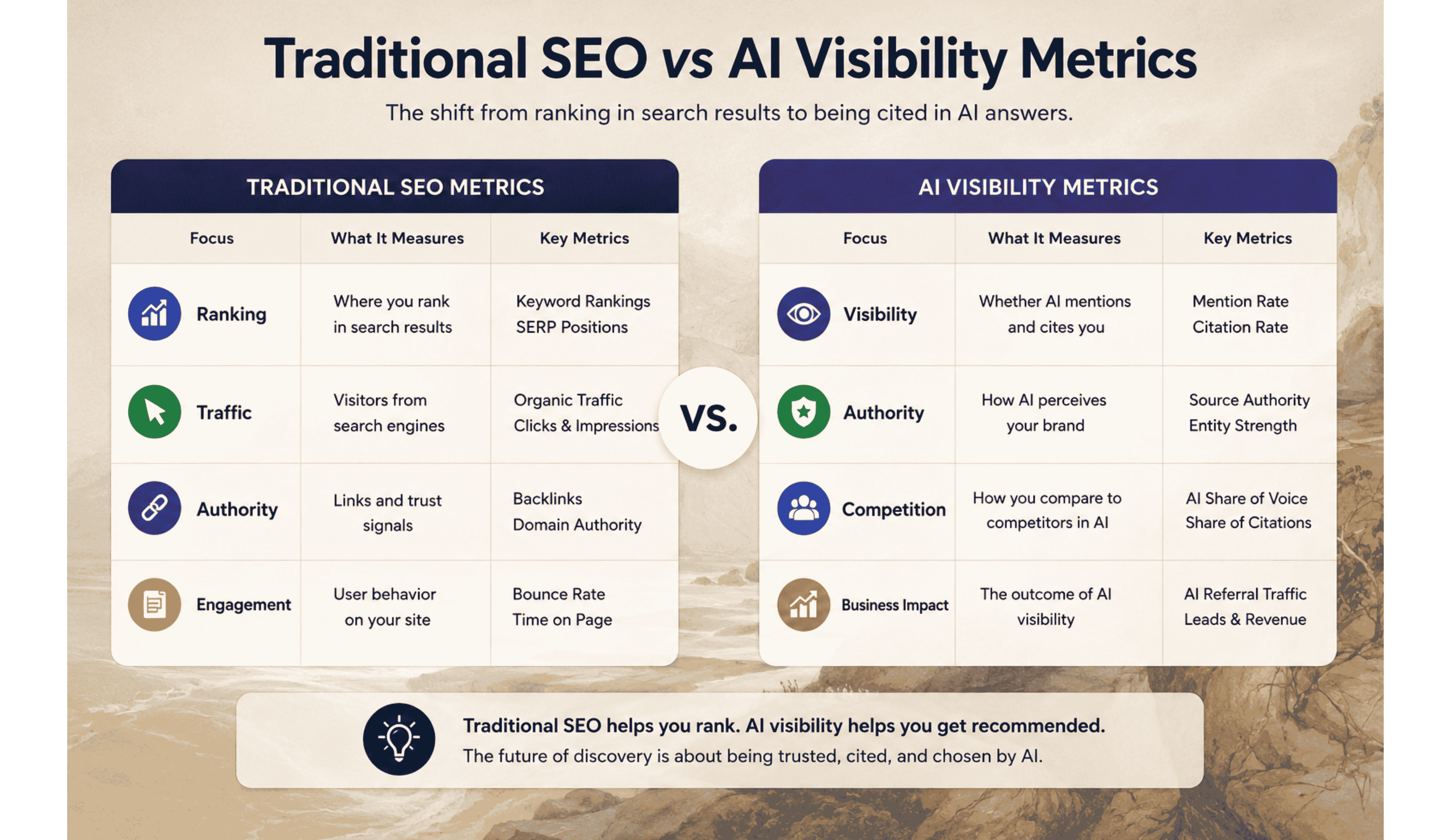
Unlike traditional SEO audits, which focus on rankings and website performance, AEO audits focus on how AI systems discover, understand, trust, cite, and recommend a brand.
The goal is simple:
Determine whether AI systems include your client in the answers buyers actually see.
A modern AEO audit evaluates visibility across platforms such as:
Rather than asking:
"Where do we rank?"
The audit asks:
This provides agencies with a completely new layer of visibility that traditional SEO tools cannot measure.
The answer is simple.
AI search is becoming a discovery channel.
When a prospect asks:
"Which AI visibility platform should I use?"
they may receive a complete answer before ever visiting a website.
If a competitor appears in that answer while your client does not, the decision-making process has already begun.
AI systems increasingly act as decision assistants.
Instead of providing ten links, they often provide:
This creates a new visibility layer between search engines and websites.
Brands that appear in AI-generated answers gain:
Brands that don't appear often lose opportunities before users even visit a website.
The impact is particularly noticeable in:
Any industry where buyers research solutions online is increasingly influenced by AI-generated recommendations.
One of the biggest mistakes agencies make is measuring only mentions.
A meaningful AEO audit requires multiple layers of analysis.
Citation Rate measures how often AI systems include links or source references to a brand.
A high citation rate often indicates stronger authority and higher potential referral traffic.
Agencies can combine citation tracking with AI Traffic Analytics to understand whether AI-generated visibility is translating into website visits and business outcomes.
Questions answered:
Mention Rate tracks how often a brand is referenced within AI-generated answers.
A brand can receive mentions even when no citation exists.
This metric helps measure awareness and recall.
Questions answered:
AI Share of Voice measures visibility relative to competitors.
Many agencies consider this the most important AEO metric because it mirrors how rankings worked in traditional SEO.
Questions answered:
Being mentioned is not enough.
The context matters.
Sentiment analysis measures whether AI describes a brand positively, negatively, or neutrally.
Questions answered:
AI systems rely on external sources to generate answers.
Understanding those sources is critical.
Questions answered:
Hallucinations occur when AI systems generate inaccurate information.
This is one of the most overlooked AEO metrics.
Questions answered:
For many clients, a hallucination audit creates immediate urgency because brand reputation can be affected without anyone noticing.

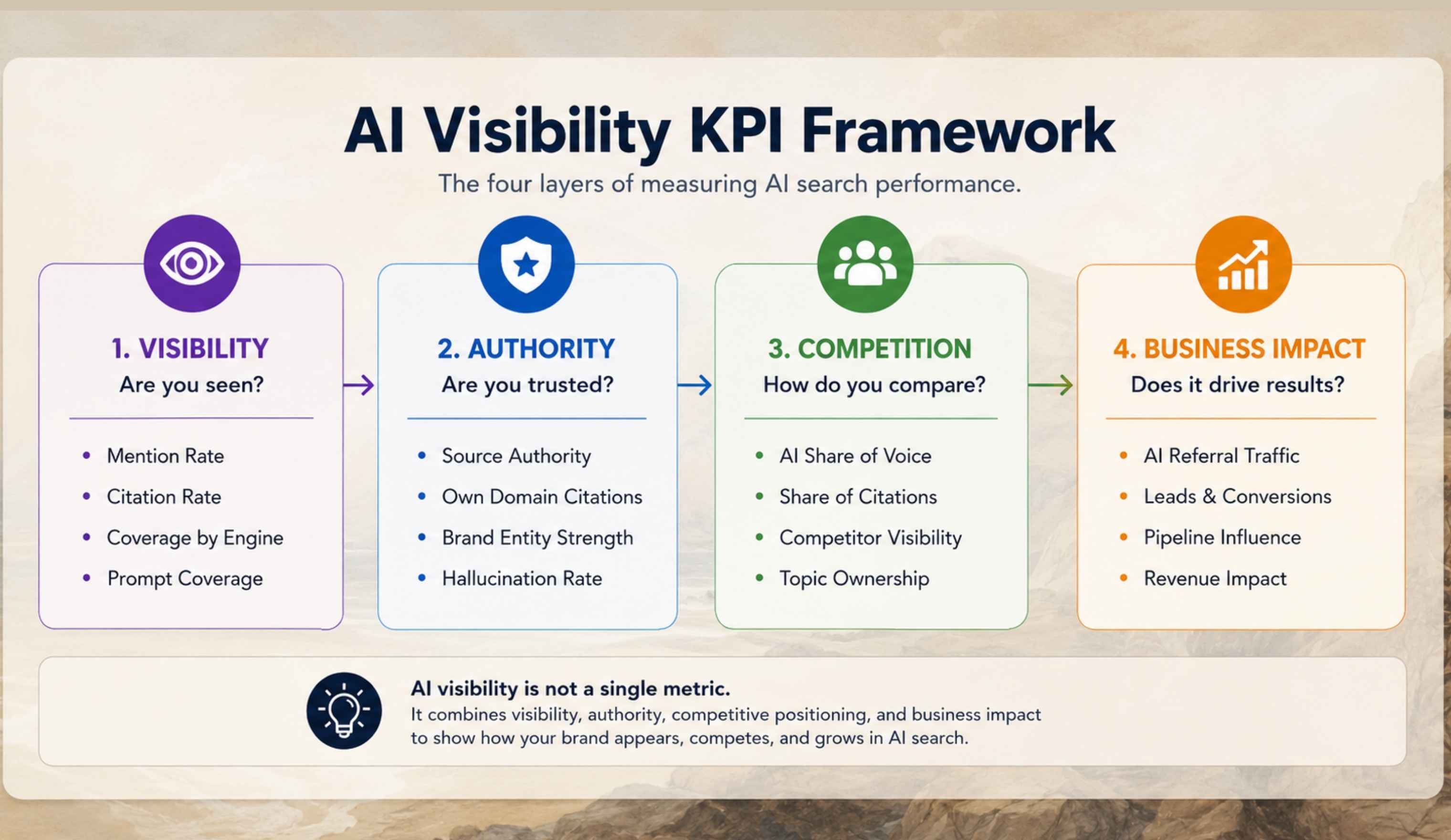
AI Visibility KPI Framework
This image helps readers understand that AI visibility is measured through four layers:
It also creates an excellent AI Overview extraction opportunity because the framework summarizes the entire methodology in a single visual.
Many agencies approach AI visibility incorrectly.
They try to sell optimization services before proving a problem exists.
An AEO audit reverses this process.
Instead of leading with a service, agencies lead with evidence.
The audit becomes a diagnostic tool that reveals:
Once clients see the data, the next steps become obvious.
Audits reduce perceived risk.
A client may hesitate to commit to a long-term AI visibility engagement.
However, they are often willing to invest in a diagnostic assessment that answers a simple question:
"How visible are we in AI search today?"
This makes the audit an ideal entry point for new relationships.
The most successful agencies treat audits as the first stage of a larger engagement.
The process often looks like:
This transforms a one-time project into a recurring service model.
AEO audits become significantly more valuable when they follow a repeatable methodology.
Many agencies make the mistake of manually testing a handful of prompts in ChatGPT and presenting screenshots as findings.
That approach rarely scales.
A professional AEO audit should generate measurable insights that can be repeated over time and compared against competitors.
The process should answer three questions:
The agencies that answer these questions consistently are the agencies most likely to win AI visibility retainers.
A high-quality audit typically includes:
Together, these elements provide a complete view of AI search performance.
The most effective agencies follow a structured framework.
This ensures audits remain consistent, scalable, and easy to communicate to clients.
Before tracking prompts, agencies should identify the topics that matter most.
This includes:
A strong topic strategy ensures the audit measures visibility where buying decisions actually happen.
Instead of tracking:
"What is AI?"
Track:
"What are the best AI visibility platforms?"
or
"Which AEO tools are best for agencies?"
The second group is much more likely to influence revenue.
Once topics are defined, create a structured prompt library.
The strongest prompt libraries contain a mix of:
This approach ensures visibility is measured across the entire buying journey.
One of the biggest mistakes agencies make is focusing exclusively on ChatGPT.
AI visibility is fragmented.
Different platforms produce different recommendations.
A complete audit should evaluate:
The visibility leader on one platform is often not the leader on another.
After collecting responses, agencies should evaluate:
This transforms hundreds of AI responses into measurable business insights.
Clients rarely care about visibility in isolation.
They care about winning.
This makes competitor benchmarking essential.
Questions agencies should answer:
Competitive benchmarking creates urgency because clients can immediately see what they are missing.
The final audit deliverable should never be a spreadsheet.
It should be a roadmap.
A strong roadmap typically includes:
The goal is to move from insight to execution.
Many agencies use AI Content Optimization workflows to prioritize content updates, create citation-focused briefs, and close visibility gaps discovered during the audit.
Most clients already know AI search matters.
What they often do not know is how far behind competitors they are.
Competitive benchmarking provides that answer.
A single chart can reveal:
That visual immediately creates urgency.
More importantly, it transforms AI visibility from an abstract concept into a measurable business challenge.
Dedicated AI Competitor Tracking helps agencies identify which competitors dominate citations, recommendations, and AI Share of Voice across major answer engines.
This is often the moment where audits convert into retainers.
The most useful benchmarking metrics include:
Measures overall visibility.
Measures authority.
Measures perception.
Measures preference.
Measures breadth of visibility.
Together, these metrics create a complete competitive picture.

Running AEO audits manually becomes difficult very quickly.
A single audit may require:
This is where dedicated AI visibility platforms become valuable.
Ansvisor helps agencies automate large parts of the audit process by providing:
Instead of collecting data manually, agencies can focus on strategy and client outcomes.
Teams can also use AI Agent Chat to explore visibility data, generate reports, discover content opportunities, and answer client questions using natural language.
One of the most effective approaches is running a preliminary audit before the sales call.
This allows agencies to show:
Rather than discussing possibilities, agencies can discuss evidence.
That shift dramatically improves credibility.
AEO audits are not only useful for SEO teams.
They also support:
As AI search adoption grows, visibility data becomes valuable across the organization.
An AEO audit evaluates how a brand appears across AI-powered answer engines such as ChatGPT, Claude, Gemini, Perplexity, and Google AI Overviews. It measures visibility, citations, sentiment, competitor presence, and recommendation frequency to identify opportunities for improving AI search performance. Many agencies use AI Visibility Monitoring to track how brands appear across ChatGPT, Gemini, Claude, Perplexity, and other answer engines over time.
Buyers increasingly rely on AI-generated answers instead of traditional search results. If a brand is not mentioned, cited, or recommended by AI systems, it may lose visibility before potential customers ever visit a website or compare vendors.
The most important metrics include Citation Rate, Mention Rate, AI Share of Voice, Sentiment, Source Authority, and Hallucination Rate. Together, these KPIs help agencies understand how AI systems perceive and recommend a brand.
SEO focuses on rankings, clicks, and organic traffic. AEO focuses on citations, mentions, recommendations, and AI-generated answers. While both disciplines share similar foundations, AEO introduces a new measurement layer designed for AI search environments.
Most agencies should perform comprehensive audits quarterly and monitor key AI visibility metrics continuously. AI platforms evolve quickly, and visibility can change as models, sources, and competitor content strategies evolve.
A complete audit should cover ChatGPT, Claude, Gemini, Perplexity, Google AI Overviews, and Microsoft Copilot. Different platforms often generate different recommendations, making cross-platform visibility analysis essential.
AI search is creating one of the biggest shifts in digital marketing since the rise of traditional search engines.
Clients no longer care only about rankings. They increasingly care about whether AI systems recommend, cite, and trust their brands.
AI Visibility Platform like Ansvisor help agencies measure, benchmark, and improve AI visibility across the rapidly growing AI search ecosystem.
This creates a significant opportunity for agencies.
By offering structured AEO audits, agencies can transform AI visibility from an abstract concern into a measurable business opportunity. Citation rates, AI Share of Voice, sentiment analysis, and competitor benchmarking provide the evidence needed to justify strategic investments and long-term engagements.
More importantly, AEO audits help agencies move beyond reporting and become trusted advisors.
The agencies that succeed in the next generation of search will not simply track rankings. They will help clients understand how AI systems perceive them, where competitors are gaining visibility, and what actions can improve their position across emerging answer engines.
As AI-generated discovery continues to expand, agencies that adopt AEO measurement early will be better positioned to demonstrate ROI, retain clients, and build scalable service offerings around AI visibility.