.svg)








Turn Prompt Discovery Into an Operating System
Finding a strong prompt is only the beginning. The next challenge is deciding who will work on it, which page should earn visibility, what evidence is missing, and whether the work improved mentions or citations after implementation.
Ansvisor brings discovery, prioritization, teamwork, performance tracking, citation analysis, and validation into the same AI Visibility workflow. Teams can move from a suggested topic to a tracked prompt, assign work, define a target URL, leave implementation notes, and monitor results without losing the context behind the opportunity.
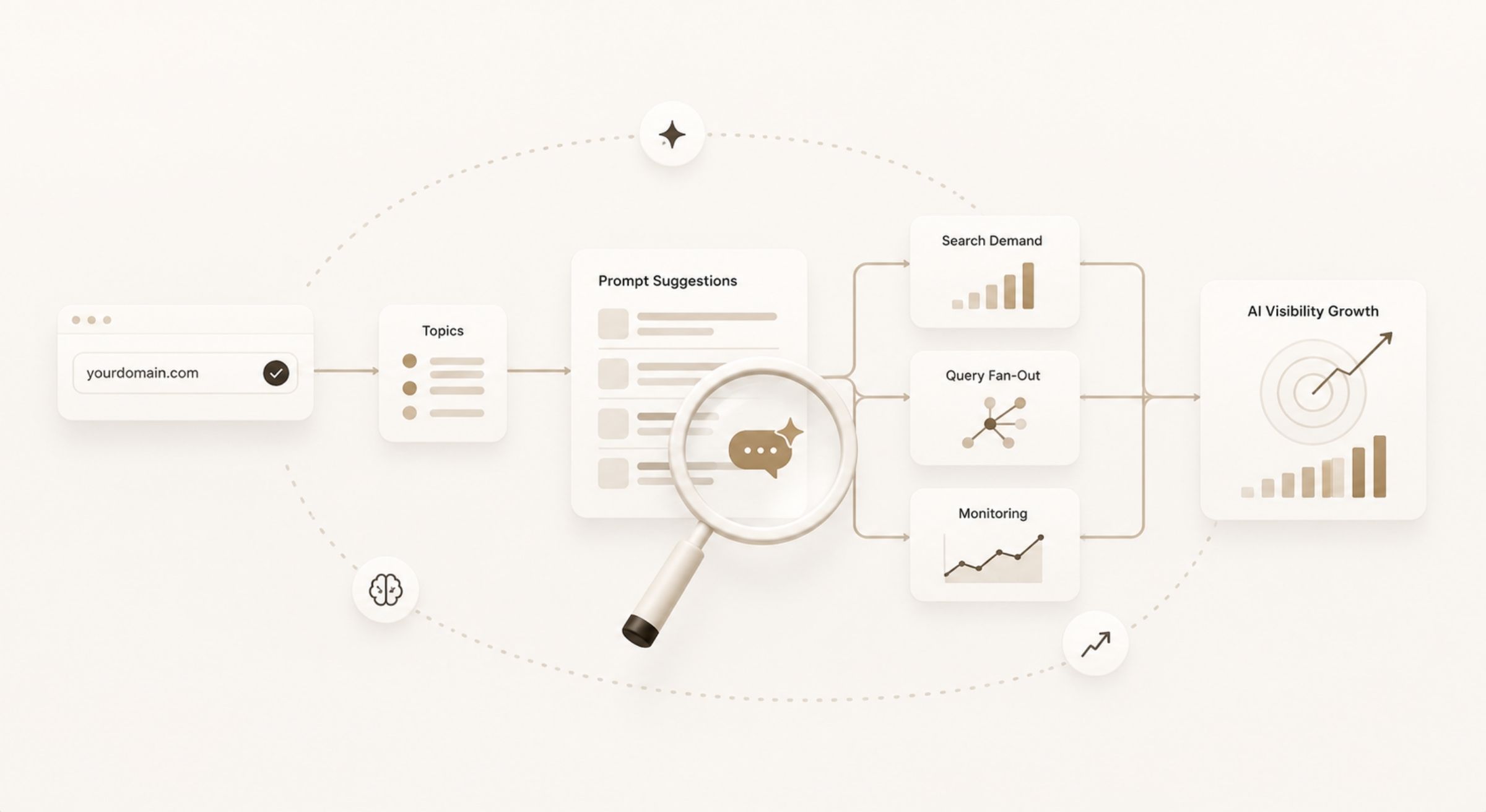
Domain → Topics → Prompts → Actions → Results
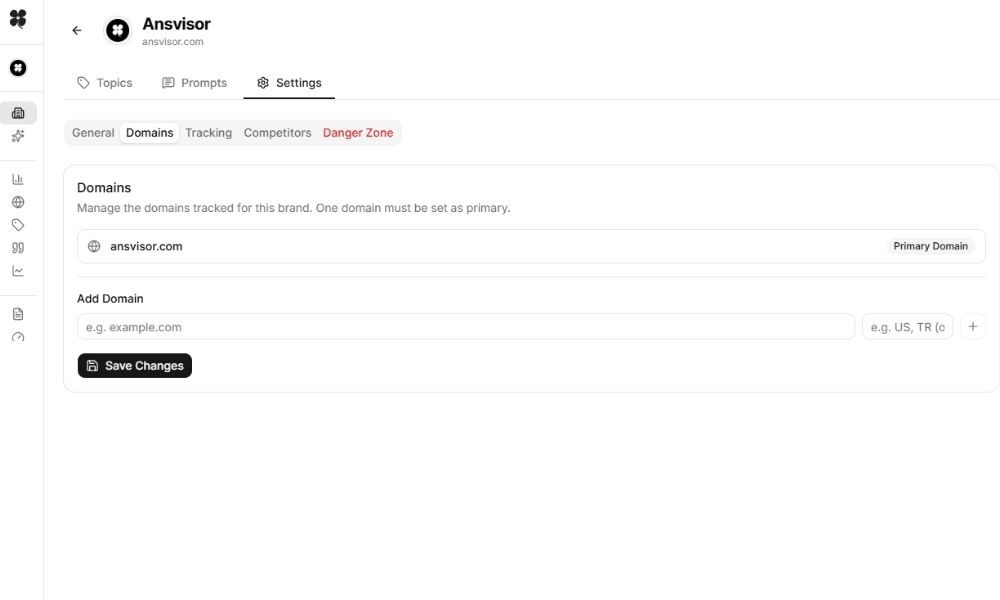
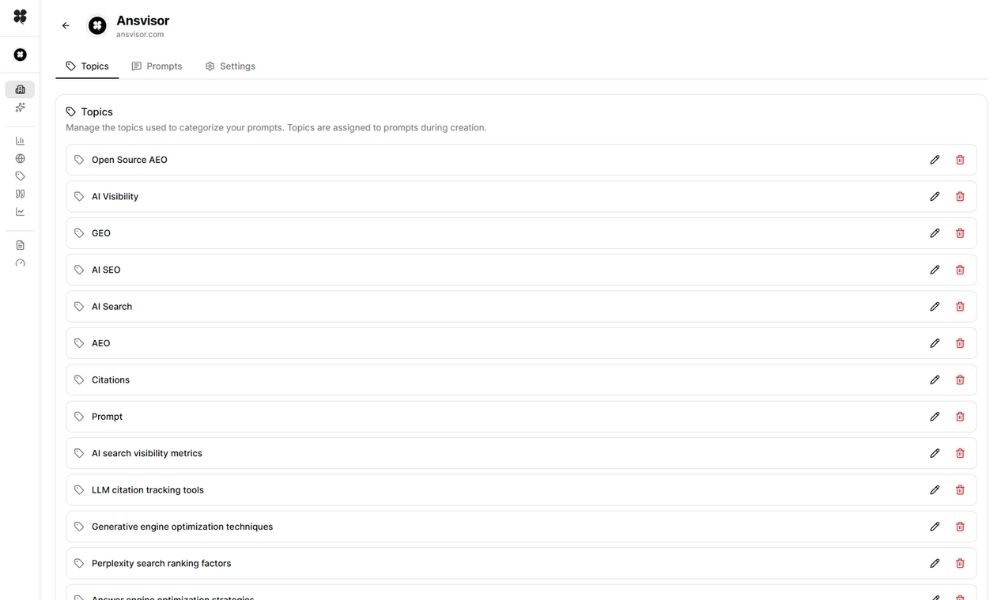
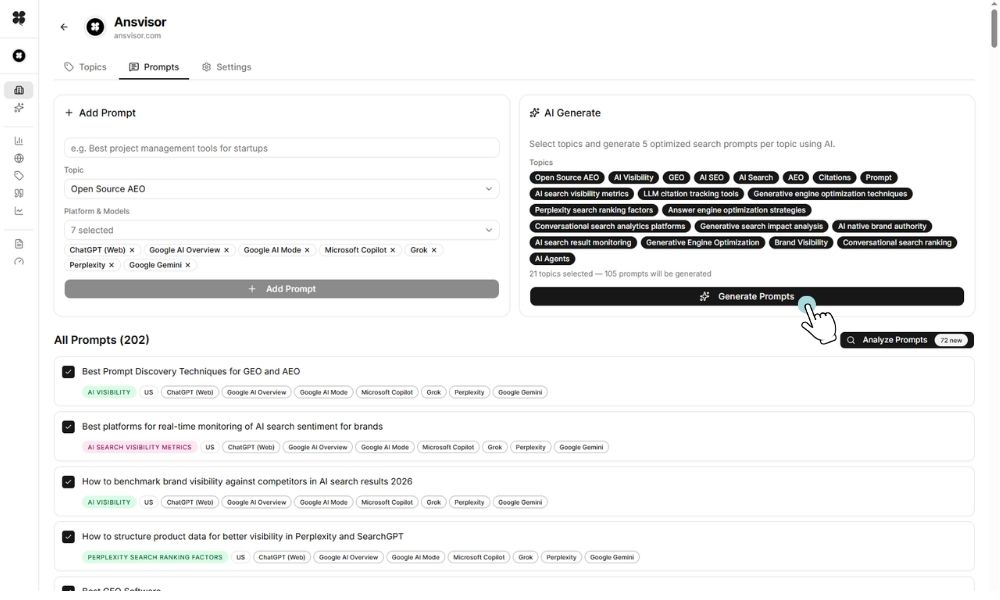
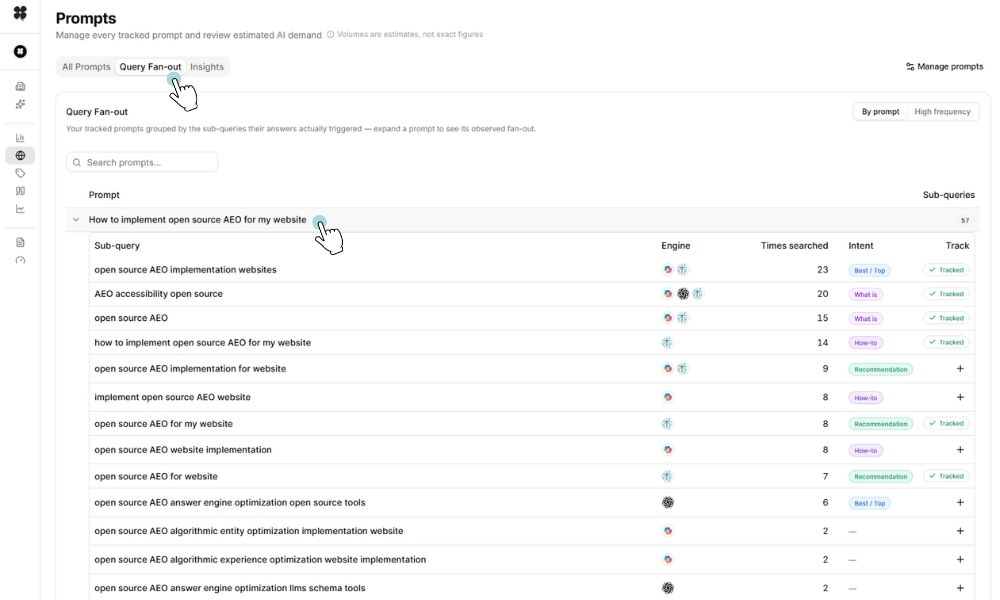
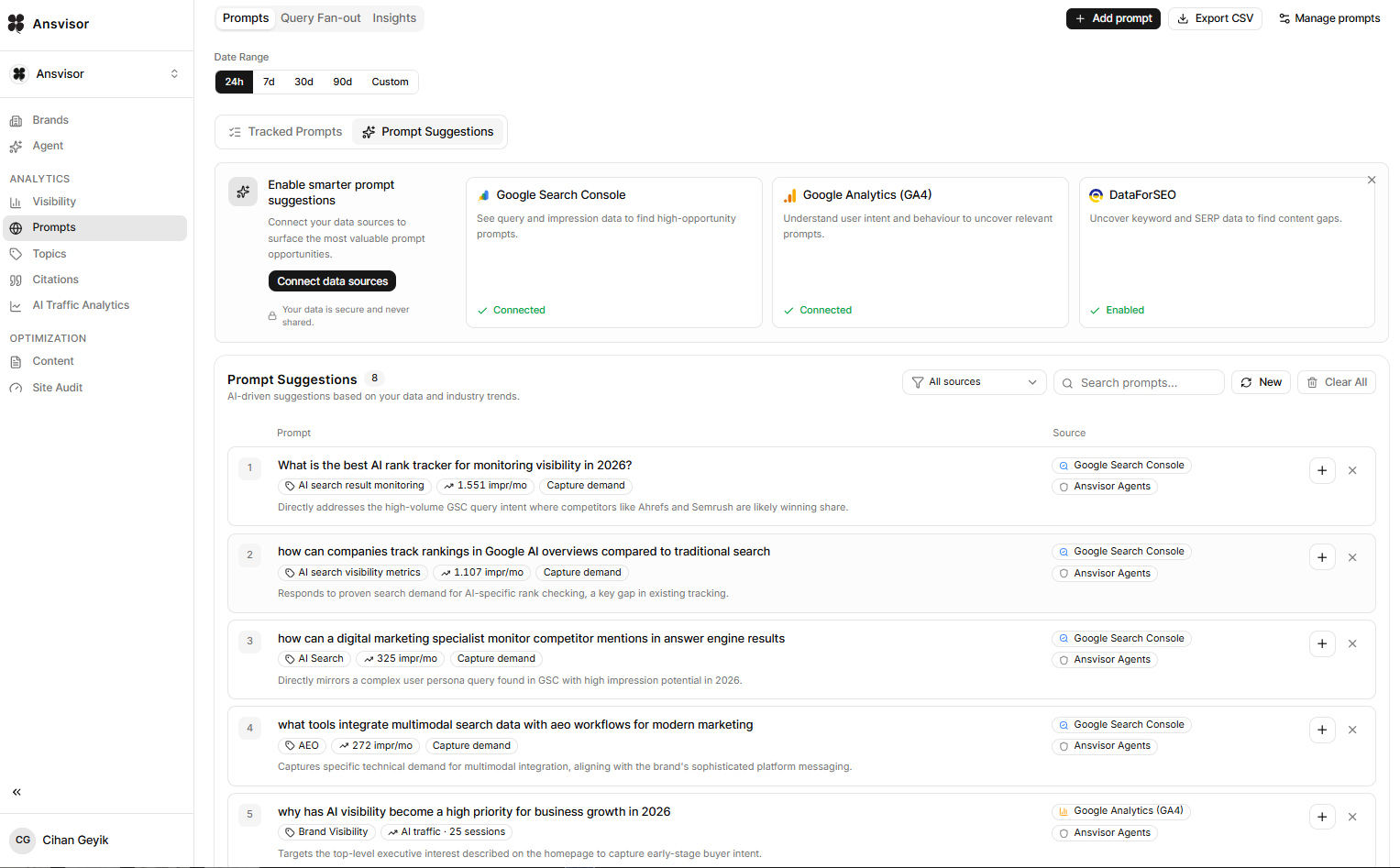
Ansvisor starts with your domain, recommends relevant topics, generates prompt opportunities, validates demand using Google Search data, reveals Query Fan-Out, and then helps your team manage the work required to increase visibility, mentions, and citations.
Manage Prompt Work Across Your Team
AI Visibility is rarely owned by one person. SEO teams may improve technical accessibility, content teams may create or update pages, brand teams may strengthen positioning, PR teams may pursue third-party citations, and product teams may provide the evidence needed for stronger recommendations.
Ansvisor allows teams to organize this work directly at the prompt level.
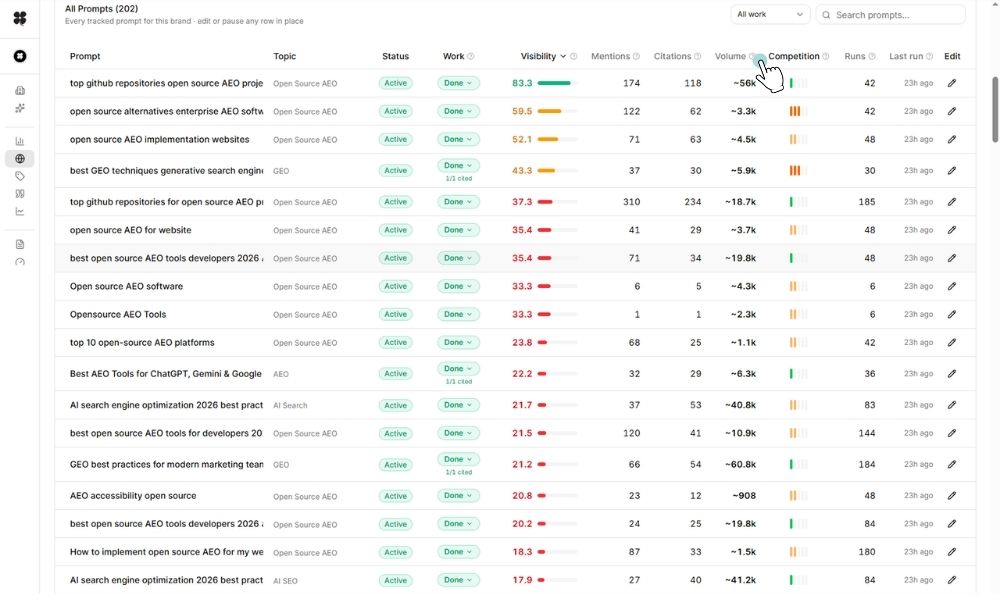
Each prompt can also include working notes and a target URL. Notes preserve the reason behind the action: what needs to change, why the opportunity matters, which source patterns were observed, and how the team intends to respond. The target URL tells everyone which page is expected to earn the mention or citation.
Why this matters: A prompt list without ownership becomes a reporting archive. A prompt list with statuses, notes, target URLs, and validation becomes an operational roadmap.
Track Prompt Performance in the Same Workspace
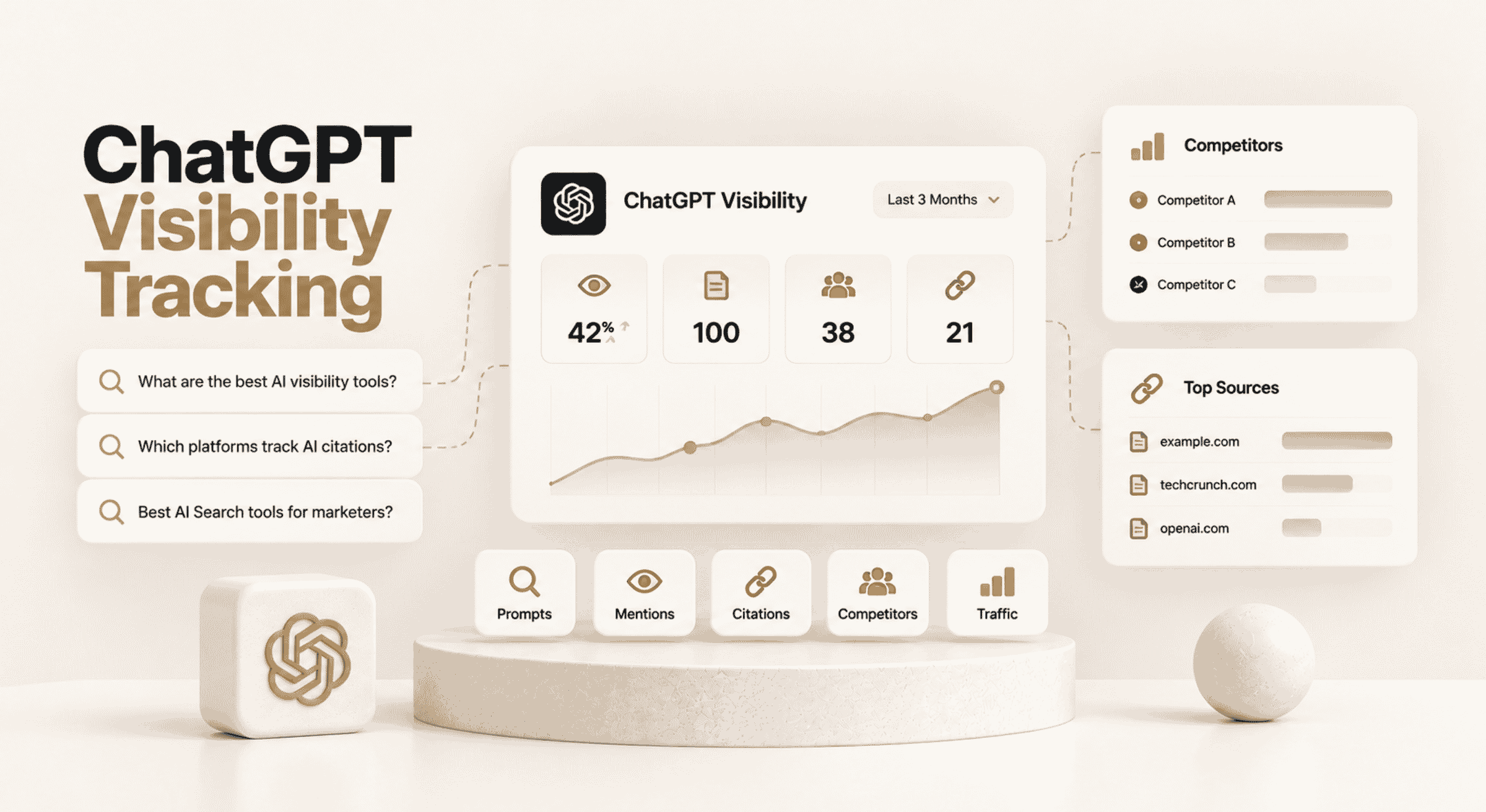
Ansvisor keeps the most important prompt-level performance signals next to the work itself. This allows teams to prioritize based on opportunity and measure whether completed actions are producing better outcomes.
Teams can manually add prompts under the relevant topic, pause prompts that are no longer useful, and continue expanding the dataset through topic suggestions, prompt suggestions, and observed Query Fan-Out. This creates a living prompt portfolio rather than a one-time research export.
Prompt Discovery Ideas for 12 Industries
Prompt discovery should reflect the decisions, risks, comparisons, and evidence requirements of each market. The table below provides starting points for increasing mentions and citations across Ansvisor's industry frameworks.
| Industry | Prompt discovery focus | Example opportunity | Best evidence to build |
|---|---|---|---|
| SaaS & Technology | Software comparisons, integrations, security, implementation, and use cases | Best software for a specific team, workflow, or technical stack | Feature documentation, comparison pages, security details, integrations, and customer proof |
| Healthcare | Conditions, treatments, provider selection, patient education, and trust | How to choose a provider or understand a treatment option | Medical review, credentials, sources, safety guidance, and clear limitations |
| Legal Services | Jurisdiction, legal process, case type, urgency, and attorney selection | What to do after a specific legal event in a named location | Attorney credentials, jurisdiction-specific explanations, disclaimers, and case experience |
| Education & EdTech | Course selection, learning outcomes, accreditation, skills, and student fit | Best program for achieving a defined career or learning goal | Curriculum, outcomes, instructor expertise, accreditation, and learner reviews |
| AI Companies | Models, agents, infrastructure, accuracy, evaluation, and deployment | Best AI platform for a specific agentic or enterprise workload | Benchmarks, architecture, evaluations, documentation, and reproducible examples |
| E-commerce & Retail | Product discovery, category comparisons, buying criteria, price, availability, and shopping intent | Best product for a specific use case, budget, audience, or constraint | Structured product data, reviews, specifications, availability, pricing, and comparison content |
| Consumer Brands & CPG | Ingredients, benefits, alternatives, lifestyle fit, and brand trust | Best product for a need, preference, dietary requirement, or routine | Ingredients, testing, expert validation, retailer coverage, and consumer proof |
| Manufacturing & Industrial | Technical specifications, suppliers, standards, applications, and total cost | Best supplier or equipment type for a specific industrial application | Datasheets, certifications, engineering guidance, case studies, and compatibility details |
| Automotive & Mobility | Vehicle comparisons, ownership costs, range, safety, maintenance, and mobility use cases | Best vehicle or mobility solution for a location, budget, or usage pattern | Specifications, safety data, cost models, charging or service coverage, and expert reviews |
| Real Estate | Locations, property types, affordability, agents, investment, and local intent | Best area, property type, or agent for a specific buyer profile | Local market data, listings, neighborhood expertise, transaction proof, and transparent methodology |
| Travel & Hospitality | Destinations, itineraries, hotels, timing, budgets, and traveler preferences | Best stay, destination, or itinerary for a specific type of traveler | Current availability, location detail, first-hand content, policies, ratings, and seasonal guidance |
| Financial Services | Products, eligibility, fees, risk, trust, regulation, and financial goals | Best financial product for a defined profile, objective, or risk level | Transparent terms, regulatory information, risk disclosures, expert review, and comparison methodology |
Prompt Discovery for E-commerce and AI Shopping
E-commerce teams should expand prompt research beyond category keywords. AI shopping assistants interpret product attributes, user constraints, price sensitivity, audience, availability, use cases, and comparisons before deciding which products to surface.
Ansvisor AI Shopping Analytics helps commerce teams evaluate how products and competitors appear inside AI shopping experiences. This adds a product-level layer to prompt discovery and allows teams to investigate questions such as:
- Which product attributes appear most often in recommendation prompts?
- Which competitors win when users add price, size, audience, or use-case constraints?
- Which product pages or third-party sources are cited before a shopping recommendation?
- Where is structured product data incomplete or inconsistent?
- Which tracked prompts generate product cards, brand mentions, or competitor visibility?
For commerce brands, the ideal workflow connects prompt discovery, product visibility, citation sources, product data, content, and AI-referred traffic rather than measuring each area separately.
Analyze Citation URLs, Prompt Coverage, and Traffic
A citation is more useful when your team understands where it appears, which prompt triggered it, and whether users visit the cited page.
Ansvisor's Citation Monitoring allows teams to open cited URLs and inspect their prompt-level performance. A URL detail view can reveal which tracked prompts cited the page, where the URL appeared in the answer's citation order, and how citation coverage is distributed across prompts.
This enables several practical analyses:
Find the most-cited content
Identify which owned and third-party URLs earn the highest number of citations across tracked prompts.
Map citations to prompts
See exactly which questions cite a URL and where prompt coverage remains weak.
Study winning formats
Compare cited guides, product pages, research, videos, community discussions, and review platforms.
Connect citations with traffic
Use AI Traffic Analytics to understand visits generated by AI platforms and cited pages.
This closes an important measurement gap. Teams can distinguish between a citation that only appears in an answer and a citation that also contributes meaningful referral traffic, engagement, or conversion opportunities.
How to Prioritize Prompt Opportunities
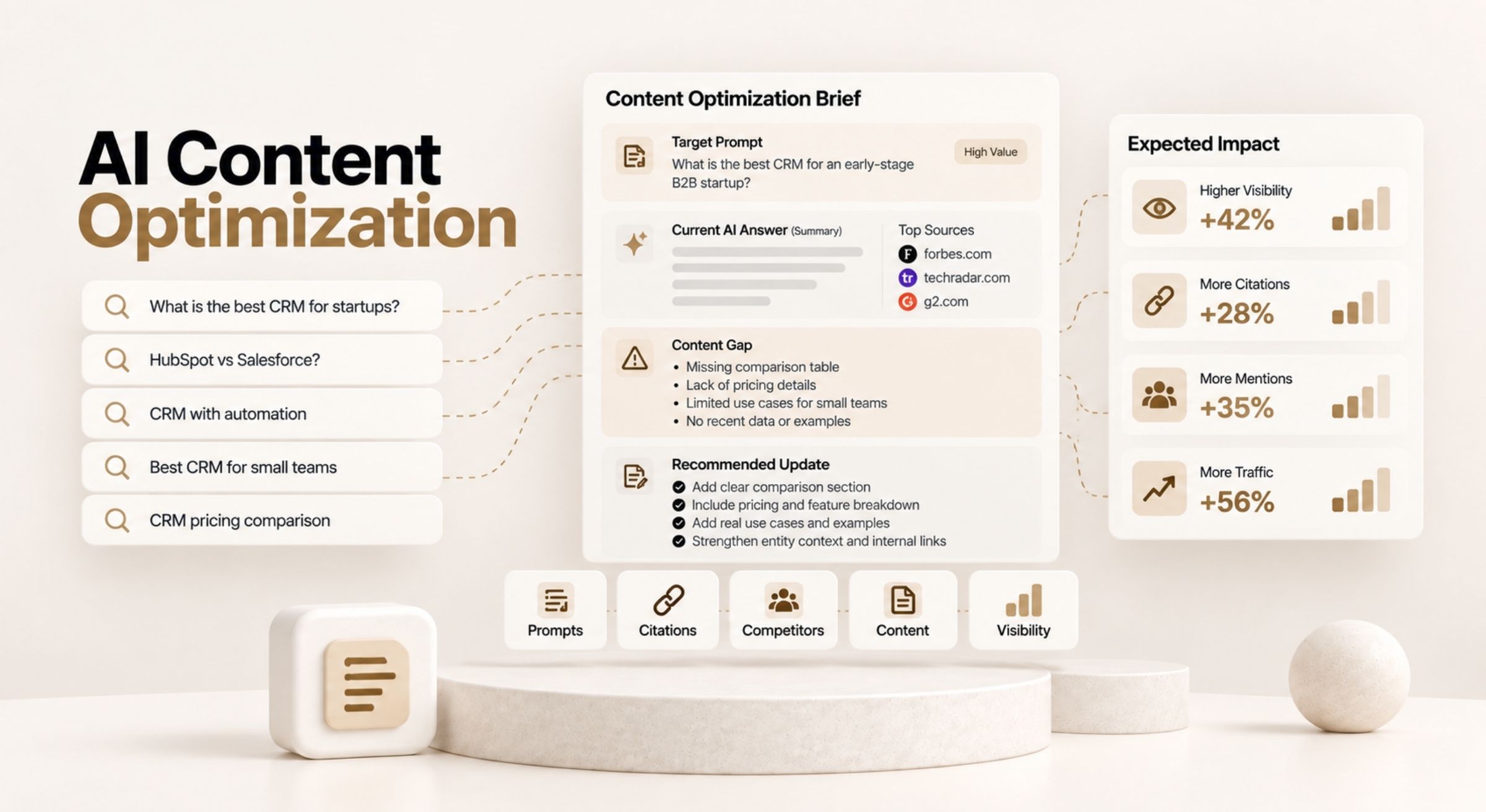
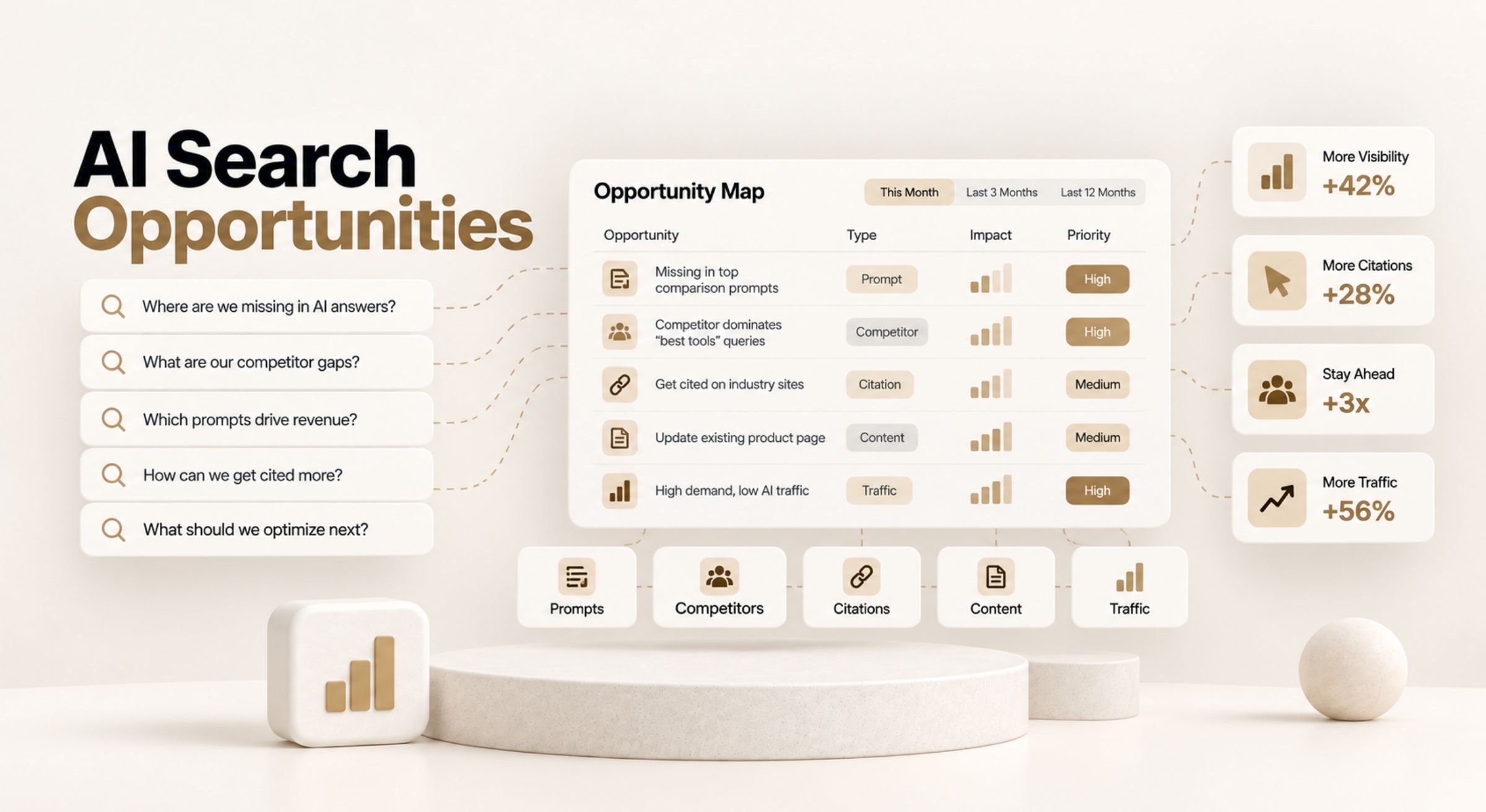
Do not prioritize prompts using estimated volume alone. A lower-volume prompt may be commercially valuable, highly relevant to the product, and easier to influence than a broad category query.
| Signal | What it tells you | Recommended action |
|---|---|---|
| High estimated volume, low visibility | The market opportunity is meaningful, but the brand is underrepresented. | Prioritize content, authority, technical, and distribution gaps. |
| Competitors mentioned, brand absent | AI systems understand the category but do not retrieve or recommend your brand. | Study competitor evidence, cited sources, positioning, and entity coverage. |
| Brand mentioned, no owned citation | The entity is recognized, but your own pages are not supporting the answer. | Improve target pages and make evidence easier to retrieve and verify. |
| Third-party citation dominates | External authority may matter more than another owned article. | Pursue relevant review, media, community, video, partner, or research coverage. |
| High-frequency Query Fan-Out | Supporting questions repeatedly influence multiple tracked prompts. | Create reusable evidence that answers the recurring sub-query directly. |
| Done status, no improvement | The action may not address the real retrieval or authority gap. | Review the cited-source pattern, Query Fan-Out, target URL, and implementation quality. |
“The best prompt discovery process does not end with a list. It connects every prompt to a topic, an opportunity, an owner, a target URL, and a measurable result.”— Cihan Geyik, Co-founder of Ansvisor
Prompt Discovery Best Practices
- Start with your domain and market before generating isolated prompt ideas.
- Organize prompts under topics so the research reflects real entity and intent clusters.
- Combine AI-generated ideas with estimated Google Search demand.
- Track both high-volume prompts and commercially valuable long-tail questions.
- Use Query Fan-Out to discover the hidden searches behind AI-generated answers.
- Separate mentions from citations and inspect the exact URLs influencing recommendations.
- Assign statuses, notes, and target URLs so prompt research becomes team work.
- Validate completed actions against visibility, mentions, citations, and AI traffic.
- Refresh topics and prompt suggestions as products, competitors, and AI behavior change.
Frequently Asked Questions
What is prompt discovery for GEO and AEO?
Prompt discovery is the process of finding the questions, comparisons, recommendations, and supporting queries that influence AI-generated answers. It combines domain analysis, topic discovery, prompt suggestions, search demand, Query Fan-Out, competitive evidence, and continuous monitoring.
How is prompt discovery different from keyword research?
Keyword research focuses on search queries and ranking pages. Prompt discovery also considers conversational intent, generated answers, brand mentions, citations, competitors, supporting LLM searches, answer context, and the sources used to verify recommendations.
How does Ansvisor generate prompt suggestions?
Ansvisor starts with the brand's domain, identifies relevant topics, recommends prompts for those topics, and adds estimated demand informed by Google Search data. Teams can add suggestions to tracking, create prompts manually, and expand them through observed Query Fan-Out.
What is Query Fan-Out in prompt research?
Query Fan-Out refers to the supporting searches an AI system may generate after receiving a user prompt. These sub-queries reveal the evidence, definitions, comparisons, and verification steps that can influence the final answer.
Can teams collaborate on prompts inside Ansvisor?
Yes. Teams can mark prompts as To do, In progress, Done, or leave them without a status. They can also add notes, define a target URL, organize prompts under topics, and review visibility, mentions, citations, volume estimates, runs, and recent performance.
How can prompt discovery increase AI citations?
Prompt discovery reveals the questions and supporting searches where AI systems need better evidence. Teams can then improve target pages, publish missing content, strengthen third-party authority, clarify product information, and monitor whether the resulting URLs earn citations.
How can e-commerce teams discover AI shopping prompts?
E-commerce teams should research prompts around products, attributes, audiences, use cases, budgets, comparisons, availability, and purchase constraints. Ansvisor combines general prompt discovery with AI Shopping Analytics to evaluate product cards, brands, competitors, and shopping-oriented visibility.
Can Ansvisor show which prompts cite a specific URL?
Yes. Citation URL detail pages show which tracked prompts cite a URL and provide prompt-level citation breakdowns. Teams can use this to find the most-cited content, study winning source patterns, and identify pages with room to expand citation coverage.
Build a Continuous Prompt Discovery Workflow
The most effective GEO and AEO strategies do not rely on a static spreadsheet of questions. They continuously discover topics, generate prompts, validate demand, inspect Query Fan-Out, assign work, track performance, analyze citations, and learn from the URLs that AI systems already trust.
Ansvisor brings this entire workflow into one open-source and cloud-ready AI Visibility platform. Start with your domain, discover relevant topics and prompts, organize the work across your team, and validate whether your actions increase visibility, mentions, citations, and AI-referred traffic.
Discover and Prioritize Your Next AI Search Opportunities
Start with AI-generated topic and prompt suggestions, uncover Query Fan-Out, manage actions with your team, and measure the results in Ansvisor.