Why Language Models matter
Language Models are AI systems trained on large amounts of text data to understand, predict, and generate human language. They form the foundation of modern AI assistants, answer engines, search experiences, and generative applications.
By learning statistical patterns, semantic relationships, and contextual information from massive datasets, language models can answer questions, summarize information, generate content, reason about concepts, and interact conversationally.
Benefits of language models include:
- Enable natural language understanding.
- Generate human-like responses.
- Support conversational interfaces.
- Improve information retrieval.
- Power AI search experiences.
Today's AI ecosystem is built largely on increasingly capable language models that can process complex instructions and synthesize information from multiple sources.
How Language Models work
Language models learn patterns and relationships from large-scale datasets during training.
- Analyze billions of text examples.
- Learn semantic relationships.
- Predict probable sequences.
- Build contextual understanding.
- Develop reasoning capabilities.
- Generate responses.
Modern language models typically use transformer architectures that enable them to process large amounts of context and understand relationships between words, entities, and concepts.
Concepts such as Embeddings, Context Window, and Foundation Models are fundamental components of modern language model architectures.
What can Language Models do?
Language models support a wide range of capabilities.
- Question answering.
- Content generation.
- Summarization.
- Translation.
- Reasoning.
- Code generation.
- Conversational interactions.
Many modern Answer Engines rely on language models to synthesize information retrieved from external sources.
How Language Models affect AI search
Language models influence nearly every aspect of AI-powered search experiences.
Modern AI search systems increasingly combine language models with technologies such as Retrieval-Augmented Generation (RAG), Grounding, and Knowledge Retrieval to improve factual accuracy and reliability.
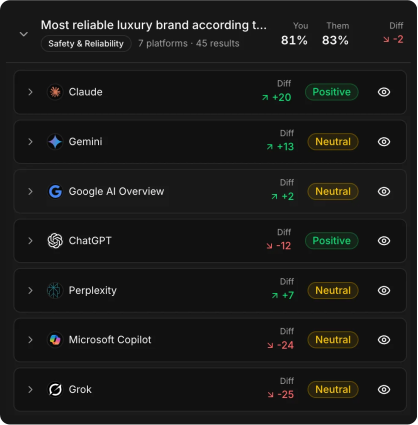
Platforms such as Ansvisor help organizations understand how language model-powered search systems retrieve, cite, recommend, and represent brands by analyzing prompts, citations, competitors, and AI visibility patterns across multiple answer engines.
Common misconceptions
Common misconceptions about language models include:
- Language models store facts like databases.
- All language models have real-time knowledge.
- Larger models are always better.
- Language models never hallucinate.
- Language models understand information exactly like humans.
Language models provide the reasoning and language capabilities behind modern AI systems, but their effectiveness depends heavily on retrieval systems, grounding, high-quality data, and trusted information sources.









.svg)
