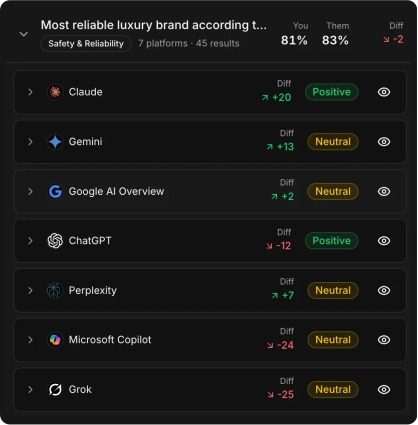
Prompt monitoring is the routine behind every AI visibility number. A fixed list of buyer questions runs on ChatGPT, Perplexity and Google’s AI features on a schedule. Every answer is stored and compared with the last run. When a competitor replaces you in an answer, or a cited page drops out, monitoring is how you find out within days.
The schedule is the method. Same prompts, same platforms, same regions, on a fixed cadence. Change any of them mid-period and the trend stops meaning anything.
How does prompt monitoring work?
Choose prompts → Assign topics and markets → Run on a schedule → Parse every answer → Compare with the last period → Alert on real changes
- Pick the questions buyers ask at each stage, from “what is” to “best X for Y” and “X vs Y.”
- Group them into topics and set the market and platforms for each prompt.
- Run them automatically, usually daily, so you never rely on a manual check.
- Parse each answer into brands named, their order, cited URLs and tone.
- Compare the latest window with the previous one and flag changes worth a look.
The analysis that follows is prompt analytics. Monitoring is the collection and alerting layer underneath it.
Prompt monitoring vs prompt tracking
Most vendors use the terms interchangeably, and buyers search for “prompt tracking” far more often. If there’s a difference, it’s emphasis.
Prompt tracking is the data collection: run the prompt, store the answer, compute the metrics. Prompt monitoring adds the watch over that data, with alerts, review cadences and owners who respond. You can track without monitoring. You can’t monitor without tracking.
Prompt monitoring vs keyword rank tracking
| Keyword rank tracking | Prompt monitoring |
|---|
| Unit | A short keyword | A full question, often with context |
| Output | A position from 1 to 100 | An answer naming a few brands, with sources |
| Run-to-run stability | Fairly stable | Changes between runs of the same prompt |
| Reading | Today’s rank | Averages over many runs |
| Scale driver | Keywords × locations | Prompts × platforms × regions × languages |
The last row is where costs come from. A set of 2,000 prompts across six platforms and three markets means 36,000 answers per run.
What should each run record?
- The full answer text, so anyone can audit a number later.
- Every brand named, in order, with the context around it.
- Each cited URL and its domain, yours or not.
- Sentiment for your brand and for competitors.
- Platform, model, region, language and timestamp.
- Where the engine exposes them, the sub-queries it searched. Our query fan-out page explains why they matter.
How often should prompts run?
Daily runs catch changes fastest. Weekly runs cost less per prompt. The bigger risk is reading too few runs.
In a SparkToro study, ChatGPT and Google’s AI had less than a 1 in 100 chance of giving the same brand list twice. The same order came up about once in 1,000 runs. The authors treat visibility across many runs as a reasonable metric and position in a single answer as unreliable.
A practical rule: run daily, read in seven-day windows, and act on patterns that hold across platforms for two weeks. Review the core set weekly and the full set monthly.
How do you build a prompt set at scale?
Brands and agencies with thousands of prompts need structure, or nobody reads the output.
- Build a topic tree by product line and intent. Every prompt belongs to one topic.
- Write prompts per market in the local language. Translate the buyer’s intent, not the English words.
- Keep a core set frozen for a quarter, and test new prompts in a separate discovery set.
- Rank prompts by estimated demand with prompt volumes, then cut the ones nobody asks.
- Separate branded prompts. They inflate every metric they touch.
For scale, our own tracking processed 103,427 AI answers and 746,702 citations in one month. Nobody reads that by hand. It needs topic grouping and alerts to be usable. Source: Ansvisor tracking data, September 15 to October 14, 2026.
For ways to find the prompts in the first place, see these prompt discovery techniques.
Which changes should trigger an alert?
Alerts should fire on patterns, not on single answers. These are the rules Ansvisor’s Daily Pulse uses after each scheduled run:
| Alert | Rule |
|---|
| Sharp drop | Visibility falls at least 3 points and 30% week over week, across 10+ prompts |
| Competitor surge | A competitor gains 15 points or more week over week |
| Lost citations | A prompt cited on 60% of days in the last 14 loses its citation on the 3 latest result days |
| Prompt gain | A prompt’s visibility rises 5 points or more week over week |
| First citation | A target URL is cited for the first time |
Repeat warnings on the same subject pause for seven days. If an engine returns far fewer answers than usual, drop warnings are held, so a collection gap doesn’t look like a lost market.
Example: what monitoring catches
A payroll software brand is cited on “best payroll software for startups” on most days. A competitor then publishes a detailed pricing comparison.
Three days later, the brand’s citation is gone from Google AI Overviews, and the competitor’s new page is cited in its place. A lost-citation alert fires that morning. The team updates its own pricing page with current plans and dated facts within a week. The citation returns about two weeks later.
Without monitoring, the loss would have surfaced in a quarterly report, if at all. The example is illustrative, but the pattern is common.
Why do results differ across platforms and runs?
Some engines search the web for each answer. ChatGPT search, Perplexity, Copilot and Google’s AI features pull fresh sources, so their citations shift as pages are crawled and re-ranked. Answers built from model memory change more slowly, then jump after a model update.
Platforms also draw on different indexes. Copilot grounds its answers in Bing, while Google’s AI features use Google’s index and fan out into sub-queries. A brand can lead on one engine and be missing on another, so set alert thresholds per platform.
Common mistakes
- Checking prompts by hand in a logged-in browser, where history and location skew the answer.
- Tracking only branded prompts, where you’ll almost always appear.
- Rewriting prompts every month, which breaks the trend line.
- Monitoring one platform and calling it the market.
- Collecting data with no owner for the alerts.
Our walkthrough on tracking prompts in ChatGPT covers the setup step by step. To see results per question, read about prompt-level visibility.
How Ansvisor helps
Ansvisor runs your prompts on ChatGPT, Google AI Overviews, AI Mode, Gemini, Copilot and Perplexity, with Claude on Enterprise plans. Prompt Monitoring and Volumes groups prompts into topics, sets regions per prompt and adds estimated demand and intent. Daily Pulse sends the changes by email or webhook after each run. Start a 14-day free trial to monitor your own prompt set.