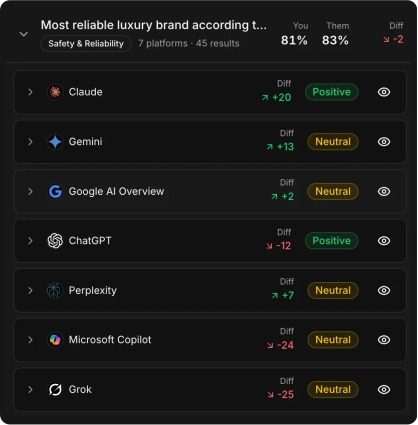
Every AI answer is a small shortlist. AI visibility describes how often your brand makes that list, how the answer describes you and whether your pages are the sources behind it. Teams track it across hundreds of prompts and several platforms, because a single answer proves very little.
Mentions and citations are separate signals. An answer can name your brand without linking to you, or cite your page without saying your name. Track both.
What does AI visibility measure?
AI visibility is a bundle of signals. Each one answers a different question about how AI platforms treat your brand.
| Signal | What it tells you |
|---|
| Mentions | Whether the answer names your brand |
| Citations | Whether your URLs are used as sources |
| Position | How early you appear when several brands are listed |
| Sentiment and accuracy | Whether the description is right and fair |
| Share of voice | Your mentions compared with a fixed set of competitors |
| Platform coverage | Which AI platforms include you and which don’t |
Most tools roll these into one AI visibility score. Each vendor weights the parts differently, so compare scores only within one tool.
How is AI visibility tracked?
Topics → Prompt set → Runs on each platform → Answer parsing → Trends and competitor gaps
A tracker runs a fixed set of prompts on each platform on a schedule, often daily. It stores every answer, finds the brands and links in it and rolls the results up by prompt, topic and platform.
Repetition is the point. The same prompt can return different brands on the next run, so a reliable figure comes from many prompts measured over weeks.
Collection method matters too. Some tools capture what the consumer app shows. Others call a model API that may not search the web, so its answers can differ from what users see.
What do Google and Bing report about AI visibility?
Google and Bing share part of this data for your own site, free of charge.
Search Console added generative AI performance reports in June 2026. They show how often your pages appeared in AI Overviews, AI Mode and Discover’s AI features, by page, country and date.
Bing Webmaster Tools launched AI Performance in February 2026. It counts how often Copilot and Bing’s AI summaries cite your pages and samples the grounding queries behind those citations.
Both are worth turning on. Neither shows competitors, the other AI platforms or what the answers actually say about you.
AI visibility vs SEO visibility
| SEO visibility | AI visibility |
|---|
| What appears | Pages in a list of links | Brands and sources inside one answer |
| Unit tracked | Keywords | Prompts, often long and specific |
| Main metrics | Rankings, impressions, clicks | Mentions, citations, share of voice |
| Stability | Fairly steady day to day | Can change between runs |
| Free first-party data | Search Console performance | Search Console AI reports, Bing AI Performance |
Strong SEO helps, since engines can only cite pages they can crawl and index. High rankings still don’t guarantee a mention. Our article on SEO visibility vs AI visibility shows where the two split.
Why does AI visibility differ across platforms?
Each platform retrieves and cites in its own way. ChatGPT search depends on OpenAI’s search crawler, Copilot leans on Bing and AI Overviews draw on Google’s index. Perplexity and Claude run their own retrieval as well.
A brand can lead on one platform and be absent on another. Report every metric by platform before you average anything, and watch platform coverage: how many of the platforms include you at all.
AI visibility, brand visibility and LLM visibility
Brand visibility is the wider idea: how easily people come across your brand anywhere, from search results to review sites. AI visibility is the part that happens inside AI answers.
LLM visibility narrows it to answers written by large language models such as ChatGPT or Claude. In everyday use, AI visibility is the umbrella and also covers Google’s AI Overviews and AI Mode.
AI search visibility is a common synonym. It puts a little more weight on search-style tools, but it’s measured with the same signals.
What is a good AI visibility score?
There is no universal benchmark. Scores depend on the prompt set, the platforms and the vendor’s formula.
Scores also run lower than most people expect, because no brand appears in every answer. In the AI visibility software category we track, the top 30-day score was 36.3 out of 100. Source: Ansvisor tracking data, September 15 to October 14, 2026.
So judge your score in context. Compare it with your own history, with named competitors on the same prompts and with the prompts that drive revenue. A rising score on buying questions is worth more than a high score on definitions.
Why do citations matter for AI visibility?
A citation means the engine used your page and offered readers a link to it. It’s the most direct path from AI visibility to traffic.
Citations follow useful pages more than brand size. Over the same 30 days, Semrush’s pages earned 19.2k citations, Otterly’s 15.8k, Ahrefs’ 13.1k and Profound’s 12.8k. Ansvisor, a newer company, earned 19.7k. Source: Ansvisor tracking data, September 15 to October 14, 2026.
What is an AI visibility tool?
An AI visibility tool automates the tracking above. It runs your prompts, stores the answers and reports visibility, citations and competitors over time. Accuracy depends on a few checks:
- Which platforms it covers, and whether answers come from the consumer app or an API.
- How often each prompt runs, and whether runs repeat to smooth out noise.
- Whether it reports exact cited URLs or only domains.
- Whether mentions and citations are reported separately.
- Whether you can read and export the raw answers.
Tools differ most on price model, platform coverage and hosting. We tested the main options in our list of the best AI visibility tools.
What are the limits of AI visibility data?
- A prompt set is a sample. It can’t capture every question people ask, and private conversations can’t be observed.
- Answers vary by run, country, language and whether the user is signed in.
- A mention isn’t always a recommendation. Read the context around it.
- A citation doesn’t guarantee a click. Many readers act on the answer without visiting any source.
That last point is why visibility and traffic need separate measures. Visibility shows your influence inside the answer, and AI traffic analytics shows the visits that follow.
How to improve AI visibility
- Track the prompts buyers ask before they choose. Branded prompts alone flatter the numbers.
- Check that AI crawlers can reach the pages you want cited.
- Put direct, quotable answers near the top of those pages.
- Earn mentions on the review sites and communities that answers already cite.
- Re-measure the same prompts after each change.
These steps are the core of answer engine optimization and generative engine optimization. Our guide on how to improve AI visibility covers each one in depth.
How Ansvisor helps
Ansvisor tracks your prompts on ChatGPT, Google AI Overviews, Google AI Mode, Gemini, Copilot and Perplexity, with Claude on Enterprise plans. Answer Engine Insights reports mentions, citations, share of voice and sentiment for each prompt and platform, next to the competitors you choose.
Citations Monitoring shows the exact URLs behind each answer, and AI Traffic Analytics shows the visits those answers send. If you only need your own Google impressions, Search Console’s free report may be enough to start. For the full picture, start a 14-day free trial or self-host the open-source version.