
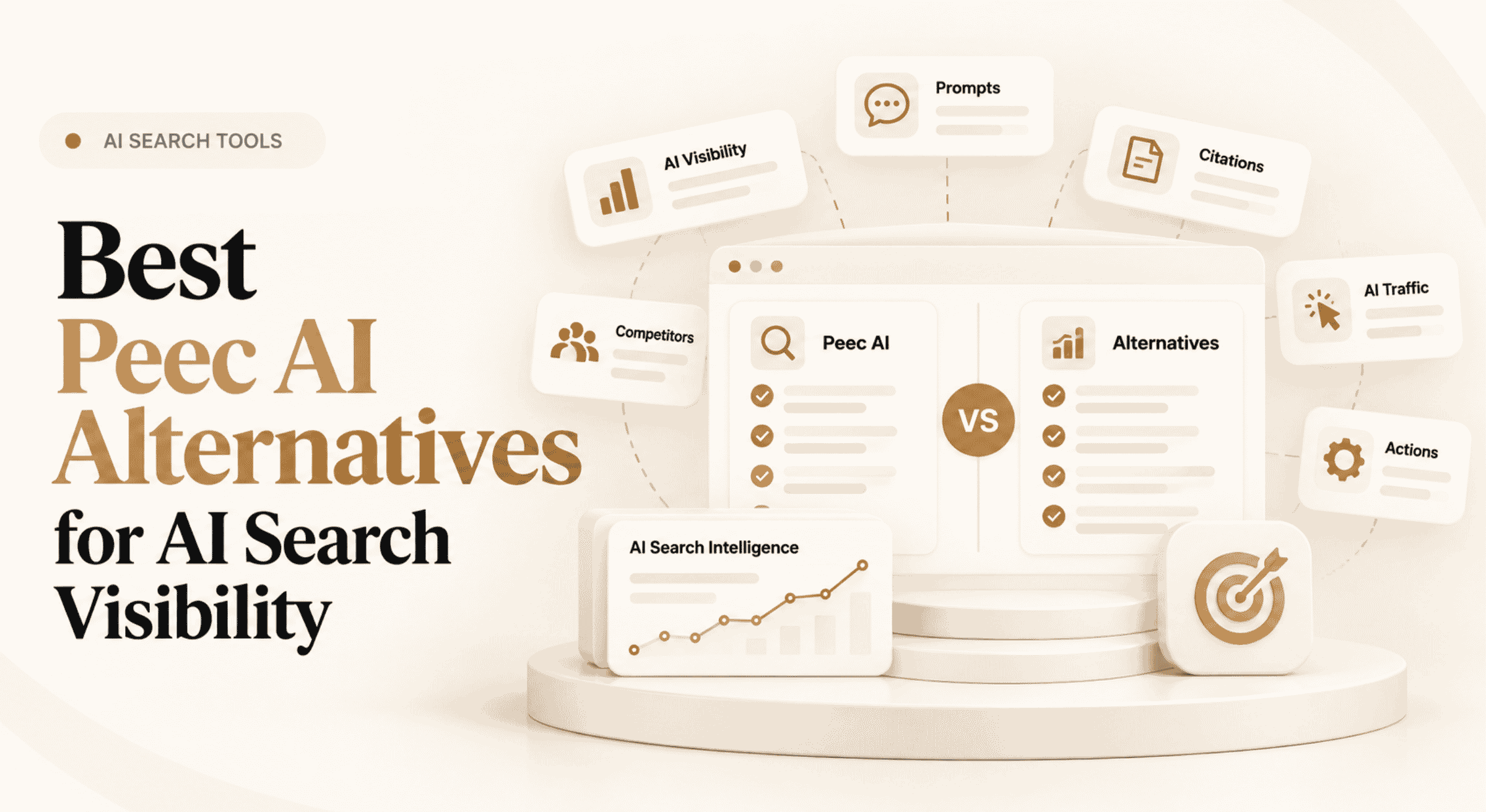
AI Search visibility platforms are becoming an important part of the marketing stack as customers increasingly use ChatGPT, Gemini, Google AI Overviews, Perplexity, Claude, Microsoft Copilot, and other AI-powered experiences to research brands and make decisions.
Peec AI is one of the platforms built specifically for this new measurement layer. It helps marketing teams monitor brand visibility, position, sentiment, Share of Voice, prompts, competitors, sources, and citations across AI-generated search experiences.
But Peec AI is not the only option. Different organizations may need broader AI Search intelligence, deeper citation analysis, stronger traditional SEO integration, open-source deployment, enterprise workflows, content intelligence, or a more direct path from measurement to execution.
This guide compares some of the best Peec AI alternatives and explains which type of team each platform may fit best.
Some of the best Peec AI alternatives include Ansvisor, Profound, Semrush, Ahrefs, Otterly.AI, and AthenaHQ. Peec AI is focused on AI Search analytics, including visibility, position, sentiment, prompts, competitors, sources, citations, and AI referrals. The best alternative depends on whether your priority is broader AI Search Intelligence, enterprise monitoring, traditional SEO integration, focused AI visibility tracking, GEO workflows, open-source deployment, or moving from insights into prioritized actions.
Peec AI is an AI Search analytics platform designed to help marketing teams understand how brands appear across AI-generated answers.
Instead of measuring only traditional search rankings, Peec AI analyzes tracked prompts and AI conversations to measure signals such as brand visibility, average position, sentiment, Share of Voice, competitor performance, sources, and citations.
Peec AI helps teams answer questions such as: How often does our brand appear in AI answers, how are we positioned against competitors, which prompts create visibility, and which sources influence those answers?
The platform can therefore be useful for SEO, AEO, GEO, content, brand, growth, and marketing teams that need repeatable AI Search measurement rather than manually testing individual prompts.
Looking for a Peec AI alternative does not necessarily mean Peec AI is missing a critical capability. More often, it means the organization has a different workflow, technology stack, deployment requirement, reporting model, or definition of what should happen after visibility is measured.
Some organizations want to move beyond measuring prompts, mentions, citations, and competitors. They may also need content intelligence, technical AI visibility auditing, traffic analytics, opportunity discovery, and a structured execution layer within the same workflow.
Deployment architecture can matter to technical teams and organizations that want greater control over their infrastructure. An open-source and self-hostable platform can therefore be a meaningful selection criterion rather than simply another feature.
Organizations heavily invested in traditional SEO may prefer an existing SEO suite that is adding AI visibility capabilities rather than introducing a dedicated AI Search platform. This is where products such as Semrush or Ahrefs can enter the evaluation.
AI Search monitoring can reveal where a brand is losing visibility, which competitors are winning, and which sources are repeatedly cited. The next question is what the team should actually do about those signals.
Some platforms focus primarily on analytics. Others are moving toward opportunity discovery, recommendations, actions, tasks, or agent-based execution. Teams should evaluate this part of the workflow separately from the visibility dashboard itself.
The key question is not simply “Which platform tracks AI visibility?” It is “Which platform matches the way our team needs to move from AI Search data to decisions and execution?”
The platforms in this guide do not all solve exactly the same problem. We therefore compare them across the capabilities that matter when building a broader AI Search intelligence workflow.
There is no single best alternative for every organization. The right choice depends on whether the priority is dedicated AI Search intelligence, enterprise monitoring, traditional SEO integration, simple visibility tracking, GEO workflows, or execution.
Ansvisor is an open-source AI Search Intelligence Platform designed to connect AI Search measurement with opportunity discovery and execution.
Teams can monitor prompts, brand visibility, mentions, citations, competitors, sources, AI traffic, content opportunities, and technical AI visibility signals across major AI-powered discovery experiences.
Ansvisor is positioned beyond visibility monitoring as a broader intelligence and execution layer. Its workflow is designed around Analytics → Opportunities → Actions, helping teams connect changes in visibility, citations, prompts, competitors, traffic, and other signals with prioritized next steps.
This becomes particularly relevant when the team wants AI Search monitoring to feed an operating workflow rather than remain a standalone analytics function.
Ansvisor's Action Center extends this model by connecting AI Search signals with actions, tasks, KPIs, and execution workflows.
Another distinction is deployment flexibility. Ansvisor is open source and can be self-hosted, while a managed cloud version is available for teams that prefer a hosted environment.
Profound is another dedicated platform in the AI Search intelligence category. It is particularly relevant for larger organizations evaluating enterprise-focused monitoring, analytics, and optimization across AI answer engines.
Teams comparing Peec AI and Profound should consider the scale of their monitoring requirements, organizational workflows, reporting needs, platform coverage, and the level of enterprise infrastructure required.
Profound can be worth evaluating when enterprise AI Search monitoring and organizational scale are central selection criteria.
Semrush approaches the market from a different direction. Rather than beginning as a dedicated AI visibility platform, it brings AI Search capabilities into a much broader digital marketing and SEO ecosystem.
This can be useful for teams already using Semrush for keyword research, rankings, competitive research, backlinks, site auditing, content, or other established SEO workflows.
The main reason is workflow consolidation. Teams that want traditional SEO and emerging AI Search measurement inside a broader existing marketing stack may prefer this model over adopting a dedicated AI Search platform.
Ahrefs is another established SEO platform expanding into the AI Search era. Its core strength remains the broader search research environment around keywords, competitors, content, backlinks, and organic performance.
For teams already using Ahrefs extensively, adding AI-related analysis within an existing research workflow may be more attractive than moving every discovery task into a separate platform.
Ahrefs can make sense for SEO-led organizations that want AI Search intelligence to remain closely connected with established organic search and competitive research.
Otterly.AI is a focused AI Search monitoring option for teams that want to track how brands appear across prompts and AI-generated answers without adopting a broader search intelligence stack.
Its narrower scope can be useful for organizations primarily interested in recurring AI visibility monitoring, brand presence, citations, and changes across tracked search experiences.
Teams looking for a relatively focused AI Search monitoring workflow may want to evaluate Otterly.AI alongside Peec AI. The decision should come down to the depth of prompt, competitor, citation, source, reporting, and optimization capabilities your organization actually needs.
AthenaHQ is another platform built around the shift from traditional search toward generative discovery. Its positioning makes it particularly relevant to teams evaluating Generative Engine Optimization workflows alongside AI visibility measurement.
Organizations comparing AthenaHQ with Peec AI should evaluate how each platform approaches visibility monitoring, prompts, competitors, citations, content recommendations, and the optimization workflow that follows the initial analysis.
AthenaHQ can be worth evaluating when GEO is a central part of the team's terminology, strategy, and optimization workflow.
The biggest mistake when comparing Peec AI alternatives is treating every platform as if it were solving exactly the same problem.
Some platforms are dedicated primarily to AI visibility monitoring. Others extend existing SEO ecosystems into AI Search. A smaller group is moving toward a broader intelligence layer that connects monitoring with opportunity discovery, content, technical analysis, actions, and execution.
Start with the workflow your team is trying to build rather than comparing feature counts in isolation.
If your main goal is to see whether your brand appears across AI-generated answers, a focused monitoring product may be enough.
If you also need to understand why visibility changed, which competitors or sources are responsible, where opportunities exist, and what should happen next, evaluate the broader intelligence workflow as well.
Identify the AI platforms that actually matter to your customers. Depending on the business, this may include ChatGPT, Gemini, Claude, Perplexity, Google AI Overviews, Google AI Mode, Microsoft Copilot, or other AI-powered discovery experiences.
Platform count alone should not determine the decision. Also investigate how frequently answers are collected, what answer-level data is retained, and whether visibility can be analyzed by prompt, platform, competitor, country, or time period.
AI Search measurement begins with the questions being monitored. A platform should therefore help teams build a meaningful prompt set rather than simply encourage them to track as many prompts as possible.
Ansvisor's Prompt Monitoring & Volumes connects recurring prompt monitoring with demand signals so teams can prioritize questions relevant to their market and customers.
A brand mention tells you that the company appeared. It does not explain the entire answer.
Strong AI Search intelligence should help teams investigate citations, cited URLs, competitors, sources, answer context, platform differences, and historical changes around those mentions.
This distinction becomes particularly important when a competitor is mentioned more frequently or when third-party sources repeatedly influence answers in which your brand is absent.
Citation analysis can reveal more than whether your own website was cited. It can show which external domains repeatedly influence relevant answers, which pages support competitors, and where source gaps may exist.
Ansvisor's Citations Monitoring helps teams investigate domains and exact URLs appearing across AI-generated answers.
AI visibility becomes more useful when measured relative to the companies competing for the same prompts.
Look for the ability to compare mentions, citations, Share of Voice, prompt-level performance, and visibility changes across competitors rather than reviewing your brand in isolation.
Ansvisor's Competitor Tracking & Benchmarking is designed to surface these competitive differences across AI Search.
Visibility inside an AI answer and traffic arriving from an AI platform are related but different signals.
A user can discover a brand without clicking. At the same time, identifiable AI referral traffic can help connect AI Search discovery with website engagement, landing pages, conversions, and other business outcomes.
If this connection matters to your organization, include AI Traffic Analytics in the evaluation rather than treating visibility as the only KPI.
This is one of the most important differences between AI Search platforms.
Imagine the system detects that your visibility has fallen for an important group of prompts. A competitor has gained mentions, several of your citations have disappeared, and new third-party sources are shaping the answers.
The dashboard has identified the problem. The next layer should help the team determine what to do about it.
Ask every vendor the same question: What happens after your platform finds an AI visibility gap?
Peec AI and Ansvisor both operate within the AI Search visibility category, but the platforms can be evaluated from different workflow perspectives.
Peec AI provides dedicated AI Search analytics around visibility, position, sentiment, Share of Voice, prompts, competitors, sources, citations, and related optimization signals.
Ansvisor is designed as a broader AI Search Intelligence Platform that combines visibility measurement with prompt intelligence, citation monitoring, competitor benchmarking, Query Fan-Out, AI traffic analytics, content intelligence, technical auditing, and action-oriented workflows.
If your evaluation has narrowed to these two platforms, you can Compare Peec AI with Ansvisor across AI visibility tracking, workflow orientation, recommendations, collaboration, deployment, and the path from monitoring to improvement.
One of Ansvisor's key distinctions is its open-source and self-hostable architecture. Organizations can use the managed cloud product or deploy the open-source version when greater infrastructure control is required.
The other distinction is what happens after analysis. Ansvisor's workflow is structured around Analytics → Opportunities → Actions, with the Action Center connecting detected signals with prioritized actions and tasks.
Ansvisor is worth considering when the goal is to connect AI visibility data with opportunity discovery, content, citations, traffic, technical signals, actions, and tasks in a broader AI Search workflow.
Profound can be relevant for larger organizations prioritizing enterprise-oriented AI visibility infrastructure and answer-engine analytics.
Semrush and Ahrefs are natural candidates when an organization already relies heavily on established SEO workflows and wants AI Search intelligence to sit alongside traditional keyword, backlink, competitor, and content research.
Otterly.AI can be evaluated by teams looking for a narrower monitoring workflow centered on recurring AI Search visibility.
AthenaHQ may appeal to teams that specifically organize their strategy around Generative Engine Optimization and want visibility measurement connected with GEO-oriented workflows.
Ansvisor stands out when open-source access, deployment flexibility, transparent product development, or self-hosting is an important part of the technology decision.
Before selecting or switching platforms, create a short list of requirements based on your actual workflow.
Peec AI is an AI Search analytics platform for monitoring how brands appear across AI-generated answers. Its capabilities include visibility, position, sentiment, Share of Voice, prompt monitoring, competitors, sources, citations, and related AI Search analysis.
Peec AI alternatives include Ansvisor, Profound, Semrush, Ahrefs, Otterly.AI, and AthenaHQ. The best option depends on whether your priority is broader AI Search Intelligence, enterprise monitoring, traditional SEO integration, focused AI visibility tracking, GEO workflows, open-source deployment, or action-oriented execution.
Ansvisor is designed for teams looking beyond visibility monitoring toward a broader AI Search Intelligence workflow. It combines prompts, citations, competitors, AI traffic, content intelligence, technical auditing, opportunity discovery, and actions within an open-source and cloud-ready platform.
Both platforms help teams understand AI Search visibility. Peec AI focuses on AI Search analytics including visibility, position, sentiment, Share of Voice, prompts, competitors, sources, and citations. Ansvisor combines AI visibility monitoring with a broader Analytics → Opportunities → Actions workflow, including traffic, content, technical auditing, open-source deployment, and an Action Center for execution.
Peec AI is primarily an AI Search analytics platform rather than a traditional SEO suite. Its focus is how brands appear inside AI-generated search experiences. Traditional SEO platforms generally place greater emphasis on keyword rankings, backlinks, technical SEO, organic traffic, and conventional search results.
Semrush and Ahrefs are strong candidates for organizations that want AI Search capabilities alongside established traditional SEO research and measurement workflows.
Ansvisor provides an open-source version and can be self-hosted. A managed cloud product is also available for teams that prefer a hosted environment.
Not necessarily. AI Search visibility and traditional SEO measure connected but distinct discovery environments. Many organizations can benefit from keeping their existing SEO workflow while adding AI Search intelligence for prompts, mentions, citations, competitors, sources, and AI referral traffic.
Peec AI is part of a growing category of platforms helping marketers understand how brands appear across AI-powered search and answer engines.
The right alternative depends on what your organization wants to accomplish with that data. Some teams primarily need monitoring. Others need enterprise infrastructure, traditional SEO integration, GEO workflows, open-source deployment, or a broader system for moving from insight to execution.
When evaluating platforms, look beyond the number of dashboards or tracked AI models. Consider the entire workflow: which prompts matter, how your brand and competitors appear, which sources shape the answers, what changes over time, and what your team can do after an opportunity is discovered.
Ansvisor combines AI visibility, prompts, citations, competitors, sources, AI traffic, content intelligence, technical auditing, and action-oriented workflows in an open-source AI Search Intelligence Platform.
The goal is to connect Analytics → Opportunities → Actions so teams can move from understanding what happened to deciding what should happen next.


Co-founder at Ansvisor
Cihan Geyik is the co-founder of Ansvisor, an open-source, cloud-ready AI Visibility platform for AI Search. With more than 15 years of experience in digital marketing and growth, he writes about AI visibility, AI search, AEO, GEO, citations, and answer engines. He focuses on helping brands understand and improve their presence across ChatGPT, Gemini, Perplexity, Google AI Overviews, and other AI-powered discovery platforms.



© 2026 Ansvisor. All rights reserved. Ansvisor is an open-source AI Search Intelligence Platform for AI Visibility.


.svg)