
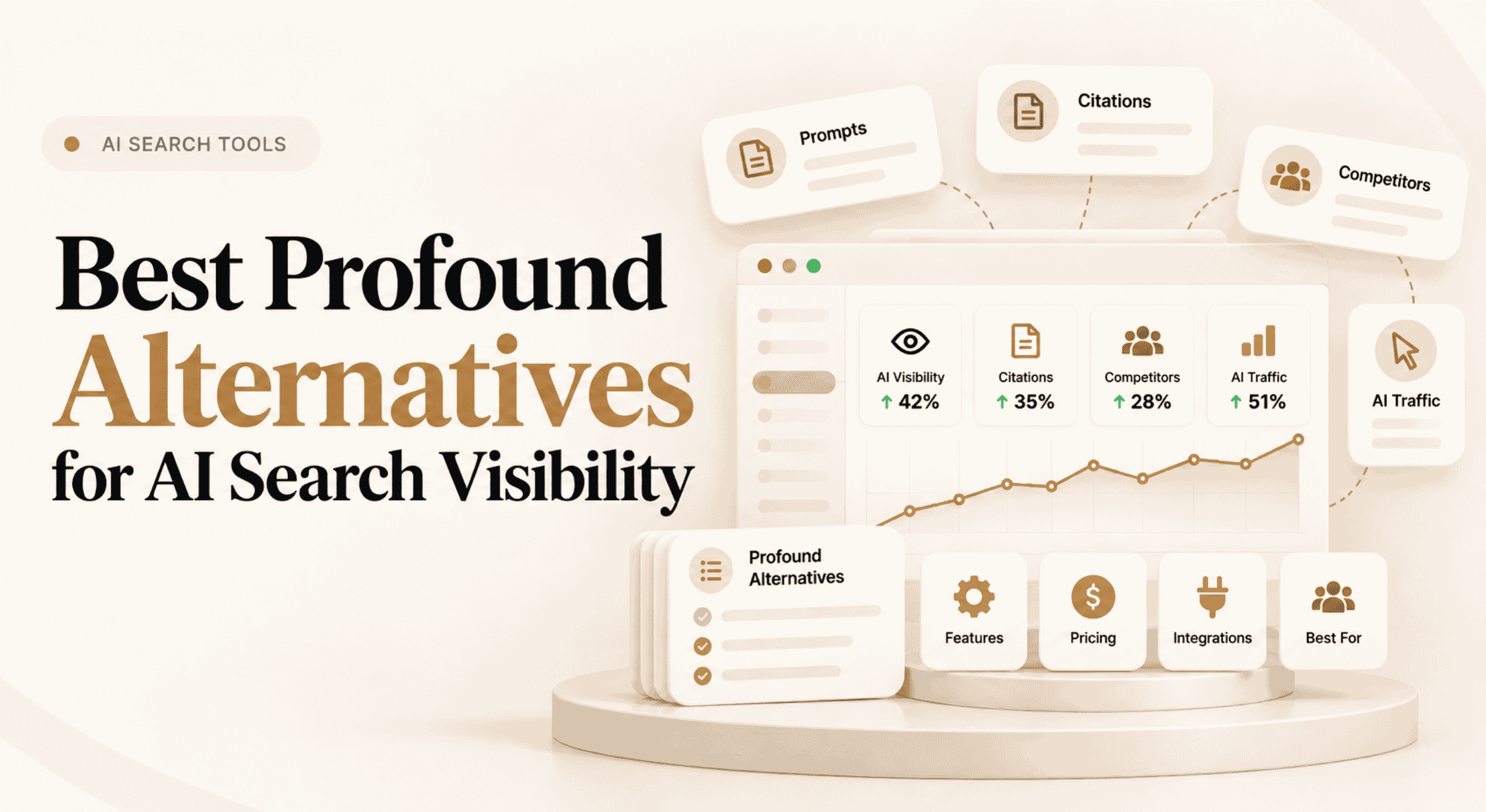
Profound has become one of the recognizable platforms in the growing AI Search visibility category. It helps marketing teams monitor how brands appear across AI-generated answers, analyze prompts and citations, understand competitive visibility, and investigate the sources influencing AI responses.
But the right AI Search platform depends on what your team actually needs. Some organizations prioritize enterprise-scale monitoring and reporting. Others need an open-source platform, more flexible deployment, simpler workflows, agency-friendly operations, traditional SEO integrations, or a clearer path from AI visibility data to optimization and action.
This guide compares the best Profound alternatives for different AI Search, AEO, GEO, and brand visibility use cases.
The best Profound alternative depends on why you are looking for an alternative. Ansvisor is a strong option for teams that want open-source AI Search Intelligence and workflows that connect analytics with opportunities and actions. Other platforms may be better suited to lightweight AI visibility monitoring, traditional SEO workflows, enterprise marketing suites, or specific reporting needs. The right choice should be based on AI platform coverage, prompt tracking, citations, competitor intelligence, AI traffic, workflow depth, deployment flexibility, and budget.
Profound is an AI Search and AEO platform designed to help marketing teams understand how brands appear across AI-powered search and answer engines.
Its platform covers areas such as AI visibility monitoring, prompt intelligence, citations, competitive positioning, AI crawler analytics, content workflows, and AI Search optimization. This makes Profound particularly relevant to organizations that want a dedicated platform for measuring and managing their presence across AI-generated discovery.
Profound can monitor consumer-facing AI experiences including ChatGPT, Perplexity, Claude, Gemini, Microsoft Copilot, Google AI Overviews, Google AI Mode, Grok, and DeepSeek, with exact coverage depending on plan and configuration.
Looking for an alternative does not necessarily mean Profound is the wrong platform. Different AI Search tools are designed around different priorities.
A team may want an alternative because it needs open-source infrastructure, self-hosting, a different pricing model, stronger connections between insights and execution, a broader SEO stack, simpler monitoring, agency workflows, or a different combination of AI Search capabilities.
AI Search tools should not be compared using a single visibility score. We evaluated the alternatives around the broader workflow required to understand and improve visibility across answer engines and generative AI experiences.
Whether the platform monitors relevant AI search and answer experiences such as ChatGPT, Gemini, Claude, Perplexity, Google AI Overviews, and AI Mode.
How teams discover, organize, monitor, and analyze the questions and prompts shaping customer discovery.
Whether teams can understand when brands appear, how frequently they appear, and how visibility changes over time.
Whether the platform identifies cited domains, exact URLs, source patterns, and citation opportunities within AI-generated answers.
How effectively teams can compare AI visibility, mentions, citations, sources, and prompt performance with competing brands.
Whether visibility data can be connected with identifiable visits and downstream website activity from AI platforms.
Whether the product stops at reporting or helps teams identify opportunities, prioritize improvements, and determine what to do next.
Deployment options, APIs, integrations, extensibility, open-source availability, and the ability to fit the platform into existing workflows.
Whether the platform fits enterprises, agencies, SaaS companies, e-commerce teams, startups, developers, or cross-functional marketing organizations.
There is no single alternative that is best for every organization. The following platforms approach AI Search visibility from different directions, ranging from dedicated AI intelligence and monitoring to broader SEO and marketing suites.
Best for open-source AI Search Intelligence and action-oriented workflows
Ansvisor is an open-source AI Search Intelligence Platform designed to help organizations measure, understand, and improve how their brands appear across AI-powered search and answer engines.
Its approach extends beyond monitoring dashboards through a broader workflow: Analytics → Opportunities → Actions. Teams can investigate what is happening across AI answers, identify why visibility gaps exist, discover opportunities, and turn those insights into work that can improve AI Search performance.
Ansvisor vs Profound: Profound is particularly strong for organizations focused on enterprise AI visibility monitoring and reporting. Ansvisor is positioned around a broader AI Search Intelligence workflow that connects measurement with opportunity discovery and action, while also offering open-source and self-hosting flexibility.
Best for focused AI Search visibility monitoring
Peec AI is focused specifically on AI Search analytics. It helps teams monitor how brands appear across AI-generated answers, compare visibility with competitors, and understand the sources influencing their presence.
Its focused product experience can make it attractive to teams that want dedicated AI visibility monitoring without adopting a broader traditional SEO platform.
Peec AI vs Profound: Both focus specifically on AI Search visibility. Peec AI may appeal to teams looking for a more focused monitoring experience, while Profound has developed a broader enterprise-oriented product suite around AI visibility, prompt intelligence, crawler analytics, content, and optimization workflows.
Best for combining AI visibility with a broader SEO and marketing stack
Semrush approaches AI Search from within a much broader digital marketing ecosystem. For teams already managing keyword research, competitive analysis, backlinks, technical SEO, content, and reporting in one environment, adding AI visibility capabilities can reduce the number of separate tools required.
This makes Semrush fundamentally different from Profound. Profound was built around AI Search visibility, while Semrush extends an established SEO and marketing platform into the AI Search category.
Semrush vs Profound: Choose between them based on scope. Profound is specialized around AI Search visibility, while Semrush is relevant when AI Search is one component of a much broader SEO and digital marketing workflow.
Best for SEO research and competitive intelligence with AI visibility context
Ahrefs is primarily known for SEO research, backlink intelligence, keyword analysis, content research, and competitive search data. Its expansion into AI Search makes it relevant to organizations that want to evaluate emerging AI visibility alongside a mature traditional SEO dataset.
Teams whose workflows remain heavily centered on SEO may prefer this integrated approach rather than adopting an AI Search-only platform as their primary research environment.
Ahrefs vs Profound: Ahrefs is the more natural fit when traditional SEO research remains central to the workflow. Profound is more specialized around measuring and managing visibility inside AI-generated search and answer experiences.
Best for straightforward AI Search monitoring
Otterly.AI is a dedicated AI Search monitoring platform built around tracking how brands and websites appear across AI-generated answers. Its focused approach can be useful for marketing and SEO teams that primarily want visibility monitoring rather than a larger enterprise AI Search stack.
The platform helps teams monitor prompts and analyze brand presence, cited links, and visibility changes across supported AI Search experiences.
Otterly.AI vs Profound: Otterly.AI may be a better fit for teams looking for a focused AI Search monitoring workflow. Profound is positioned toward a broader AI Search intelligence and enterprise workflow that includes additional analysis, optimization, and operational capabilities.
Best for GEO-focused optimization workflows
AthenaHQ is positioned around Generative Engine Optimization and helping brands understand and improve their presence across AI-powered discovery experiences.
This makes it relevant for organizations evaluating Profound primarily because they want a dedicated GEO platform rather than an extension of a traditional SEO suite.
AthenaHQ vs Profound: Both address the emerging AI Search optimization category. AthenaHQ places explicit emphasis on GEO workflows, while Profound offers a broader AI Search platform spanning visibility, prompt intelligence, crawler analytics, content, and enterprise use cases.
The biggest difference between these platforms is not whether they can display an AI visibility metric. The more important distinction is the workflow each product is designed to support.
Start with the problem you are trying to solve rather than comparing tools feature by feature. AI Search platforms increasingly share terminology such as visibility, citations, prompts, competitors, and GEO, but the depth and purpose of those capabilities can differ substantially.
If the primary goal is to see whether your brand appears across a defined set of prompts, a focused monitoring product may be enough.
If you also need to understand why visibility changes, discover opportunities, analyze competitors and citations, connect performance with traffic, and determine what should happen next, look beyond basic monitoring.
A more complete AI Search Intelligence workflow should also help answer why it happened, where the opportunity is, and what action should come next.
Platform count alone is not a useful buying criterion. Start with the AI experiences your customers actually use and confirm that the product supports the markets, languages, models, locations, and monitoring workflows relevant to your business.
For many teams, this can include ChatGPT, Gemini, Claude, Perplexity, Google AI Overviews, Google AI Mode, and Microsoft Copilot. Coverage can change over time and may differ by provider or plan.
A summary score can make reporting easier, but it should not become the entire AI Search strategy.
Teams should be able to investigate the underlying signals: which prompts trigger visibility, which competitors appear, whether the brand is mentioned or cited, which domains and URLs influence answers, and how those patterns change over time.
Knowing that a competitor appears in an AI answer is useful. Knowing which sources are associated with that visibility can be much more actionable.
Look for the ability to investigate cited domains, exact URLs, recurring sources, competitor citation patterns, and gaps where authoritative sources are influencing the answer but your brand is absent.
Visibility is an intermediate metric. Ultimately, organizations need to understand whether AI-powered discovery contributes to website visits, signups, leads, purchases, or other meaningful business outcomes where those journeys can be measured.
Ansvisor's AI Traffic Analytics helps teams analyze identifiable AI-referred visits alongside broader AI Search intelligence.
Deployment and transparency can become important selection criteria for technical teams, agencies, enterprises, and organizations with specific infrastructure or data requirements.
Ansvisor is available as an open-source project under the MIT license and can be self-hosted, while its managed cloud product provides an alternative for teams that do not want to operate the infrastructure themselves.
The project is available on GitHub.
One of the most important questions is what happens after a dashboard identifies a problem.
If visibility falls, a competitor begins appearing more frequently, an important source is missing, or a new prompt opportunity emerges, the platform should help teams understand the next step rather than leaving the insight isolated in a report.
A strong fit when open-source availability, self-hosting, extensibility, and AI Search Intelligence are important requirements.
Relevant for teams looking for a focused product centered on AI Search visibility and competitive monitoring.
Relevant when AI visibility needs to live alongside a broad set of established SEO and digital marketing workflows.
A natural option for SEO-led teams that value backlink, content, keyword, and competitor intelligence alongside emerging AI Search data.
Relevant for teams primarily seeking straightforward AI Search monitoring rather than a larger intelligence stack.
Relevant for organizations specifically prioritizing Generative Engine Optimization and AI Search optimization workflows.
Profound and Ansvisor both operate in the AI Search category, but their positioning and product philosophy are different.
Profound is designed around enterprise AI Search visibility and optimization. Ansvisor is designed as an AI Search Intelligence Platform that connects measurement with opportunity discovery and action while also providing an open-source foundation.
The better choice depends on the organization's requirements. Teams should evaluate both products directly based on current platform coverage, workflow requirements, deployment, integrations, reporting needs, and pricing.
Profound alternatives include Ansvisor, Peec AI, Semrush, Ahrefs, Otterly.AI, and AthenaHQ. The best option depends on whether your priority is AI Search Intelligence, focused AI monitoring, traditional SEO integration, GEO workflows, open-source deployment, or enterprise requirements.
Ansvisor is an open-source AI Search Intelligence Platform available under the MIT license. Teams can self-host the open-source project or use Ansvisor Cloud, making it relevant to organizations that consider source-code access and deployment flexibility important.
Ansvisor is designed specifically as an AI Search Intelligence Platform, combining visibility, prompts, citations, competitors, AI traffic, content intelligence, opportunities, and actions. The best product still depends on the organization's specific requirements and workflows.
Semrush and Ahrefs are particularly relevant when established SEO research and workflows are a major requirement alongside AI Search capabilities. Dedicated AI Search platforms such as Ansvisor can also be used alongside an existing SEO stack rather than replacing it.
Profound is primarily positioned around AI Search, AEO, and generative discovery rather than as a traditional all-in-one SEO suite. Its use cases center on understanding and improving brand presence across AI-generated search and answer experiences.
Profound operates across the broader AI Search optimization category and is relevant to both AEO and GEO workflows. These terms overlap substantially in practice, so it is more useful to evaluate the actual visibility, prompt, citation, competitor, content, and optimization capabilities than to assign the platform to only one acronym.
Not necessarily. AI Search Intelligence and traditional SEO solve overlapping but different measurement problems. Many teams can use a dedicated AI Search platform alongside existing SEO tools for keyword research, technical SEO, backlinks, rankings, and organic search performance.
Evaluate AI platform coverage, prompt intelligence, brand mentions, citations, cited URLs, competitor tracking, source analysis, AI traffic, historical data, integrations, deployment options, reporting, workflow depth, actionability, and total cost based on your use case.
Profound is one of the platforms helping define the emerging AI Search software category. The reason to consider an alternative is not that every team needs the same product with a different interface. It is that organizations have different requirements for monitoring, intelligence, optimization, deployment, SEO integration, workflow depth, and execution.
Teams that primarily need straightforward visibility monitoring may prefer a focused product. SEO-led organizations may favor platforms that combine traditional search data with newer AI visibility capabilities. Enterprise teams may prioritize scale, governance, and reporting. Technical organizations may care more about open-source access and self-hosting.
And teams that want to move beyond reporting should evaluate what happens after an opportunity is discovered.
Ansvisor brings prompts, visibility, citations, competitors, AI traffic, content intelligence, and other AI Search signals into one intelligence layer designed to help teams understand what is happening, identify opportunities, and decide what to do next.


Co-founder at Ansvisor
Cihan Geyik is the co-founder of Ansvisor, an open-source, cloud-ready AI Visibility platform for AI Search. With more than 15 years of experience in digital marketing and growth, he writes about AI visibility, AI search, AEO, GEO, citations, and answer engines. He focuses on helping brands understand and improve their presence across ChatGPT, Gemini, Perplexity, Google AI Overviews, and other AI-powered discovery platforms.



© 2026 Ansvisor. All rights reserved. Ansvisor is an open-source AI Search Intelligence Platform for AI Visibility.


.svg)