
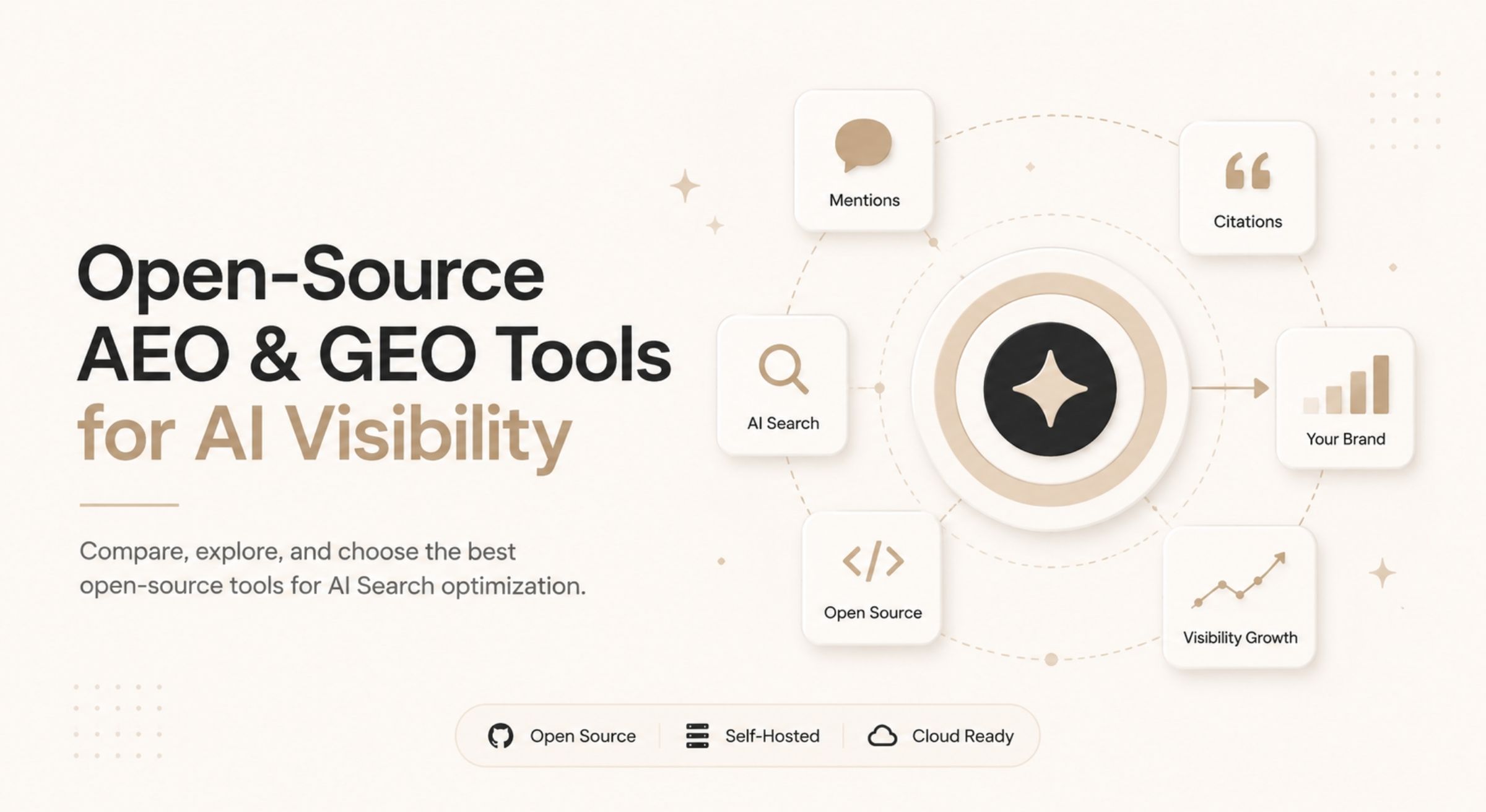
Open-source AEO and GEO tools give teams a transparent way to understand, measure, and improve how their brands appear in AI-generated answers. Depending on the project, they can help with prompt monitoring, citation tracking, technical audits, AI crawler readiness, competitor analysis, structured data, and continuous AI Visibility measurement.
If you want to explore an open-source platform without setting up infrastructure first, you can explore Ansvisor and start with a 14-day free cloud trial.
Answer Engine Optimization is quickly becoming an operational discipline rather than a single SEO tactic. Marketing, SEO, content, growth, brand, and engineering teams increasingly need to understand not only whether a page ranks in traditional search, but whether a company is mentioned, cited, compared, or recommended when customers ask questions in ChatGPT, Gemini, Claude, Perplexity, Google AI Overviews, Google AI Mode, Microsoft Copilot, and other AI-powered discovery systems.
That has created a new category of software around Answer Engine Optimization (AEO), Generative Engine Optimization (GEO), AI Search optimization, and AI Visibility.
Many of the best-known platforms in this category are commercial SaaS products. But there is also a growing ecosystem of open-source AEO platforms, self-hosted AI Visibility tools, technical AEO utilities, GitHub repositories, and developer-first GEO projects.
This guide compares those approaches and explains when open-source AEO software makes sense, how it differs from enterprise platforms, what developers should evaluate before choosing a repository, and how to build a practical open-source AEO strategy for your website.
Open-source AEO and GEO tools are software projects whose source code can be inspected, modified, extended, and—in many cases—self-hosted by the user.
They are designed to support one or more parts of the AI Search optimization workflow, including:
The important distinction is that open source describes how the software is made and distributed—not necessarily how it is deployed.
An open-source AEO platform can be entirely self-hosted, entirely developer-operated, or offered in parallel as a managed cloud product.
AEO is still an evolving field. Terms, measurement methodologies, AI platforms, crawler behavior, citation formats, and answer-generation systems continue to change.
In that environment, transparency matters.
If a platform tells you that your AI Visibility Score is 63%, that your brand has gained visibility, or that one prompt represents a major opportunity, you should ideally be able to understand how those conclusions were reached.
Open-source AEO software can make that easier because developers and technical teams can inspect the implementation instead of relying entirely on a closed scoring system.
Open-source projects make it possible to inspect code, methodologies, schemas, integrations, data models, issue discussions, and implementation decisions.
This is especially valuable for AI Visibility because there is currently no universal industry standard for every metric used across AEO and GEO platforms.
Organizations with stricter infrastructure, security, or data requirements may prefer to host an AEO platform inside their own environment.
Self-hosting can provide more control over databases, API keys, prompt libraries, historical AI responses, integrations, and internal workflows.
Open-source software can be adapted to workflows that a SaaS vendor may never prioritize.
Developers can build integrations, modify workflows, connect internal data sources, add new reporting layers, create agents, or contribute improvements back to the project.
With proprietary software, the vendor controls which features are built and when they are released.
Open-source communities create another path. Teams can submit issues, propose improvements, build missing integrations, contribute pull requests, or fork the project when their requirements are highly specific.
AI Search changes too quickly for every useful idea to come from one internal product team.
Community contributors can identify new use cases, surface bugs, improve documentation, add integrations, challenge methodologies, and accelerate product development.
Ansvisor follows this model directly. More than 50 GitHub contributors have contributed to the platform's development, and developers can continue participating by completing existing issues, opening new issues, submitting pull requests, suggesting improvements, and sharing feedback.
The choice between an open-source AEO platform and enterprise AEO software is not simply a choice between free and paid software.
The more useful comparison is between control, transparency, operational effort, customization, support, and deployment model.
| Area | Open-Source AEO Software | Traditional Enterprise AEO Software |
|---|---|---|
| Source code | Inspectable and extensible | Usually proprietary |
| Deployment | Can support self-hosting, cloud, or both | Usually vendor-hosted SaaS |
| Methodology transparency | Can be inspected directly in the implementation | Depends on vendor disclosure |
| Customization | Potentially extensive | Usually limited to supported configurations |
| Infrastructure work | Higher when self-hosted | Usually handled by vendor |
| Product roadmap | Community and maintainers can both contribute | Controlled by vendor |
| Support | Community, documentation, or commercial support depending on project | Usually included according to plan |
| Vendor lock-in | Generally lower | Can be higher |
There is also a third model that combines both approaches: open-source software with a managed cloud deployment.
This is the model Ansvisor uses. Developers can inspect, extend, contribute to, and self-host the platform, while marketing and growth teams can use the managed cloud product without maintaining crawlers, schedulers, databases, infrastructure, and reporting pipelines themselves.
There is no single best open-source AEO tool for every workflow.
Some repositories focus on continuous AI Visibility monitoring, while others are technical audit tools, local-first trackers, citation utilities, knowledge bases, or developer automation projects.
The most useful way to compare them is by the problem they solve.
| Project | Best For | Primary Focus | Deployment / Format |
|---|---|---|---|
| Ansvisor | End-to-end AI Visibility | Prompts, citations, competitors, Query Fan-Out, AI traffic, content opportunities, site audits, and actions | Open source + self-hosted + cloud |
| GetCito | AEO/GEO experimentation | AI Visibility tracking and optimization workflows | Open source + self-hosted |
| geo-aeo-tracker | Local-first monitoring | Brand visibility across multiple AI models | Open source + local-first |
| Canonry AEO Audit | Technical AEO auditing | Website checks across technical AEO factors | Open-source developer package |
| GEO Optimizer | AI readiness auditing | Technical GEO and citation-readiness checks | Open-source developer workflow |
| mcp-ai-visibility | MCP-based AI auditing | AI Visibility audit workflows through MCP | Open-source MCP project |
| citation-gap-mcp | Citation gap analysis | Investigating why competitors are cited and websites are missed | Open-source MCP server |
| oneglanse | Self-hosted GEO tracking | Brand monitoring across AI engines | Open source + self-hosted |
| answer-engine/aeo | AEO education and implementation guidance | Community-driven AEO knowledge base | Open-source knowledge project |
| Awesome GEO | Research and ecosystem discovery | GEO research, resources, protocols, and projects | Open-source curated repository |
Ansvisor is an open-source AI Visibility platform designed to help companies understand, measure, and improve how they appear across AI-generated answers.
It differs from many open-source AEO tools because it is not limited to a page audit, citation checker, or developer script. The goal is to connect the full AI Search optimization workflow:
Analytics → Opportunities → Actions → Validation → Learning.
Teams can use Ansvisor to monitor visibility across AI platforms, understand which prompts generate mentions and citations, discover competitor sources, analyze Query Fan-Out behavior, identify content opportunities, connect AI Search data with traditional search data, and prioritize actions based on measurable opportunities.
Developers can clone and self-host Ansvisor from GitHub, inspect the code, extend the platform, and adapt it to their infrastructure.
Teams that prefer a managed experience can instead use Ansvisor Cloud through monthly plans without operating the underlying infrastructure themselves.
New users can explore the cloud product with a 14-day free trial.
Ansvisor is developed in public with contributions from more than 50 GitHub contributors.
You do not need to build a large feature to participate. Contributors can:
This open development model is particularly useful in AI Search, where new answer engines, APIs, crawler behaviors, retrieval patterns, and optimization workflows continue to emerge rapidly.
Best for: Developers, SEO teams, AEO/GEO specialists, content teams, growth teams, agencies, and enterprises that want a transparent and extensible AI Visibility platform without being forced to choose between open source and cloud convenience.
GetCito is an open-source and self-hosted project focused on AI Visibility and optimization across overlapping categories including Answer Engine Optimization, Generative Engine Optimization, and AI Search Optimization.
It is relevant for developers who want to experiment with AI Visibility workflows while retaining control over deployment and implementation.
Compared with a broader operational platform such as Ansvisor, GetCito can be especially useful when the priority is technical experimentation and building or adapting an AEO/GEO workflow directly from an open-source project.
Best for: Developers looking for a self-hosted open-source AEO and GEO project for experimentation and customization.
geo-aeo-tracker represents another useful category in the open-source AEO ecosystem: lightweight and local-first AI Visibility monitoring.
Instead of trying to become a complete enterprise optimization suite, tools in this category are useful for developers and technical marketers who want direct access to the underlying tracking workflow and greater control over how prompts, responses, and visibility data are collected.
This approach can be especially useful for experiments, internal research, prototype dashboards, or teams that want to build their own AI Search intelligence layer around an existing open-source foundation.
Best for: Developers and technical teams looking for a lightweight, local-first starting point for AI Visibility monitoring.
Not every open-source AEO tool needs to monitor thousands of prompts.
Technical audit projects focus on a different question: Is your website structured in a way that makes it easier for search engines and AI systems to access, interpret, retrieve, and reuse your content?
Depending on the project, these tools can help inspect areas such as:
These utilities are useful when your immediate goal is not continuous brand monitoring but improving the technical foundation that supports AEO and GEO.
Best for: Developers, technical SEO teams, and website owners who want an open-source way to audit AI Search readiness.
Model Context Protocol projects are creating another layer of open-source AEO tooling.
Instead of requiring users to work only inside a fixed dashboard, MCP-based projects can expose AI Visibility data and optimization capabilities directly to AI assistants, agents, developer environments, and automated workflows.
For example, an MCP-based workflow could help an agent:
This model is particularly interesting for developers building agentic SEO, AEO, GEO, or content operations.
Ansvisor also supports an MCP-based approach so teams can connect AI Search intelligence with agents and external workflows rather than treating visibility data as something that only lives inside a dashboard.
Citation-focused open-source tools address one of the most important questions in modern AI Search:
Why is another website being cited when yours is not?
A citation gap workflow typically compares the sources appearing in AI-generated answers with the pages, domains, or competitors a company wants to benchmark.
This can reveal opportunities such as:
Citation analysis becomes significantly more useful when it is connected to prompt monitoring rather than performed as a one-time audit.
This is why Ansvisor combines citation monitoring with prompt-level visibility, competitor tracking, and Query Fan-Out analysis.
Best for: SEO, content, AEO, digital PR, and developer teams investigating why specific sources earn visibility in AI-generated answers.
Some open-source projects focus primarily on giving teams a self-hosted environment for monitoring how a brand appears across generative AI platforms.
These projects can be attractive when the core requirement is ownership of the deployment environment rather than a broad enterprise feature set.
For smaller developer teams, this can also provide a useful foundation for building proprietary workflows on top of prompt-response data.
The main trade-off is operational responsibility. Self-hosting means your team may need to manage infrastructure, databases, API credentials, model integrations, scheduling, retries, storage, monitoring, and upgrades.
Best for: Technical teams that prioritize deployment control and are comfortable operating their own AI Visibility infrastructure.
Some of the most useful open-source AEO resources are not software platforms at all.
Community-maintained knowledge bases, implementation repositories, research collections, and curated GitHub lists can help teams understand how Answer Engine Optimization is evolving.
These resources can be especially useful for:
They are not replacements for continuous AI Visibility tracking, but they can be valuable additions to an open-source AEO stack.
Searching for the “best open-source AEO tool” can be misleading because the category includes very different kinds of projects.
Before comparing GitHub stars or feature lists, define the workflow you actually need.
| If You Need... | Look For... |
|---|---|
| Continuous AI Visibility monitoring | Prompt scheduling, historical tracking, mentions, citations, competitors, and reporting |
| Technical AEO auditing | Crawler checks, structured data analysis, page structure, and technical accessibility |
| Developer experimentation | Readable code, modular architecture, documented APIs, and easy local deployment |
| Enterprise deployment | Security controls, scalable infrastructure, permissions, integrations, support, and reporting |
| Agentic workflows | API, MCP, webhooks, external integrations, and automation support |
| Content optimization | Prompt gaps, citation gaps, competitor intelligence, Query Fan-Out, and content recommendations |
| Full deployment control | Self-hosting, open licensing, documented environment configuration, and data ownership |
| Fast marketing-team adoption | A managed cloud option that does not require infrastructure setup |
Open source alone does not make a project useful.
Check recent commits, issue activity, pull requests, documentation quality, release history, contributor participation, and whether maintainers are responding to bugs and feature requests.
Some products publish only a small SDK, connector, or supporting library while keeping the core platform proprietary.
If openness is important to your organization, verify which parts of the product can actually be inspected, modified, and self-hosted.
The repository license determines how you can use, modify, redistribute, or build on the software.
Ansvisor uses the MIT License, making it possible for developers to inspect, modify, and build on the project under the terms of that license.
A self-hosted AEO platform may look inexpensive at first, but infrastructure also has a cost.
Your team may need to operate:
This is one reason hybrid open-source plus cloud models can work well. Developers retain transparency and extensibility while non-technical teams can use a managed environment.
Installing an open-source AEO platform is not the strategy itself.
The software provides infrastructure. The strategy begins with identifying the questions that influence discovery, evaluation, trust, and purchase decisions in your market.
Start with topics rather than hundreds of random prompts.
Examples might include:
Each topic can then be expanded into the actual prompts users are likely to ask AI systems.
AEO monitoring becomes much more useful when prompts represent real commercial or informational intent.
For example, a company selling AI Visibility software might track prompts such as:
The objective is not to win every possible prompt. It is to identify the prompts where visibility could influence business outcomes.
Run your prompt set across the AI platforms that matter to your audience and establish a baseline.
Measure:
Historical tracking is important because an individual AI response is only a snapshot.
A brand mention tells you that an AI system knows or retrieves your brand.
A citation can provide another layer of evidence by showing which page or source contributed to an answer.
Look for patterns:
This turns citation monitoring into a repeatable growth system rather than a vanity metric.
A single AI prompt may trigger multiple supporting searches, retrieval steps, or subqueries before the final answer is generated.
Understanding those supporting queries can reveal content opportunities that are not obvious from the original prompt alone.
For example, a broad prompt about the best AEO platform might fan out into questions about:
By covering the surrounding information need rather than only the exact prompt wording, teams can build stronger topical and citation coverage.
AI Visibility should not be analyzed in isolation.
Traditional search data can help answer a more important question:
Which AI Search opportunities have actual demand or existing business value?
For example, connecting Google Search Console data with AI Visibility can help identify:
Ansvisor is built around this broader intelligence model by connecting traditional search data with AI Search behavior rather than treating them as separate channels.
Once the data is collected, convert it into work.
Typical actions might include:
Optimization should not end when a page is published.
Continue monitoring the target prompts and determine whether the action resulted in improved mentions, citations, coverage, competitive positioning, or AI-referred traffic.
This creates a continuous loop:
Measure → Discover → Prioritize → Act → Validate → Learn.
You do not need to rebuild your entire SEO program to start using open-source AEO tools.
A practical website-level implementation can begin with four layers.
Ensure important pages are crawlable, indexable where appropriate, technically accessible, and not accidentally blocked by robots directives or infrastructure rules.
Use clear headings, direct definitions, structured sections, descriptive titles, supporting evidence, useful internal links, and relevant structured data where appropriate.
Do not create content only around short keywords.
AI Search users often ask longer questions containing comparisons, constraints, context, and specific requirements.
Your content should answer those questions clearly while also covering the supporting concepts AI systems may retrieve during Query Fan-Out.
Publishing content is not evidence of visibility.
Track whether the brand appears, which pages are cited, which prompts produce visibility, and whether changes persist across repeated monitoring runs.
Yes. Open-source software is not limited to hobby projects or small development teams.
For enterprise organizations, open source can offer important advantages around transparency, extensibility, deployment control, internal integration, and data ownership.
But enterprise adoption also introduces additional requirements:
This is where a managed open-source model can become valuable.
Teams that want full infrastructure control can self-host Ansvisor, while organizations that prefer faster deployment can use the managed cloud version.
Self-hosting and cloud deployment solve different problems.
| Self-Hosted | Managed Cloud | |
|---|---|---|
| Setup | Your team installs and configures the environment | Ready to use |
| Infrastructure | Managed internally | Managed by provider |
| Customization | Maximum flexibility | Product-supported customization |
| Code access | Available when project is open source | Depends on underlying product |
| Maintenance | Your responsibility | Provider responsibility |
| Time to value | Depends on implementation | Usually faster |
| Best for | Engineering-led teams requiring control | Marketing, SEO, growth, and cross-functional teams that want fast adoption |
Ansvisor supports both approaches.
You can self-host the open-source platform or start immediately with Ansvisor Cloud.
You do not need to configure infrastructure before seeing how the platform works.
Start with Ansvisor Cloud and explore prompt monitoring, citations, competitors, Query Fan-Out, AI Search insights, and optimization workflows with a 14-day free trial.
One of the biggest advantages of open-source Answer Engine Optimization software is that users do not have to remain passive customers.
If a feature is missing, an integration could be improved, or you discover a new AI Search use case, you can participate directly in development.
Ansvisor is being developed with contributions from 50+ GitHub contributors.
There are several ways to participate:
You can explore the repository, issues, and project activity on Ansvisor GitHub.
Accessibility in AEO is not only about technical website accessibility. It is also about who can access the technology required to understand AI Search.
Closed enterprise platforms can create barriers for developers, startups, SMBs, agencies, researchers, and teams that want to experiment before committing to a large software contract.
Open-source AEO software can lower those barriers by giving teams access to:
Managed cloud deployment can lower another barrier: infrastructure complexity.
Combining open source with cloud availability allows technical teams to retain control while giving marketing teams a much easier path to adoption.
An open-source AEO tool is software whose source code can be inspected and, depending on its license, modified or self-hosted. These tools help teams improve visibility in AI-generated answers through workflows such as prompt monitoring, citation analysis, technical auditing, competitor tracking, AI Search analytics, and content optimization.
The best platform depends on the workflow. Ansvisor is designed for end-to-end AI Visibility monitoring and optimization, while other open-source projects may focus primarily on technical audits, local-first tracking, citation analysis, MCP workflows, research collections, or developer experimentation.
Answer Engine Optimization focuses on improving how content and brands are surfaced in systems that directly answer user questions. Generative Engine Optimization focuses specifically on visibility within generative AI responses. In practice, the terms overlap significantly, and many modern AI Search platforms support workflows relevant to both.
Yes. Open-source AEO tools can be used to audit website accessibility, monitor prompts, track brand mentions and citations, analyze competitors, identify content opportunities, and measure whether website changes improve visibility across AI-generated answers over time.
Yes. Ansvisor is open source and self-hostable, giving developers the ability to inspect the code, operate their own environment, modify the platform, and integrate it with internal workflows.
Yes. Teams that do not want to manage the infrastructure themselves can use Ansvisor Cloud through monthly plans. New users can explore the cloud platform with a 14-day free trial before deciding which deployment model best fits their needs.
It can be. Enterprise teams often value the transparency, extensibility, data control, and deployment flexibility of open-source software. They should also evaluate security, scalability, maintenance, permissions, integrations, reporting, support, and the operational cost of running a self-hosted environment.
Developers should evaluate the license, architecture, documentation, deployment process, API support, code quality, issue activity, contributor activity, integrations, historical tracking capabilities, and whether the project is actively maintained. The best choice should match the workflow rather than simply having the most features.
Yes. Developers can contribute by completing existing issues, opening new issues, submitting pull requests, reporting bugs, improving documentation, proposing integrations, and sharing product or technical feedback with the community.
More than 50 GitHub contributors have participated in the development of Ansvisor. The project is built openly, allowing developers and users to inspect the code, follow development, suggest improvements, and directly contribute to the platform.
Choose self-hosting when infrastructure control, customization, or internal deployment requirements are the priority. Choose managed cloud when faster deployment and lower operational overhead matter more. With Ansvisor, teams can choose either approach instead of being locked into one deployment model.
AI Search is creating a new layer between traditional search and the customer.
Brands increasingly need to understand what happens between a user's prompt and the recommendation, citation, comparison, or answer that an AI system ultimately produces.
Open-source AEO and GEO software gives teams another way to build that capability without relying entirely on closed methodologies and proprietary infrastructure.
The right tool depends on what you need. A developer may only need a technical auditing library. A researcher may need a local-first tracker. A content team may need citation intelligence. An enterprise may need a complete platform connecting AI Visibility with search, business data, collaboration, and actions.
Ansvisor is designed for teams that want that broader workflow while keeping the technology open.
You can inspect the code, self-host the platform, contribute through GitHub, open issues, submit improvements, or use the managed cloud version without maintaining the infrastructure yourself.
Want to explore the product first?
Use Ansvisor Cloud and try the platform free for 14 days.
Want full control?
Explore the open-source repository and self-host Ansvisor.
Want to help build the open future of AI Visibility?
Pick an issue, open a new one, submit a pull request, or share your feedback with the community.
Need help deciding how Ansvisor fits your organization?
Contact our team and tell us what you are trying to build.


Co-founder at Ansvisor
Cihan Geyik is the co-founder of Ansvisor, an open-source, cloud-ready AI Visibility platform for AI Search. With more than 15 years of experience in digital marketing and growth, he writes about AI visibility, AI search, AEO, GEO, citations, and answer engines. He focuses on helping brands understand and improve their presence across ChatGPT, Gemini, Perplexity, Google AI Overviews, and other AI-powered discovery platforms.



© 2026 Ansvisor. All rights reserved. Ansvisor is an open-source AI Search Intelligence Platform for AI Visibility.


.svg)