


GEO for CMOs: Business Case, Budget, KPIs and 90-Day Plan





Your organic traffic report can look flat and healthy while buyers build their vendor shortlist inside an AI answer you never see.
Fixing that takes an owner, a budget and numbers the board will accept. Here’s how to make the case, staff the work and run the first 90 days. For the basics, start with our complete guide to generative engine optimization.
Key takeaways
- Pew Research found users clicked a search result in 8% of visits with an AI summary, versus 15% without one.
- Bain found about 80% of consumers rely on zero-click results in at least 40% of their searches.
- Fund the first GEO pilot from work you already pay for, plus a tracking tool.
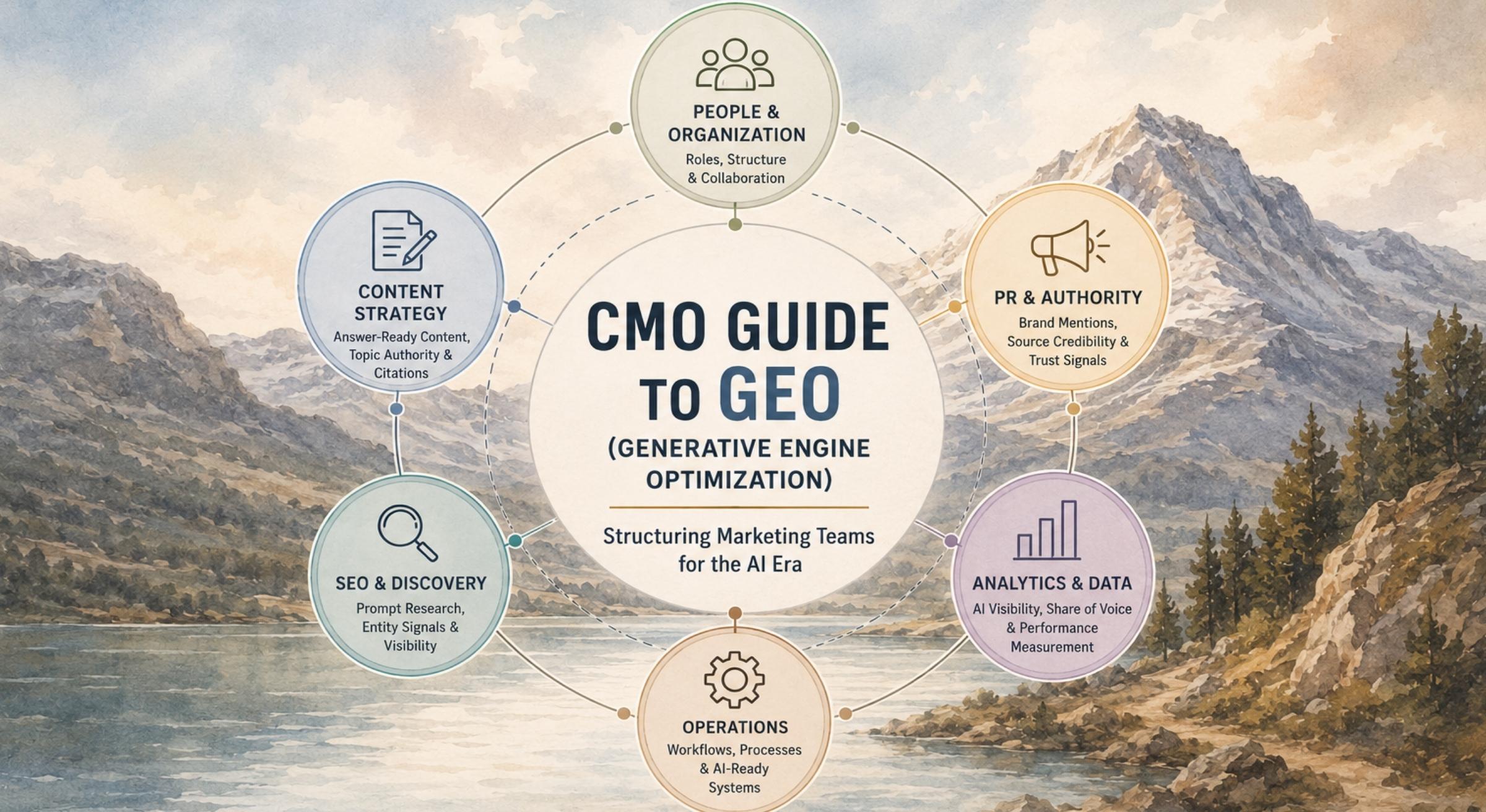
- Give GEO one accountable owner and a monthly review, with actions spread across five or six teams.
- Report AI share of voice, high-intent prompt coverage and AI-referred pipeline to the board.
- In our own data, ChatGPT sent 87% of our AI-referred visits. A brand’s most visible engine isn’t always the one that sends traffic.
Why is GEO a priority for CMOs?
GEO belongs on the CMO agenda because it shapes demand before that demand shows up in your analytics. It also cuts across SEO, content, PR and product marketing, so no single team owns it by default.
The audience is large. ChatGPT reached about 10% of the world’s adult population by July 2025, according to an NBER working paper on how people use ChatGPT.
The same paper found that practical guidance, seeking information and writing make up nearly 80% of conversations. Many of those questions are ones your marketing used to answer.
The risk: zero visibility is the new page two
Clicks fall where AI answers appear.
A Pew Research Center analysis found users clicked a result in 8% of visits with an AI summary, versus 15% without one.
Bain and Company found about 80% of consumers rely on zero-click results in at least 40% of their searches. Bain estimates this reduces organic web traffic by 15% to 25%.
A brand that ranks well on Google can still be missing from the AI answer. Nothing in a rank report will tell you.
The opportunity: being the named answer
AI answers usually name only a handful of brands. Each mention reaches a buyer at the moment of choice, with an implied endorsement attached.
GEO also builds on work you already fund. Google’s guide to its generative AI features says they rely on core Search ranking and quality systems, so strong SEO still counts.
If your team asks how GEO differs from SEO and AEO, share our comparison of AEO vs SEO vs GEO.
How to build the business case for GEO
A credible business case answers three questions with your own data. Industry averages won’t persuade the people who sign budgets.
How much demand flows through AI answers? Estimate prompt volumes for your category and check AI referral sessions in your analytics.
How visible are we today? Measure mention rate, citation rate and share of voice on 50 to 100 buyer prompts.
What is a gap worth? Map missing high-intent prompts to the pipeline value of the deals they influence.
Show the gap against named competitors. A line such as "we appear in 12% of comparison prompts and our main rival in 60%" moves a budget talk faster than a trend chart.
How to budget for generative engine optimization
There is no standard GEO budget. Be wary of anyone who quotes one before they’ve seen your category and your competitors.
Plan the spend in three buckets.
| Budget bucket | What it pays for |
|---|---|
| Measurement | A tool that tracks your prompts and competitors on every platform, plus the analytics setup. |
| Content capacity | Writer and subject-expert time to refresh priority pages and publish the missing comparisons and evidence. |
| Authority | Digital PR, review profiles, community work and partner content on the sites AI engines cite. |
Much of this can come from pointing existing SEO, content and PR plans at the prompts that matter. Fund a 90-day pilot first, then scale what moves the numbers.
Who should be on the GEO team?
You won’t need a new department for GEO. One accountable owner is enough, as long as the existing teams know their part.
The owner, often the SEO lead and sometimes someone in growth or content, runs the prompt set, weekly tracking and the monthly review.
Content refreshes pages, adds evidence and fills gaps in comparison and how-to content.
PR and communications earn coverage on the publications and review sites that AI answers cite.
Product marketing keeps positioning and product facts consistent everywhere.
Analytics tracks AI referral traffic and ties it to conversions and pipeline.
Web and engineering keep pages crawlable and fast, with the main content in the HTML.
Our GEO best practices for marketing teams describe each team’s weekly routine in more detail.
Which GEO KPIs should CMOs track?
Split GEO metrics into a board view and a team view. The board wants a few numbers tied to revenue. Your team needs diagnostics.
Board-level GEO KPIs
AI share of voice: your mentions as a share of all mentions for you and named competitors.
High-intent prompt coverage: the share of comparison and "best tool" prompts where you appear.
AI-referred pipeline: sessions, sign-ups and opportunities that start on AI platforms.
Answer accuracy: the share of answers that describe your product correctly.
Team-level GEO metrics
- Mention rate and citation rate by platform
- Top cited URLs, plus citations gained and lost
- Third-party domains cited for your priority prompts
- Sentiment and positioning in answers that name you
For Google, Search Console now has generative AI performance reports, available to all sites since August 31, 2026. They show page impressions in AI Overviews and AI Mode. Queries and clicks aren’t included, and neither are competitors.
Our glossary explains how to calculate AI share of voice and which GEO metrics sit behind it.
What our data shows: visibility and traffic differ by platform
Ansvisor, an open-source AI search intelligence platform, tracks prompts about AI search for its own brand. The figures below are Ansvisor tracking data, September 15 to October 14, 2026. That dataset holds 103,427 AI answers and 746,702 citations.
Visibility
In our tracking data, a brand’s share of voice can differ several-fold between AI engines in the same month.
Traffic
ChatGPT sent 87% of our AI-referred visits in the same period.
The engine where a brand is most visible isn’t always the one sending visits. We also got Claude visits, although Claude was not part of this tracking dataset. A platform can matter before it shows up in your reports.
Claude tracking is available on Enterprise plans.
For a CMO, that changes the order of work. Rank platforms by buyer usage and referral traffic first, then fix visibility where the two overlap.
A 90-day GEO plan for marketing leaders
Copy this plan and adjust the prompt count and competitor list to your category.
Days 1 to 30: baseline and ownership
- Name one owner and fix a monthly review date.
- Choose 50 to 100 prompts across awareness, comparison and purchase intent.
- Pick five competitors to benchmark and the AI platforms your buyers use.
- Record mentions, citations, share of voice and answer accuracy for every prompt.
- Set up AI referral segments and sign-up events in analytics before you change anything.
Days 31 to 60: fix and publish
- Fix technical blockers on priority pages, such as blocked AI search crawlers or text hidden in scripts.
- Refresh the ten pages closest to winning citations. Give each one a direct answer, named sources and current data.
- Where competitors win, publish the pages you’re missing, such as comparisons, use cases or pricing explainers.
- Correct wrong product facts on your site and on review and directory profiles.
Days 61 to 90: authority and review
- Pitch original data or expert commentary to the publications cited for your prompts.
- Update review profiles and take part in communities where buyers ask questions.
- Re-run the full prompt set and compare every KPI with the day-30 baseline.
- Keep what moved the numbers, stop what didn’t, and set next quarter’s priorities.
For page-level methods your team can apply in days 31 to 60, see our GEO techniques backed by research.
Questions for your monthly GEO review
Which high-intent prompts did we win or lose this month, and why?
Which competitor gained the most share of voice, and on which platform?
Which of our URLs gained or lost citations?
Do AI answers describe our product accurately and with current facts?
What did AI-referred visitors do on the site, and did they convert?
Which three actions will we ship before the next review?
What GEO cannot promise
Be careful with vendors or agencies that guarantee AI rankings. Google’s guide says no third-party tool has access to its internal ranking or AI systems.
AI answers also vary by session, location and model version. Set targets as rates across many prompts, such as share of voice. A fixed position in one answer isn’t a target anyone can hold.
How Ansvisor helps CMOs run GEO
Ansvisor tracks your prompt set across ChatGPT, Google AI Overviews, Google AI Mode, Gemini, Copilot and Perplexity. Answer engine insights report share of voice, mentions, citations and sentiment against competitors.
Competitor benchmarking shows who gains ground and where. AI traffic analytics connects AI-referred visits to landing pages and outcomes.
FAQ
Why should CMOs care about generative engine optimization?
Buyers ask AI assistants to explain categories and compare vendors, and shortlists often form there. If your brand is not named in those answers, competitors shape the first impression. GEO is how marketing leaders measure and improve that presence.
How much budget does a GEO program need?
There is no standard figure. Most teams can start by redirecting part of existing SEO, content and PR work and adding a tracking tool. Fund a 90-day pilot on a fixed prompt set, then scale based on measured changes in share of voice and AI-referred pipeline.
Which GEO KPIs should a CMO report to the board?
Report AI share of voice against named competitors, coverage of high-intent prompts, and AI-referred sessions and conversions. Add answer accuracy for your brand. Keep mention and citation rates as working metrics for the team.
Who should own GEO in a marketing team?
One accountable owner, usually in SEO, growth or content, should run the prompt set and the monthly review. Content, PR, product marketing, analytics and web teams own their parts of the work. The CMO sets priorities and removes blockers.
How long before GEO shows results?
Plan for a baseline in the first two weeks and a first full read on changes after about 90 days. Improved pages can be picked up once AI search tools recrawl them, while share of voice and pipeline effects build more slowly.


Cihan Geyik
Co-founder at Ansvisor
Cihan Geyik is the co-founder of Ansvisor, an open-source, cloud-ready AI Visibility platform for AI Search. With more than 15 years of experience in digital marketing and growth, he writes about AI visibility, AI search, AEO, GEO, citations, and answer engines. He focuses on helping brands understand and improve their presence across ChatGPT, Gemini, Perplexity, Google AI Overviews, and other AI-powered discovery platforms.


Get more Ansvisor insights in Google
Add Ansvisor as a Preferred Source to see more of our AI Search, AEO, GEO, and AI Visibility insights across Google.
Make Your Brand Visible in AI Answers.

INDUSTRIES


© 2026 Ansvisor. All rights reserved. Ansvisor is an open-source AI Search Intelligence Platform for AI Visibility. Ansvisor is a brand owned and operated by Empler AI Inc.