Ask Perplexity or Google AI Mode a buying question and the answer comes back dotted with numbered markers, link chips or source cards. Each of those is an AI citation: a pointer from generated text to a page the engine relied on. Mentions, sentiment and rankings are all inferred from prose. A citation is a URL, so it’s the part of AI visibility you can trace, count and fix.
A citation credits a page, not a brand. The engine is saying “this URL supports what I just wrote.” Whether your brand is named in the text is a separate question.
What counts as an AI citation?
A citation has three parts: a claim in the answer, a marker or link attached to it, and the URL behind that marker. Remove one and you’re looking at something else.
| What appears in the answer | Citation? | Why |
|---|
| A numbered footnote or link chip pointing to your page | Yes | The answer credits your URL for a claim |
| Your page in a source card or source panel | Yes | Listed as a source, even if no single sentence links to it |
| Your brand named, with no link | No | That’s an AI mention |
| “yourdomain.com” written as plain text | No | A domain mention, with nothing to click |
| A link to a syndicated copy of your article | Not for you | The credit goes to the copy’s domain |
| A broken or invented URL on your domain | No | Flag it, because it sends readers to an error page |
Agree on these rules before anyone counts anything, then freeze them. Most disagreements between citation reports come from definitions, not data.
Where do AI citations come from?
Prompt → Search queries → Retrieved pages → Drafted answer → Sources attached
Citations exist only when the engine retrieves something. It turns the prompt into one or more searches, reads the results, drafts an answer and attaches the pages it leaned on. When an engine answers from model memory alone, there’s nothing to cite.
Google says AI Overviews and AI Mode may use query fan-out, running related searches across subtopics before writing. That’s why a page can be cited for a prompt it never targeted. It answered one of the sub-questions.
So eligibility comes first. Google’s documentation on AI features sets a plain bar for supporting links. The page must be indexed and eligible to show with a snippet. OpenAI’s crawler documentation says sites that opt out of OAI-SearchBot won’t be shown in ChatGPT search answers. No index entry, no citation.
Which formats do AI citations take?
Four formats cover most engines. Inline links or chips sit inside a sentence, and numbered footnotes tie claims to a source list. Source cards line up beside the answer, and an expandable panel lists every source used. Layouts differ by engine and change with product updates. How each one displays and orders its sources is covered under source attribution.
For measurement, the format matters less than the fact of being cited. For clicks, it matters a lot. A card at the top of an answer gets seen, while the seventh footnote is easy to miss.
Why do AI citations matter?
- They shape what the answer says. The engine builds its text from the pages it cites, so a competitor’s comparison page as the source means their framing becomes the answer.
- They can be counted. You can see which page earned each citation, on which prompt and platform, and which pages earned none.
- They reveal who defines your category. Many cited pages belong to review sites, forums, video channels and publishers that describe you whether you take part or not.
- They open a click path, though a narrow one. Treat referral visits as a bonus and judge citations on their own terms.
The volume is large and spread out. In Ansvisor tracking data, September 15 to October 14, 2026, 103,427 AI answers carried 746,702 citations to 122,066 distinct URLs. That’s about six citations per URL on average. Averages hide a long tail, so check which of your own URLs carry the load.
AI citations vs AI mentions
A mention is your brand named in the answer text. A citation is your page credited as a source. The two overlap less than most teams expect.
Any answer lands in one of four states: named and cited, named but not cited, cited but not named, or absent. The third one stings. It happens with how-to content, where the engine uses your explanation and then recommends a competitor. Track AI mentions next to citations so neither hides the other.
Are AI citations the same as backlinks?
No. A backlink is placed by a publisher and stays until someone edits the page. An AI citation is chosen by the engine for one answer, and the next run may pick a different source.
The two connect upstream, though. Engines retrieve from search indexes, and pages that rank and earn links get retrieved more often. Link building still feeds citations; it just doesn’t guarantee them.
How do you measure AI citations?
A raw count of links is where measurement starts. It’s a poor place to stop. These measures answer different questions:
- Citation rate is the share of tracked answers that cite your domain at least once.
- Citation coverage shows how widely those cited answers spread across topics, platforms and markets.
- Citation share is your citations as a percentage of all citations on the same prompts.
- URL-level counts show which pages earn citations, and for which prompts.
Measure on a fixed prompt set and read the trend, because cited sources change between runs. Citation monitoring covers that ongoing workflow.
How do you earn more AI citations?
Start with the gaps: prompts where answers cite competitors or third parties but not you. AI citation opportunities explains how to find and rank them.
Then work the levers described under AI citation optimization. Those are crawler access, original data, comparison content and a place on the third-party pages engines already cite. Our walkthrough on getting cited in ChatGPT and AI search goes through the steps engine by engine.
Common misreadings
- Reading a citation as an endorsement. An answer can cite your pricing page and still recommend a rival.
- Treating one run as the truth. Sources shift between runs, so judge trends over weeks.
- Missing syndicated copies, which can collect the citations your original should have earned.
- Ignoring broken links. An invented URL on your domain sends buyers to a 404.
- Reporting one blended number for every engine, when Google AI Overviews and ChatGPT cite in very different volumes.
How Ansvisor helps
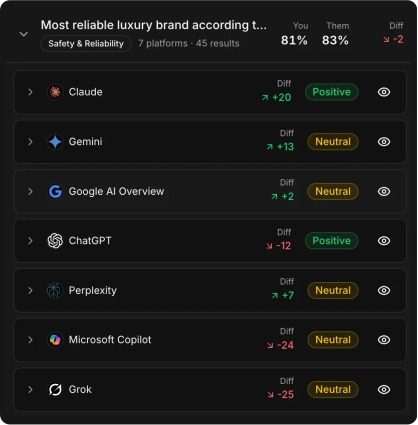
Ansvisor’s Citations Monitoring logs every domain and URL cited in your tracked answers. It covers ChatGPT, Google AI Overviews, Google AI Mode, Gemini, Microsoft Copilot and Perplexity. Claude is tracked on Enterprise plans. Switch between all sources, competitors only and your own domain, then filter by topic, prompt and platform. The Competitor gaps view lists prompts where rivals are cited and you aren’t. Start a 14-day free trial to see your own citation data.