Why User Intent matters
User Intent refers to the underlying goal, motivation, need, or objective that a user seeks to accomplish when performing a search, asking a question, or interacting with an AI system. Rather than focusing solely on keywords, modern search engines and answer engines attempt to understand what users actually want to achieve.
As search behavior shifts toward conversational interactions and AI-generated answers, understanding user intent has become one of the most important capabilities of modern search systems.
Benefits of understanding user intent include:
- Improve answer relevance.
- Increase retrieval accuracy.
- Enhance user satisfaction.
- Support conversational experiences.
- Improve AI visibility.
AI systems that accurately understand user intent can deliver more useful, contextual, and personalized experiences.
What types of User Intent exist?
User intent can be categorized into several common intent types.
- Informational intent.
- Navigational intent.
- Commercial intent.
- Transactional intent.
- Comparative intent.
- Research intent.
For example, a user asking "What is AI visibility?" demonstrates informational intent, while a user asking "Best AI visibility platforms for B2B SaaS" demonstrates commercial and comparative intent.
Modern AI systems frequently infer multiple intent signals within a single conversation or search session.
How AI systems understand User Intent
AI systems use multiple technologies to identify user intent.
These technologies help AI systems interpret context, semantics, entities, user behavior, and conversational patterns to understand what users are trying to accomplish.
How User Intent affects AI visibility
User intent strongly influences which brands, entities, and sources are retrieved and surfaced by answer engines.
Organizations that align their content, authority, and retrieval strategies with user intent are more likely to be retrieved, cited, recommended, and included in AI-generated answers.
Strategies such as AI Content Strategy, Answer Engine Optimization (AEO), and LLM Optimization often begin with understanding user intent patterns and behaviors.
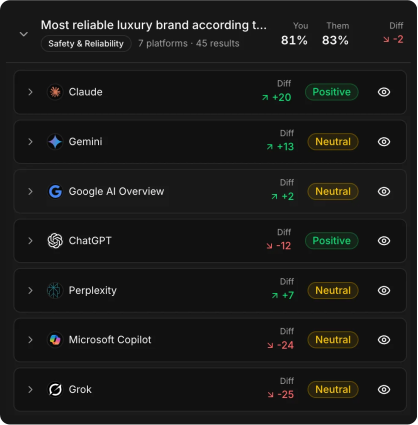
Platforms such as Ansvisor help organizations analyze user intent across prompts, customer journeys, competitors, answer engines, regions, and languages to identify high-value AI visibility opportunities.
Common misconceptions
Common misconceptions about user intent include:
- Keywords and intent are identical.
- Every user has the same intent.
- User intent never changes.
- Intent classification is always binary.
- Traditional search intent models fully explain AI search behavior.
As AI search evolves, user intent increasingly determines how information is retrieved, synthesized, and presented because answer engines optimize for user goals rather than exact keyword matches.








.svg)
