.svg)








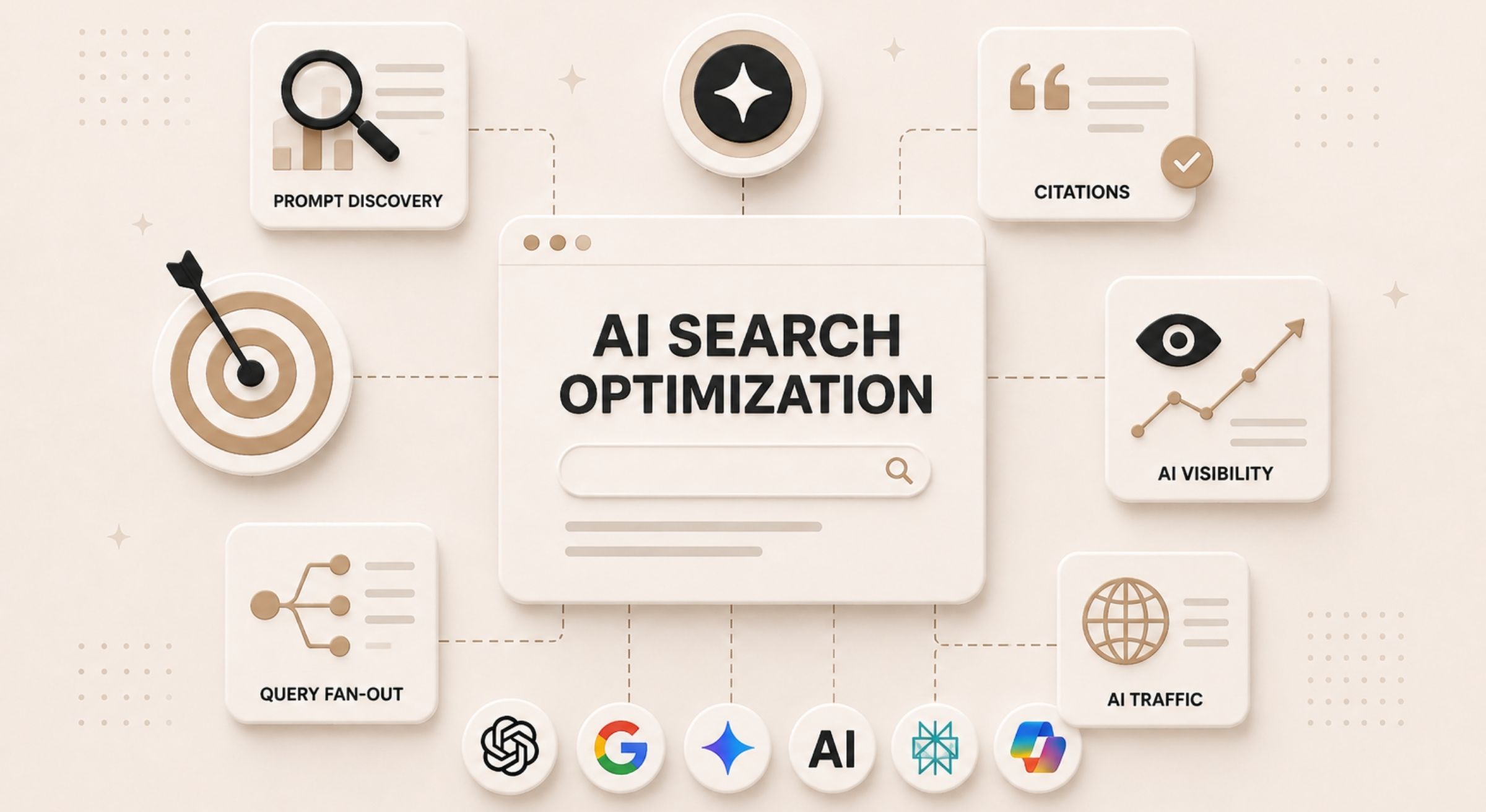
To optimize for AI search engines, make your website easy to discover, understand, verify, cite, and recommend. Start with solid SEO foundations, then expand your work to include prompt discovery, Query Fan-Out, answer-ready content, original evidence, consistent brand information, third-party authority, and continuous measurement across AI platforms.
At Ansvisor, we do not treat AI search optimization as a collection of shortcuts. We treat it as a repeatable operating process: discover the questions that matter, understand how AI systems research them, improve the evidence available to those systems, and validate whether visibility, mentions, citations, and AI traffic actually increase.
TL;DR
- Keep foundational SEO strong because AI search systems still depend on crawlable, indexed, useful web content.
- Publish non-commodity content with first-hand experience, original evidence, clear authorship, and current facts.
- Answer important questions directly, then support the answer with context, proof, limitations, and practical steps.
- Use Query Fan-Out to cover the supporting questions behind a user’s original prompt without creating thin pages for every variation.
- Build brand authority across owned pages, expert sources, reviews, communities, media, video, and other trusted third-party surfaces.
- Track prompts, mentions, citations, competitors, cited URLs, and AI referral traffic instead of relying on isolated screenshots.
- Use Ansvisor to connect discovery, optimization, team actions, and post-implementation validation.
People increasingly use AI-generated answers to research products, compare vendors, solve problems, and make decisions. That changes how information is presented, but it does not eliminate the need for strong websites or traditional SEO.
Google’s official guidance states that existing SEO best practices remain relevant to generative AI features because AI Overviews and AI Mode are grounded in Google’s Search index and core ranking systems. Google also describes Query Fan-Out as a process in which the model generates related searches to gather additional information before answering.
Direct answer: AI search optimization is not about writing for a machine instead of a person. It is about making genuinely useful information technically accessible, clearly structured, independently supportable, and easy to retrieve for the questions people actually ask.
What Is AI Search Optimization?
AI search optimization is the process of improving how a brand and its information are retrieved, interpreted, verified, cited, and recommended in AI-generated answers. It includes traditional SEO, Answer Engine Optimization (AEO), Generative Engine Optimization (GEO), AI Visibility measurement, citation analysis, and content execution.
The term applies to experiences such as ChatGPT Search, Google AI Overviews, Google AI Mode, Gemini, Claude, Perplexity, Microsoft Copilot, and other conversational or agentic discovery systems.
Be discoverable
Important pages must be crawlable, indexable, internally linked, technically reliable, and useful enough to qualify for retrieval.
Be usable in an answer
The information must clearly address the question, support a claim, establish trust, and fit the context of the generated response.
HubSpot’s AEO guide frames the opportunity around helping brands show up in answer engines. ROI Revolution’s AI search optimization guide emphasizes technical accessibility, direct answers, brand consistency, source authority, measurement, and freshness. We build on those ideas by connecting them to prompt-level measurement and continuous action inside Ansvisor.
How Does AI Search Work?
AI search systems do not always respond to a prompt by locating one page that contains the same words. Depending on the platform and request, the system may expand the prompt, retrieve several sources, compare passages, verify details, and synthesize a final response.
Query Fan-Out Expands the Original Question
A user may ask for the best software for a particular team. The AI system may then search for pricing, security, integrations, reviews, implementation, alternatives, use cases, and current product information before producing a recommendation.
This is why optimizing only for the visible prompt is incomplete. Ansvisor Query Fan-Out helps teams see the supporting searches associated with tracked prompts and identify the content or evidence missing from the current strategy.
Retrieval and Grounding Select Supporting Sources
Google describes retrieval-augmented generation as using Search systems to retrieve relevant and current pages, then reviewing information from those pages to create a more reliable response with supporting links. Other AI search products also retrieve web sources, although their systems, interfaces, and citation behavior differ.
Your goal is not to force every platform to use the same page. Your goal is to make the best source available for each important question and supporting claim.
Traditional Search vs. AI Search
| Area | Traditional search | AI search |
|---|---|---|
| Starting point | Keyword or query | Conversational prompt, task, or question |
| Research process | Search results ranked for the query | Prompt expansion, retrieval, comparison, and synthesis |
| Primary outcome | A list of pages users can visit | A generated answer supported by selected sources |
| Visibility metric | Rankings, impressions, clicks, and traffic | Prompt visibility, mentions, citations, sentiment, Share of Voice, and AI traffic |
| Optimization target | Rank the relevant page | Make the brand and evidence retrievable, verifiable, citable, and recommendable |
Traditional SEO and AI search optimization should reinforce each other. Google explicitly warns against abandoning foundational SEO for unsupported AEO or GEO shortcuts. Strong technical structure, useful content, internal linking, page experience, and Search eligibility remain essential.
What Makes Content Easy for AI Search Engines to Cite?
A citable page does not need to sound robotic or reduce every idea to tiny fragments. Google says there is no required content “chunking” format or special AI-only writing style. The practical objective is to help people understand the page while making important answers and evidence easy to locate.
- Lead important sections with a direct, self-contained answer.
- Use descriptive H2 and H3 headings that match real questions and subtopics.
- Add original research, first-hand experience, benchmarks, examples, or expert analysis.
- Support factual claims with relevant primary or authoritative sources.
- Explain methods, definitions, limitations, dates, and the scope of the evidence.
- Use tables, lists, and comparisons when they genuinely improve understanding.
- Keep author credentials, company details, contact information, privacy, and trust pages clear.
- Update time-sensitive facts, product information, prices, availability, and examples.
- Use structured data when relevant and ensure it matches the visible content.
- Add useful images and video where they improve the page rather than decorate it.
Important nuance: Structured data can help search engines understand content and qualify pages for supported rich results, but Google states that no special schema is required for inclusion in its generative AI search features.
The Five Principles of AI Search Optimization
Optimize for retrieval
Keep important content public, crawlable, indexed where applicable, internally linked, fast, mobile-friendly, and technically stable.
Optimize for understanding
Clarify what the brand does, who it serves, how products relate to use cases, and what each page is designed to answer.
Optimize for verification
Provide evidence, authorship, methods, current facts, independent confirmation, and trustworthy supporting sources.
Optimize for citation
Create specific passages and resources that can support the claims an AI system needs to make in its answer.
Optimize for recommendation
Demonstrate real fit through product facts, comparisons, reviews, availability, use cases, outcomes, and third-party authority.
Measure and validate
Track the same prompt portfolio after changes so the strategy is based on evidence rather than assumptions.
“I would not optimize a page only for an algorithm. I would optimize the evidence an AI system needs to retrieve, verify, cite, and recommend the brand accurately.”— Cihan Geyik, Co-founder of Ansvisor
Build the Technical Foundation First
Before creating new pages, verify that search engines and the AI crawlers you intentionally support can reach the content. At Ansvisor, we regularly see teams focus on copy while overlooking indexing, canonical, JavaScript, robots.txt, sitemap, or page-experience issues that limit discovery.
- Return the correct status code and use one clear canonical URL.
- Keep essential content visible in the rendered page and accessible without login.
- Review robots.txt and firewall rules for the crawlers you want to allow.
- Maintain current XML sitemaps and submit important URLs through relevant webmaster tools.
- Use descriptive internal links so priority pages are easy to discover.
- Reduce unnecessary duplication and conflicting page versions.
- Test mobile usability, latency, navigation, and main-content visibility.
- Keep structured data valid, relevant, and consistent with visible claims.
Use the Ansvisor AI Visibility Site Audit to evaluate important pages across structure, content, authority, E-E-A-T, and trust signals before investing in broader optimization.
Find the AI Search Opportunities Your Website Is Missing
Discover strategic prompts, uncover Query Fan-Out, audit target pages, analyze citations, and monitor improvements across major AI platforms with Ansvisor.