A buyer asks ChatGPT for the best payroll software for a 40-person company. The answer names five vendors in two short paragraphs, with no links. Each of those names is an AI mention, and for a lot of buyers that paragraph is the shortlist. If your brand isn’t in it, no ranking report will tell you, because nothing on a results page changed.
Named, not linked. An AI mention is about your brand appearing in the answer text. Whether the answer also links to your site is a separate signal, the AI citation.
What counts as an AI mention?
Any reference a reader would recognize as your company or product. That includes:
- Your brand name and product names, including sub-brands.
- Common short forms and spelling variants, such as “Hubspot” for HubSpot.
- Former names after a rebrand, which models may keep using long after the change.
- Your flagship feature or founder, when the answer clearly ties them to you.
Watch for brand names that are also ordinary words. If your product is called “Beacon,” count it only when the answer is clearly talking about your category. Otherwise every lighthouse fact inflates the total.
Your domain shown only in a source list doesn’t count; that’s a citation. A domain written as plain text in the answer is a domain mention. Settle these rules early, because they decide what every later number means.
What types of AI mentions are there?
| Type | Example in an answer | What it tells you |
|---|
| Recommendation | “For teams under 50, X is the best fit.” | You’re the answer, not one option |
| Comparison | “X is cheaper than Y but has fewer integrations.” | How you’re positioned against a rival |
| List inclusion | “Popular options include X, Y and Z.” | You’re in the consideration set |
| Passing reference | “Tools such as X can automate this.” | Category association, little weight |
| Factual answer | “X’s Starter plan costs $29 a month.” | Whether engines hold correct facts |
| Cautionary | “Some users report X’s support is slow.” | A reputation risk to fix |
A raw count treats all six the same. Tag mentions by type, or a spike in cautionary mentions will look like growth on the dashboard.
Where do AI mentions come from?
Two places. The first is model memory, meaning what the model absorbed about your category in training. The second is live retrieval: pages the engine searches and reads before it answers.
Prompt → Memory or live search → Training data and retrieved pages → Brands named → Order and framing
The engine decides per prompt. Google’s Gemini API documentation describes the model analyzing a prompt and deciding whether a Google Search would improve the answer. When it doesn’t search, the answer can still name brands from memory. It just carries no sources.
That split explains a common puzzle. A brand can be named often on prompts that rarely trigger a search, while its pages earn few citations. The fixes differ, too. Training data changes slowly, while the pages an engine retrieves can change this week.
You can often tell which path produced a mention. If the answer shows sources, open them and look for your name; that page is what to protect or improve. If it shows none, the mention came from memory, and only broader coverage over time will shift it.
AI mentions vs AI citations
Mentions and citations measure different things, and they don’t move together. Some brands get named constantly and cited rarely. Others supply the sources for answers that recommend someone else.
So keep two lines in every report. AI citations covers the source side in detail. For mentions across the wider web, and their value for SEO, see brand mentions.
Which AI mentions are worth the most?
Weight mentions before you add them up. Five factors do most of the work:
- Position. The first brand named gets read; the sixth may not.
- Framing. “Best for enterprise” and “budget option” attract different buyers.
- Accuracy. A mention that quotes last year’s pricing can cost you the deal.
- Prompt intent. A mention on “best X for Y” outweighs one on “what is X.”
- Demand. Prompts that many buyers ask matter more than rare ones.
Say two brands each appear in 400 of 1,000 tracked answers. Brand A is named first in 260 of them, mostly on buying prompts. Brand B sits fourth or lower in most of its answers, mostly on definition prompts. Their mention counts match. Their pipelines won’t.
Why do engines mention some brands and not others?
Engines name the brands that their sources keep naming. Three patterns show up again and again:
- Third-party consensus. Roundups, review sites, Reddit threads and YouTube comparisons that list you give both retrieval and training data something to repeat.
- Category association. Pages that put your name and your category in the same sentence, consistently, teach the link.
- Consistent facts. When your pricing and product names match across your site and profiles, engines describe you with more confidence.
Recency matters for answers built on live search. It matters far less for answers drawn from memory.
How do you measure AI mentions?
Three measures cover most needs. Mention frequency is the share of answers that name you. Share of voice compares your mentions with competitors’ on the same prompts. Mention monitoring tracks both over time and flags changes.
Report each one by platform and market. A brand that Gemini names often can be nearly invisible on ChatGPT, and a leader in the US can be missing in France.
How do you earn more AI mentions?
- Get onto the pages engines already read for your prompts: the roundups and threads they cite.
- Publish comparison pages for the “X vs Y” and “best X for Y” prompts buyers use.
- State your category plainly on your own site: what you are, who it’s for and what it costs.
- Correct wrong facts at the source, starting with the pages that answers cite.
- Keep product and plan names identical everywhere they appear.
Our guide on increasing AI mentions and citations walks through each step with examples.
Common mistakes
- Counting branded prompts. Asking “what is [your brand]” will always produce a mention.
- Missing name variants, so mentions under an old product name never get counted.
- Adding up mentions without reading them, so a warning counts the same as a recommendation.
- Expecting traffic from mentions. Without a citation, there’s nothing to click.
How Ansvisor helps
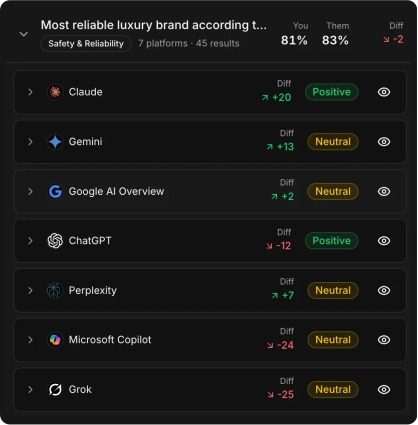
Ansvisor’s Answer Engine Insights counts mentions of your brand and competitors. It covers ChatGPT, Google AI Overviews, Google AI Mode, Gemini, Microsoft Copilot and Perplexity. Claude tracking is available on Enterprise plans. Brand Sentiment and Context shows how answers describe you, and trends split by topic, region, language and platform. For teams running thousands of prompts in several languages, that’s how you see which markets name you and which don’t.








 ChatGPT
 AI Overviews
 AI Mode
 Gemini
 Copilot
 Perplexity
 Claude