A sales rep hears it on a call: "ChatGPT recommended them." AI competitor analysis checks whether that holds across hundreds of prompts. It shows which competitors AI answers name most, on which platforms, and which sources make the case for them.
Your AI competitors may differ from your sales competitors. Review sites, roundup publishers and large SEO suites often take the slots in AI answers.
Why AI competitor analysis matters
Classic competitor analysis looks at rankings and traffic. AI answers work differently. They name a few brands, cite a few sources and leave everyone else out, so a rival’s gain is usually your loss on that prompt.
The analysis shows where you trail, why, and which gaps are worth closing first.
Which metrics should you compare?
| Metric | Question it answers |
|---|
| Mention rate | How often is each brand named on the prompt set? |
| Share of voice | What portion of all mentions goes to each brand? |
| Position | Who is recommended first, and who is listed last? |
| Cited URLs | Which pages back each competitor’s mentions? |
| Sentiment | How do answers describe each brand? |
| Platform split | Where does each competitor lead or trail? |
Read share of voice and cited URLs together. A competitor that leads on mentions but relies on two roundup articles is easier to catch than one cited across dozens of sources. Source diversity measures exactly that.
How to do AI competitor analysis
Choose competitors → Build a prompt set → Run it on each platform → Compare metrics → Read the winning answers → Plan the response
- Pick three to six competitors: direct rivals plus any brand that keeps appearing in answers.
- Build a prompt set around buying questions such as "best X for Y," comparisons and alternatives. Leave out branded prompts.
- Run every prompt on each platform several times, so one odd answer doesn’t skew the picture.
- Compare mention rate, share of voice and cited URLs by topic and platform.
- Open the answers where a competitor wins. List the sources it cites and what they say.
- Decide the response: a new page, an update or outreach to the cited sites.
Our guide to tracking competitors in ChatGPT shows the setup on one platform. AI benchmarking covers how to set targets from the results.
Example: the competitor pages AI cites most
In our category, the most-cited competitor pages were guides and lists that closely match common buyer prompts. LLM Pulse’s list of the best Google AI Overviews trackers drew 1,988 citations. Otterly’s guide to tracking Google AI Overviews drew 1,792, and Profound’s citation analysis feature page drew 1,690. Source: Ansvisor tracking data, September 15 to October 14, 2026.
These are strong pages, and they show the useful output of a competitor analysis: specific URLs to study. Each one answers a question buyers ask. To compete, you need a page that answers it with better data, a sharper structure or a more current view.
How to analyze competitor presence in Google AI Overviews
AI Overviews appear only for some queries, so first record whether one shows up at all. Then log which brands it names and which links it shows, query by query.
Search Console’s generative AI performance reports show AI impressions for your own pages only. They don’t show competitors, so you need a tracker for the comparison. We compared the options in our list of AI Overviews rank tracker tools.
Can you analyze competitors’ AI traffic?
Not directly, because their analytics are private. Panel-based tools such as Similarweb estimate AI referral traffic for any domain, with a margin of error.
A practical proxy is visibility on high-demand prompts. A competitor that is named on the prompts with the most estimated demand is likely getting a large share of the visits.
Common pitfalls
- Choosing competitors from your sales deck and missing the brands AI actually names.
- Monitoring only one competitor or one platform.
- Including branded prompts, which inflate everyone’s numbers.
- Comparing domains only, when the insight is in the exact cited URLs.
- Focusing on traffic alone and ignoring the third-party pages that mention competitors.
- Changing the prompt set between comparisons.
How Ansvisor helps
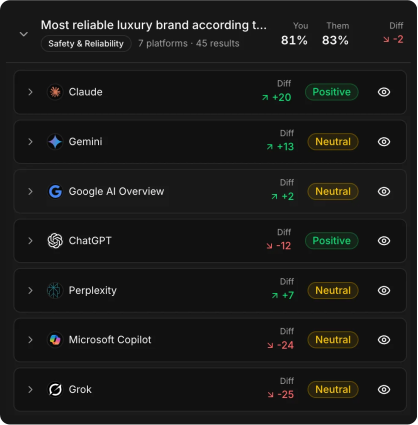
Ansvisor’s Competitor Tracking & Benchmarking compares your visibility, mentions, citations and share of voice with each rival’s. The Gaps & Strengths view lists the prompts competitors win. Answer Insights opens the answers and cited domains behind each number.
Tracking covers ChatGPT, Google AI Overviews, Google AI Mode, Gemini, Copilot and Perplexity, with Claude on Enterprise plans in Ansvisor.