


AI Search Glossary: 40 AEO, GEO and AI Visibility Terms





"Visibility score" means something different in almost every AI search tool. AEO and GEO often describe the same work. And the vocabulary keeps moving.
We define 40 terms here in one or two sentences each, with official sources where they exist. They’re grouped by topic, starting with the three you’ll meet first. Each linked term has a full page in our glossary.
Key takeaways
- Google AI Overviews, AI Mode and ChatGPT search all write one answer from several sources and cite some of them. That’s AI search.
- A citation is a linked source and a mention is your brand name in the answer text. You can get one without the other.
- AEO and GEO both describe earning visibility in AI answers. Google says that, from its side, this is still SEO.
- Google says its AI features use retrieval-augmented generation and query fan-out on top of its core ranking systems.
- Track AI visibility with citation rate, mention rate, share of voice and AI traffic across a fixed set of prompts.
AI search glossary: the three terms to know first
What is AI search?
AI search is a way of searching where an AI model reads several sources and writes one answer. A classic search engine would return a ranked list.
Examples include Google AI Overviews, Google AI Mode, ChatGPT search, Gemini, Microsoft Copilot, Claude and Perplexity. The answer usually cites the pages it used.
What are AI answers?
AI answers are the responses an AI search tool generates for a prompt. One answer often summarizes several sources.
An AI answer can name brands, cite links, compare options or recommend a product. Ask the same prompt on another day, or on another platform, and the answer can change.
What are AI citations?
AI citations are links to sources shown with an AI answer, as footnotes, source cards or inline links.
They show which pages supported the answer. They’re also the main way an AI answer sends traffic to a website.

AI visibility vs SEO vs AEO vs GEO: what is the difference?
Classic SEO
Classic SEO is about ranking pages in search results.
AEO and GEO
AEO and GEO try to get your content cited, or your brand named, inside AI answers.
AI visibility is the outcome you measure across both. It tells you how often and how well your brand appears when people ask AI tools about your category.
Google’s view is that optimizing for its AI features is still SEO, because they rely on its core ranking systems. For a deeper comparison, read AEO vs SEO vs GEO.
AI search glossary: core concepts
AI mentions
AI mentions are appearances of your brand name in the text of an AI answer. You can be mentioned without a citation, and cited without a mention.
AI visibility
AI visibility is how often and how well your brand appears in AI answers for the prompts that matter to you. People also call it AEO visibility or GEO visibility.
Answer engines
Answer engines are tools that respond with a direct answer instead of a ranked list of links. ChatGPT and Perplexity are answer engines, and so are Gemini and Google AI Mode.
Large language models (LLMs)
Large language models are AI models trained on large amounts of text to understand and generate language. Models from OpenAI, Google and Anthropic power most AI search tools.
Conversational search
Conversational search lets people ask follow-up questions while the system keeps the context. Prompts tend to be longer and more specific than classic keywords.
Zero-click search
A zero-click search ends without a click to any website, because the answer appears on the results page.
A Pew Research Center study found users clicked a result in 8% of visits with an AI summary, versus 15% without one.
AI search platforms
Google AI Overviews
Google AI Overviews are AI-written summaries at the top of some Google results, with links to supporting pages.
Google’s documentation on AI features says they appear only when its systems decide they add value.
Google AI Mode
Google AI Mode is Google’s conversational search mode for complex questions and comparisons, with room for follow-ups. Alphabet said in July 2026 that it had merged AI Overviews and AI Mode into one experience.
ChatGPT search
ChatGPT search is the web search feature inside ChatGPT that answers with cited sources. OpenAI’s OAI-SearchBot crawler finds the pages it can show.
Gemini
Gemini is Google’s AI assistant app, which can ground answers in Google Search results. Alphabet reported 950 million monthly active users for the Gemini app in July 2026.
Microsoft Copilot
Microsoft Copilot is Microsoft’s AI assistant. For web answers, it writes short search queries, sends them to Bing and grounds its response in the results.
Claude
Claude is Anthropic’s AI assistant. With web search turned on, it can look up current pages and cite them in its answers.
Perplexity
Perplexity is an AI answer engine that searches the web for each question and shows numbered citations. Its search crawler is called PerplexityBot.
Optimization terms: AEO, GEO and AI SEO
AEO (answer engine optimization)
Answer engine optimization (AEO) is the practice of making content easy for AI tools to use as a direct answer. The work is mostly direct answers, tidy structure and facts that can be quoted.
GEO (generative engine optimization)
Generative engine optimization (GEO) is the practice of improving how often generative AI answers cite or mention your brand.
The term comes from a 2023 research paper on GEO, which reported visibility gains of up to 40% in generative engine responses.
AI SEO
AI SEO means optimizing for both classic search results and AI answers. The term also covers using AI tools in SEO work, and some teams call it LLM SEO.
Content and technical terms
Non-commodity content
Non-commodity content offers first-hand experience, original data or expert views that go beyond common knowledge. Google’s 2026 guide says such content will likely matter more than any other tip it gives.
E-E-A-T
E-E-A-T stands for experience, expertise, authoritativeness and trustworthiness. Google uses the concept to describe helpful, reliable content.
Content freshness
Content freshness is how current a page’s facts and examples are, dates included. On fast-moving topics, show a visible update date and refresh numbers regularly.
Schema markup
Schema markup is structured data code that labels page content, such as a product, a review or an organization. Google says AI features need no special schema, but markup still supports rich results.
llms.txt
llms.txt is a proposed text file that lists a site’s main pages for AI tools. Google says Google Search doesn’t use it, though other services may.
Retrieval and crawler terms
Retrieval-augmented generation (RAG)
Retrieval-augmented generation (RAG) is a method where the AI first retrieves relevant documents, then writes an answer based on them.
Google’s guide to generative AI features says its AI features use RAG with its core Search ranking systems.
Grounding
Grounding means tying an AI answer to retrieved sources, such as current web pages, to make it more accurate. Google uses the word as another name for RAG.
Grounding query
A grounding query is a search phrase an AI system uses to retrieve content it later cites. Bing Webmaster Tools shows a sample of these queries in its AI Performance report.
Query fan-out
Query fan-out is when an AI model runs several related searches to answer one prompt. A page can get cited for a sub-question it never targeted.
AI crawlers
AI crawlers are bots that fetch web pages for AI search, AI training or user-requested actions. Each has its own user agent, which you can allow or block in robots.txt.
OAI-SearchBot
OAI-SearchBot is OpenAI’s crawler for ChatGPT search.
OpenAI’s crawler documentation says sites that block it won’t appear in ChatGPT search answers, though navigational links may still show.
GPTBot
GPTBot is OpenAI’s crawler for content that may be used to train its models. OpenAI says its robots.txt setting is independent of OAI-SearchBot.
Google-Extended
Google-Extended is a robots.txt token that controls whether Google may use your content for Gemini models and grounding in Gemini apps. It doesn’t affect inclusion or ranking in Google Search.
To leave AI Overviews and AI Mode, you need a different switch: the Search generative AI control in Search Console.
AI visibility metrics
AI visibility score
An AI visibility score is one number that sums up how often a brand appears in AI answers across tracked prompts. Each tool calculates it differently, so only compare scores within one tool.
AI share of voice
AI share of voice is your share of mentions or citations compared with competitors for the same prompts. It shows who is gaining ground and who is losing it.
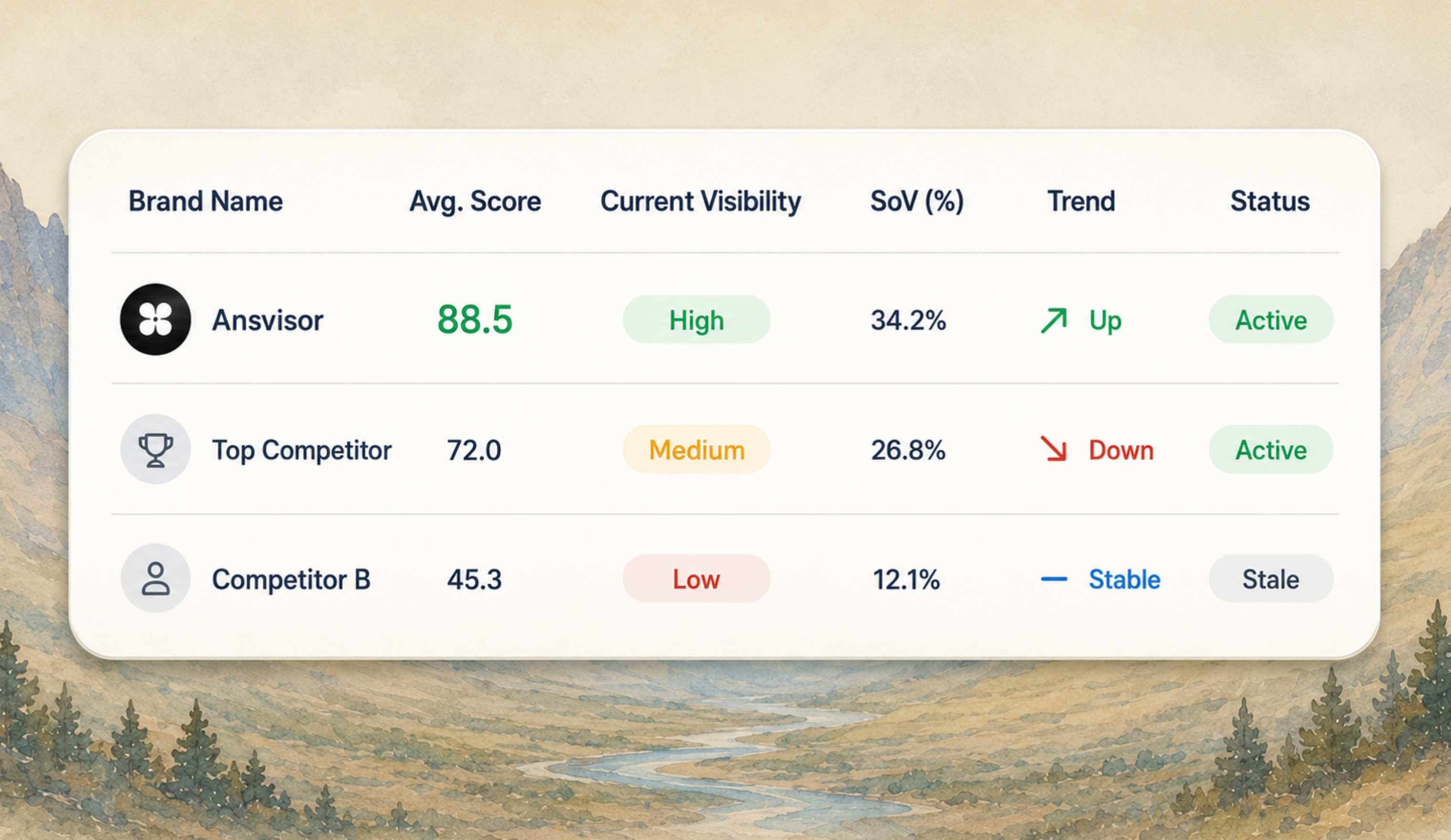
Citation share
Citation share is the percentage of all citations for a query that point to your site. Bing added it to Webmaster Tools as a preview metric in June 2026.
Citation rate
Citation rate is the share of tracked AI answers that cite at least one of your URLs. It’s the closest AI search counterpart to ranking on page one.
Prompt volume
Prompt volume is the estimated number of times people ask AI tools a question or a close variant. AI platforms don’t publish it, so tools estimate it.
Prompt monitoring
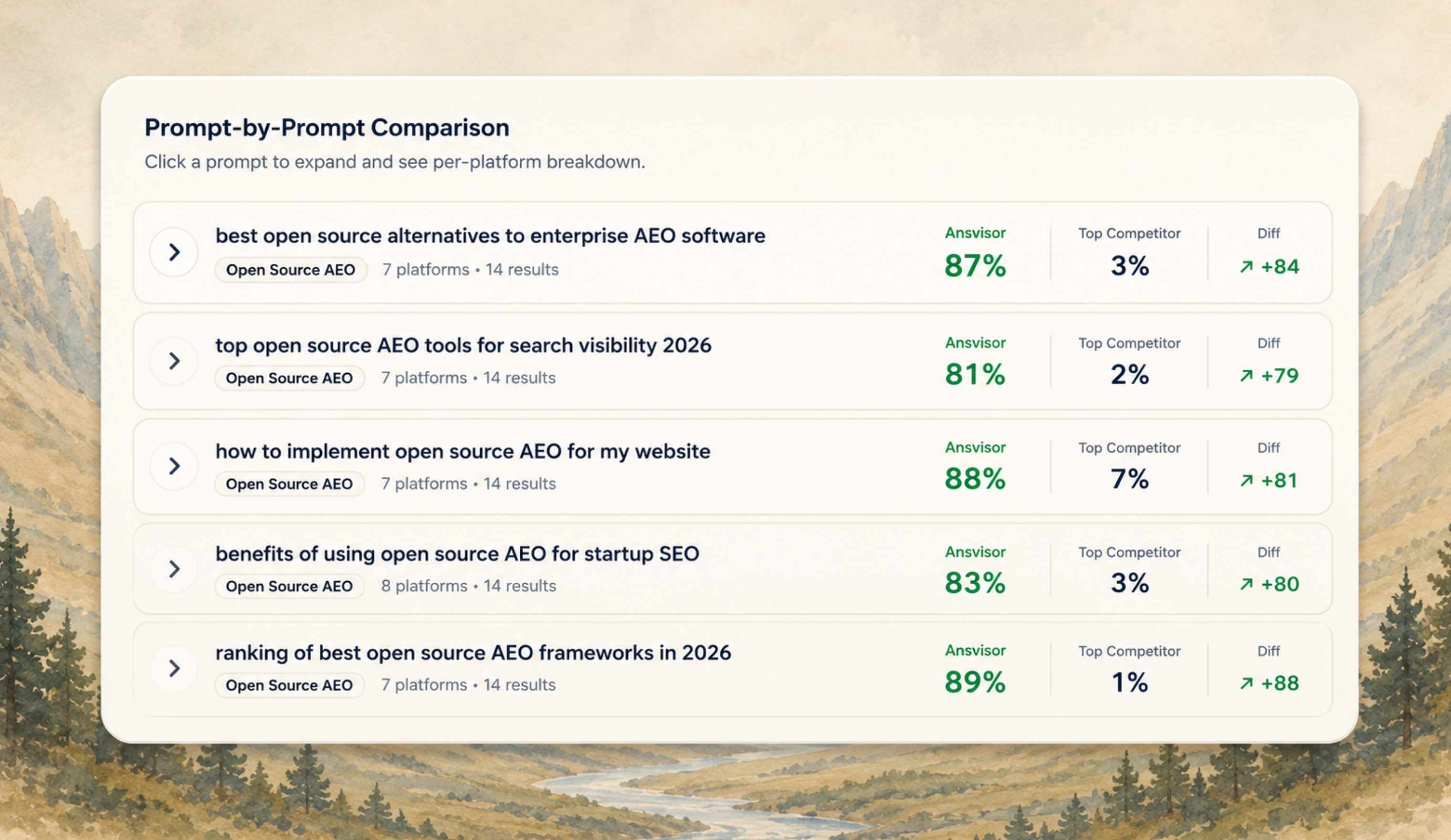
Prompt monitoring means running a fixed set of prompts on a schedule and saving each AI answer. Over time it shows how your mentions and citations move, and which competitors gain.
AI rank tracking
AI rank tracking records where and how your brand appears in AI answers for tracked prompts. It swaps a single rank number for three readings: presence, order in the answer and citations.
AI traffic
AI traffic is visits that come from AI tools, such as clicks on links in a ChatGPT or Perplexity answer. Analytics tools can separate it by referrer.
To see how these metrics fit together, read our guide to AI visibility KPIs and benchmarks.
Mentions vs citations: what our tracking data shows
Ansvisor, an open-source AI search intelligence platform, tracks prompts about AI search on six AI platforms.
All tracked answers
From September 15 to October 14, 2026, AI engines cited 746,702 links across 103,427 tracked answers. That’s 7.2 links per answer on average.
Semrush mentions and citations
In the same period, Semrush had 110.2k mentions and 19.2k citations in those answers.
So a brand can be named almost six times as often as it is cited. That’s why mentions and citations get separate entries here. Track both.
How Ansvisor helps
Ansvisor turns these terms into reports. It tracks your prompts across ChatGPT, Google AI Overviews, Google AI Mode, Gemini, Copilot and Perplexity, plus Claude on Enterprise plans.
Answer Engine Insights shows visibility and share of voice by platform and competitor, with mentions and citations counted separately. Teams can also connect the data to their AI agents through MCP.
You can use Ansvisor Cloud or self-host the open-source project on GitHub. Browse the full AI visibility glossary for more than 200 terms.
Start a 14-day free trial and see how often AI answers mention and cite your brand.
FAQ
What is the difference between AI visibility and SEO, GEO, or AEO?
SEO tries to rank pages in search results, while AEO and GEO work on getting your content cited or your brand mentioned in AI answers. AI visibility is the result you measure: how often and how well your brand shows up in those answers.
What is AEO visibility?
AEO visibility is how often your brand is mentioned or cited in AI answers for the prompts you track. It’s another name for AI visibility. You measure it with citation rate, mention rate and AI share of voice across platforms.
What is the difference between an AI mention and an AI citation?
A mention is your brand name in the text of an AI answer. A citation is a link to one of your pages shown as a source. One can happen without the other, so track both.
Is GEO the same as AEO?
They overlap almost completely. AEO grew out of optimizing for direct answers, while GEO comes from a 2023 research paper on generative engines. Both describe earning citations and mentions in AI answers, and many teams use the terms interchangeably.
Do I need llms.txt or special schema for AI search?
Not for Google. Google says its Search features don’t use llms.txt and need no special schema for AI Overviews or AI Mode. Other AI services may read llms.txt, so keeping one does no harm.