Why Model Context Windows matter
A Model Context Window is the maximum amount of information an AI model can process and consider simultaneously during inference. The context window determines how much text, conversation history, retrieved information, and instructions a model can use when generating responses.
As AI systems increasingly rely on retrieval, reasoning, and multi-step interactions, context windows have become a critical factor influencing answer quality, accuracy, and user experience.
Benefits of larger context windows include:
- Process longer documents.
- Support multi-turn conversations.
- Improve reasoning capabilities.
- Enable richer retrieval.
- Increase contextual understanding.
Modern AI systems use context windows to combine user prompts, retrieved documents, instructions, and conversation history into a single reasoning process.
How Model Context Windows work
Context windows define the amount of information available to a model at generation time.
- User prompts.
- Conversation history.
- Retrieved documents.
- System instructions.
- Tool outputs.
- External knowledge.
All information included within the context window competes for the model's attention and influences the final output.
Technologies such as transformer attention mechanisms allow models to process relationships between different parts of the context simultaneously.
How Model Context Windows affect AI search
Context windows play a major role in AI-powered search and answer generation.
Larger context windows allow AI systems to consider more evidence, compare multiple sources, and maintain longer conversations before generating responses.
What limits Model Context Windows?
Despite recent improvements, context windows still have practical limitations.
- Computational costs.
- Latency.
- Attention dilution.
- Memory constraints.
- Retrieval quality.
- Information prioritization.
Simply increasing context size does not guarantee better answers. Models must still identify and prioritize the most relevant information.
Concepts such as Hybrid Search, Embeddings, and Dynamic Retrieval help optimize how information enters the context window.
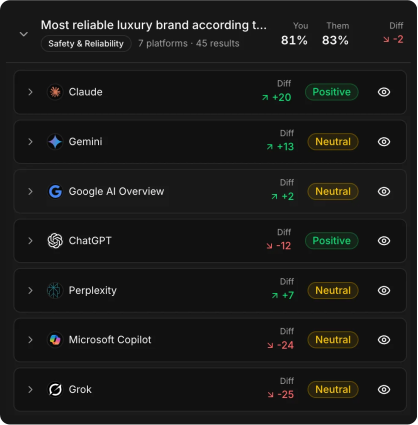
Platforms such as Ansvisor help organizations understand how AI search systems retrieve, prioritize, cite, and synthesize information by analyzing prompts, citations, competitors, and answer patterns across multiple answer engines.
Common misconceptions
Common misconceptions about context windows include:
- Bigger context windows always produce better answers.
- Context windows function like permanent memory.
- All retrieved information receives equal attention.
- Context windows eliminate hallucinations.
- Context size alone determines model quality.
Context windows determine how much information a model can consider at once, but answer quality ultimately depends on retrieval quality, information relevance, model architecture, and reasoning capabilities.








.svg)
