An AI answer rarely quotes a whole page. It lifts a sentence, a list or a number and links the source. AI content optimization makes those pieces easy to lift and worth citing. Most of it is careful editing for one specific reader: a retrieval system looking for the passage that answers a single question.
Optimize each passage. AI answers quote sections, not whole pages. Every section should answer one question well enough to stand alone.
What makes content easy for AI to cite?
| Element | What to do |
|---|
| Opening | Answer the main question in the first two sentences |
| Headings | Phrase them the way buyers ask, often as questions |
| Facts | Use specific numbers, dates and names, with sources |
| Structure | Use short lists and tables for steps and comparisons |
| Freshness | Show an updated date and keep facts current |
| Access | Let AI crawlers in and keep the main text in the HTML |
None of this is new to a good editor. What changes is the bar for precision. A vague paragraph can still rank in Google, but it gives an AI answer nothing specific to quote.
The last two rows are easy to miss. Content freshness affects which version of a fact gets repeated. AI crawler accessibility decides whether the page is read at all.
Does AI content optimization work?
The research says yes, within limits. The paper that coined generative engine optimization found targeted edits could raise a source’s visibility in generative answers by up to 40%. It also found results vary by domain, so test changes on your own prompts.
Google points the same way. Its guidance on AI features says no special markup or file is needed for AI Overviews or AI Mode. The work happens in the content itself.
Example: a page built to be cited
Our list of the top GitHub repositories for AEO and GEO drew 7,007 citations in AI answers in 30 days. Source: Ansvisor tracking data, September 15 to October 14, 2026.
The page answers one narrow question, and its first lines name the answer. Each repository then gets the same short block: its type, what it does, who it’s best for and a link. An engine can quote one entry or the whole list without rewriting anything.
You can see the format on the page itself. The lesson carries over to any category: a specific question, a direct answer and a repeatable structure.
AI content optimization workflow
Pick target prompts → See who gets cited → Map gaps to pages → Rewrite or create → Recheck citations
- Pick the prompts a page should win, grouped by topic.
- Read the current answers and list the cited URLs. Note their format, depth and freshness.
- Decide whether to update a page or create a new one. A broad guide rarely wins a narrow prompt.
- Write a brief, then edit for direct answers, specific facts and question-style headings. AI content briefs speed this step up.
- Recheck the same prompts over several weeks and compare citations with your baseline.
Our AI content optimization workflow covers each step in more detail.
Beyond single pages, a few site-level moves pay off. Build topic clusters so related pages support each other. Publish comparison pages for the "X vs Y" prompts buyers ask. Update older pages before their facts go stale.
How to measure AI content optimization
- Citation frequency for each optimized URL on its target prompts.
- Brand mentions in the same answers, since a citation doesn’t guarantee your name appears.
- Prompt coverage, or the share of target prompts where the page or brand shows up.
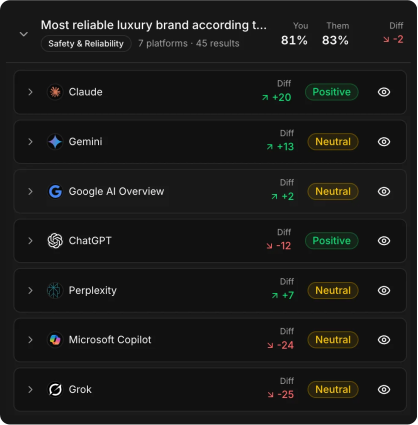
- Platform coverage, because a page cited by Gemini may be ignored by ChatGPT.
- AI referral visits to the page, to see whether visibility turns into traffic.
Set a baseline before you edit, and keep the prompt set fixed while you compare.
AI content optimization tools
The label covers two kinds of tools. Some use AI to score a draft against top search results and suggest terms, as Surfer does. Others measure what AI answers cite and turn the gaps into briefs.
The first kind speeds up writing. The second tells you which pages to work on and whether the work paid off. Many teams use one of each.
Common pitfalls
- Adding FAQ blocks that repeat the body in question form.
- Publishing AI-generated filler with no facts of its own.
- Burying the answer under a long introduction.
- Hiding core text in tabs or scripts that crawlers may not render.
- Judging success by rankings alone, without checking citations.
- Letting pages age. Outdated prices and features get repeated in answers.
How Ansvisor helps
Ansvisor’s Content Intelligence groups related prompts and fan-out queries into topics. It shows where a new or improved page would gain AI visibility and generates a brief from those prompts.
Each opportunity goes to the Action Center, where you assign it and track the result in citations and mentions.