
Brand discovery is expanding beyond traditional search results. Customers now ask ChatGPT, Gemini, Claude, Perplexity, Microsoft Copilot, and other AI systems questions about products, companies, alternatives, recommendations, and buying decisions.
That creates a new measurement problem. Traditional rank tracking can show where a page ranks in search results, but it does not fully explain whether an LLM mentions your brand, recommends a competitor, cites your website, relies on another source, or changes its answer across different prompts and platforms.
LLM Visibility tools are designed to measure this emerging discovery layer. This guide compares leading platforms for tracking brand visibility across LLMs and AI Search, and explains which capabilities matter when choosing a tool.
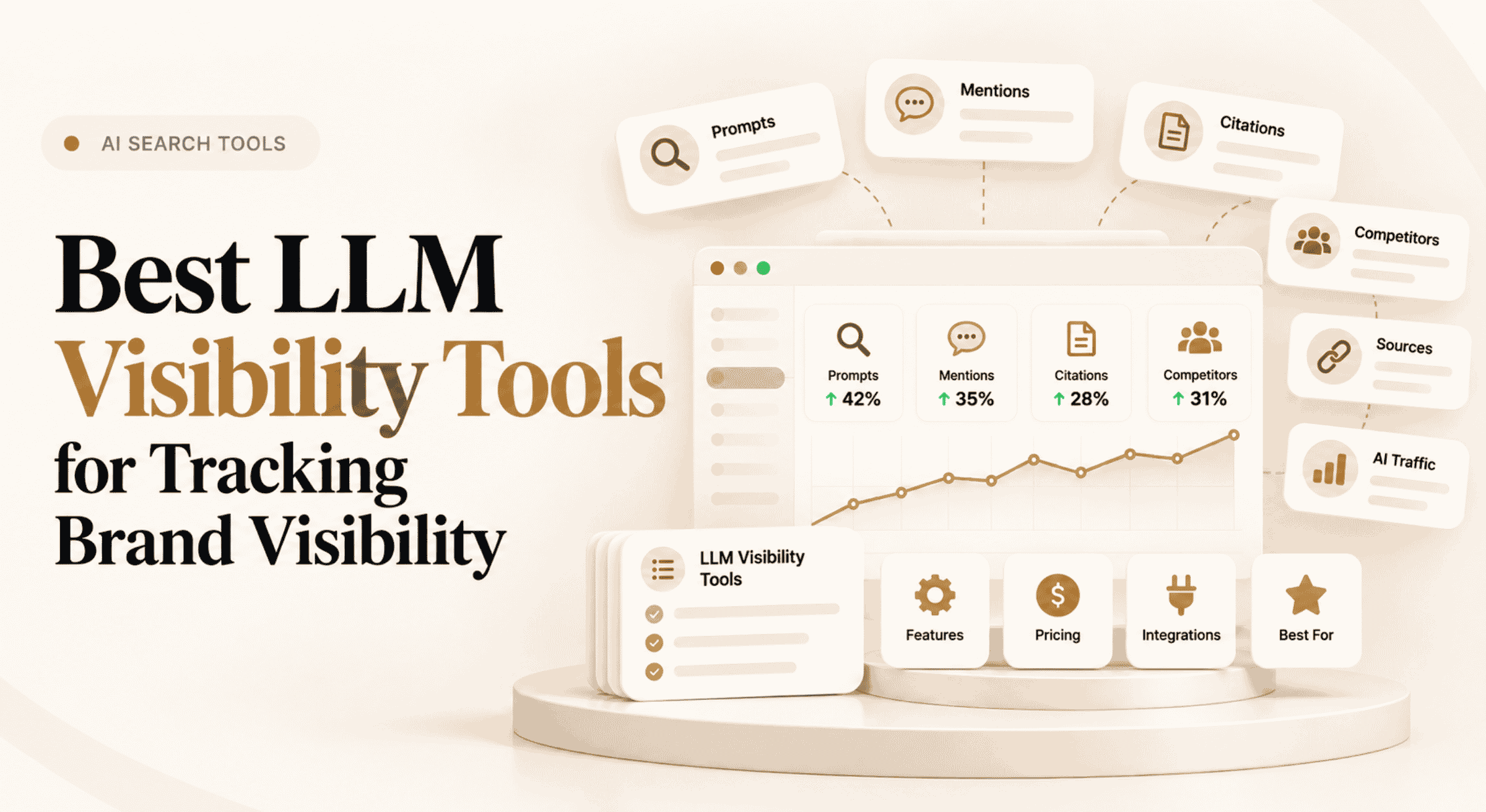
The best LLM visibility tools help brands track more than whether they appear in an AI answer. A useful platform should monitor prompts, brand mentions, citations, competitors, cited sources, historical trends, and platform-level visibility. More advanced workflows can also connect AI visibility with referral traffic, content opportunities, and actions. Ansvisor, Profound, Peec AI, Semrush, Ahrefs, Otterly.AI, and AthenaHQ are among the platforms organizations can evaluate depending on their requirements.
LLM visibility describes how a brand, product, website, or other entity appears within responses generated by large language models and AI-powered search experiences.
Unlike traditional rankings, LLM visibility is not necessarily represented by one fixed numerical position. A brand might be mentioned first in one answer, cited as a source in another, included among several recommendations, absent from a third, or represented differently when the wording of the prompt changes.
Useful measurement can include whether your brand appears, how it is described, which competitors appear alongside it, whether your website is cited, which external sources influence the answer, and how those patterns change across prompts, platforms, locations, and time.
This is why an LLM Rank Tracker should be evaluated differently from a traditional SERP rank tracker. AI-generated answers can contain multiple brands, sources, citations, recommendations, and contextual relationships rather than a simple ordered list of ten blue links.
The strongest tools provide enough underlying data to explain visibility rather than reducing the entire AI Search channel to a single score.
The questions and queries where customers may discover, compare, evaluate, or investigate brands and products.
Whether the brand appears in an AI-generated answer and how consistently it is surfaced across tracked prompts.
Whether your website or another relevant source is cited or linked within AI-generated responses.
Which competing brands appear for the same prompts and where your relative visibility differs.
Which domains and URLs influence or appear within AI answers, including third-party sources that may shape brand discovery.
How visibility, mentions, citations, competitors, and source patterns change over time.
Differences in visibility across the AI experiences that matter to your customers.
Identifiable referral visits from AI platforms and their contribution to measurable website activity.
Visibility, citation, competitor, prompt, content, or authority gaps that can inform what the team should investigate next.
There is no universal platform list for every business. The right coverage depends on where customers research your category and which AI experiences influence discovery and buying decisions.
For many organizations, the measurement set now includes standalone AI assistants alongside generative experiences inside traditional search.
Tracking several platforms matters because an AI visibility strategy should not assume that the same answer, source set, or competitive landscape will appear everywhere.
LLM visibility software is developing quickly, and products often use similar terminology for capabilities that differ in depth. We therefore focus on the workflow behind the feature names rather than treating every visibility metric as equivalent.
The range of AI assistants, answer engines, and generative search experiences available for relevant monitoring.
Tools for discovering, organizing, monitoring, and analyzing prompts rather than relying only on manually entered questions.
Brand mentions, presence, context, historical visibility, and enough underlying data to investigate why performance changes.
The ability to inspect cited domains, exact URLs, recurring sources, and citation gaps.
Comparative visibility, mentions, citations, prompts, and source patterns for competing brands.
The ability to understand whether visibility is improving, declining, or changing across a consistent measurement set.
Connections between observable AI referrals and website visits or downstream business outcomes where measurement is possible.
Whether the product helps teams move from reporting toward opportunity discovery, prioritization, and execution.
Reporting, integrations, deployment, collaboration, APIs, agency workflows, and other requirements that determine whether the platform fits the organization.
The best platform depends on whether your priority is dedicated AI monitoring, enterprise intelligence, traditional SEO integration, open-source infrastructure, GEO optimization, or turning visibility signals into actions.
Best for open-source AI Search Intelligence and action-oriented workflows
Ansvisor is an open-source AI Search Intelligence Platform for understanding how brands appear across AI-powered discovery experiences.
Rather than treating LLM visibility as an isolated score, Ansvisor brings together prompt-level analysis, mentions, citations, competitors, sources, historical performance, AI traffic, and other signals that can help teams investigate why visibility changes.
Why it stands out: Ansvisor is designed around the progression Analytics → Opportunities → Actions. This is useful for teams that want AI Search measurement to lead to prioritized work rather than ending with another monitoring dashboard.
The Action Center extends this approach by connecting signals and KPIs with actions and tasks, helping teams determine what should happen after an opportunity or visibility change is identified.
Best for enterprise-oriented AI Search intelligence
Profound is a dedicated AI Search platform built for organizations that want to understand and manage how their brands appear across generative and answer-driven discovery.
Its product suite addresses areas including AI visibility, prompt intelligence, citations, competitive analysis, crawler activity, content, and optimization, making it relevant to enterprises building a dedicated AI Search program.
Consider Profound when: your priority is a dedicated, enterprise-oriented AI Search platform and your organization wants to build visibility monitoring and optimization into a larger marketing operation.
Best for focused LLM visibility and competitive monitoring
Peec AI focuses specifically on visibility across AI-generated discovery experiences. It helps organizations monitor brand presence, compare performance with competitors, and investigate the sources associated with AI answers.
Its focused approach can make it attractive to teams whose primary requirement is understanding whether their brand is appearing across important AI prompts and how that presence compares with competing companies.
Consider Peec AI when: your team wants a focused AI visibility product centered on monitoring brand and competitor presence across generative search.
Best for combining LLM visibility with a broader SEO stack
Semrush approaches LLM visibility from within a much broader digital marketing platform. That can be valuable for organizations that already manage organic search, competitive research, content, backlinks, and reporting within the same ecosystem.
Instead of treating AI Search as an entirely separate discipline, teams can evaluate generative visibility alongside their established search workflows.
Consider Semrush when: AI visibility is one part of a broader SEO and digital marketing workflow rather than the organization's only measurement requirement.
Best for SEO-led teams adding AI visibility intelligence
Ahrefs is best known for traditional SEO research, including keywords, backlinks, competitors, content, and organic search performance. Its expansion into AI visibility makes it relevant to organizations that want to understand generative discovery without separating it completely from their existing SEO research.
This can be particularly useful when the team wants to investigate how traditional web authority, content, competitors, and search visibility relate to newer AI discovery patterns.
Consider Ahrefs when: traditional SEO intelligence remains central to your workflow and you want AI visibility to complement rather than replace that research environment.
Best for straightforward LLM and AI Search monitoring
Otterly.AI focuses on monitoring brand and website visibility across AI Search. Its narrower scope can appeal to marketing and SEO teams that want to begin tracking generative search without adopting a broader AI Search intelligence or enterprise marketing platform.
Teams can use this type of monitoring to understand whether brands and websites appear across tracked prompts and how those signals evolve over time.
Consider Otterly.AI when: your primary requirement is accessible, focused monitoring of AI Search visibility rather than a larger intelligence and execution layer.
Best for GEO-focused visibility and optimization
AthenaHQ approaches the category explicitly through Generative Engine Optimization. It is relevant to organizations that want to understand their presence across generative AI experiences and use that intelligence to inform optimization.
Its GEO positioning makes it particularly relevant for teams treating generative discovery as a dedicated marketing discipline rather than simply adding another metric to traditional SEO reporting.
Consider AthenaHQ when: GEO is a dedicated part of your marketing strategy and your team wants a platform explicitly organized around generative visibility and optimization.
Most platforms in this category can tell you something about brand presence in AI-generated answers. The more meaningful differences appear when you examine how deeply each platform measures the underlying signals and what happens after the data is collected.
A visibility score can summarize performance, but the underlying prompts, mentions, competitors, citations, sources, platforms, and historical changes are what help explain why that score moved.
When evaluating software, ask whether you can investigate those underlying signals rather than only viewing an aggregate percentage.
Strong fit for teams looking for an open-source AI Search Intelligence layer that connects analytics, opportunities, actions, and tasks.
Relevant for larger organizations building dedicated AI Search visibility and optimization programs.
Relevant for focused brand visibility, competitive monitoring, and AI Search analytics.
Strong fit when AI visibility needs to coexist with a broad SEO and digital marketing toolset.
Relevant for SEO-led organizations connecting established search intelligence with emerging AI discovery.
Useful for teams looking for a focused AI Search monitoring workflow.
Relevant for organizations explicitly building Generative Engine Optimization workflows.
Start with the questions your team needs the software to answer. Buying a tool based only on the number of supported AI platforms or a single visibility metric can create a dashboard that looks useful but provides little guidance when performance changes.
LLM visibility depends heavily on the questions being measured. A brand can be highly visible for informational prompts and nearly absent from commercial comparison or recommendation prompts.
Your measurement set should reflect real customer journeys: category discovery, problems, alternatives, comparisons, use cases, product evaluation, and buying decisions.
A brand mention and a website citation are related but different signals.
An AI answer may recommend your company without linking to your website. It may also cite your content without prominently mentioning the brand. Tracking both provides a more complete view of visibility.
Visibility becomes more meaningful when measured relative to alternatives customers could choose.
If your brand appears in 40% of tracked answers, that percentage means something different when the leading competitor appears in 20% versus 80%.
Source intelligence can reveal why another brand is winning visibility.
AI systems may surface company websites, publishers, review platforms, community discussions, documentation, comparison pages, or other third-party sources. Identifying recurring domains and exact URLs can reveal content, authority, citation, and distribution opportunities.
A single AI response is a snapshot. Useful visibility measurement requires a consistent prompt set and repeated observations over time.
Historical data helps teams distinguish an isolated answer from a meaningful trend and makes it possible to evaluate whether optimization work is associated with improved visibility.
AI visibility and AI referral traffic are not the same metric. A customer can discover a brand through an AI answer without clicking immediately, while some AI platforms can also send identifiable referral visits to websites.
The strongest measurement framework treats these as complementary signals: visibility helps explain discovery, while referral analytics can help quantify observable website activity.
Monitoring is useful, but teams eventually need to decide what to do with the information.
A visibility drop might require investigating lost citations. A competitor gain might reveal a new source or content gap. An emerging prompt may create a new content opportunity. A platform gap may require understanding why the brand appears in one AI experience but not another.
Traditional SEO rank tracking and LLM visibility tracking answer different questions. They should usually be treated as complementary rather than competing measurement systems.
Measures where pages rank for search queries within conventional search results and monitors those positions over time.
Measures how brands, products, websites, competitors, citations, and sources appear within AI-generated answers.
Combines traditional search performance with newer AI discovery signals to provide a broader view of how customers find and evaluate brands.
A page can rank well in traditional search without being cited prominently in AI answers. Likewise, a brand can gain meaningful visibility inside an LLM through third-party sources even when its own website is not the highest-ranking organic result.
This is one reason AI Search should be treated as an additional discovery and intelligence layer rather than a replacement for SEO.
There is no single metric that fully describes brand performance across LLMs. A practical measurement framework combines several signals.
The proportion of tracked prompts or responses in which the brand appears under a defined measurement methodology.
The frequency and context in which the brand is included across tracked AI responses.
Whether owned or relevant third-party URLs are surfaced as sources within AI answers.
Relative brand visibility compared with competitors across a defined set of prompts.
How broadly the brand appears across the questions and customer journeys that matter.
Identifiable website visits originating from AI platforms where referral measurement is available.
LLM visibility is useful anywhere AI-generated answers can influence how customers discover, compare, or evaluate organizations.
Understand how products and brands are represented across AI-powered customer journeys.
Extend traditional search measurement into AI answers, citations, prompts, and sources.
Discover questions, citation gaps, source patterns, and content opportunities.
Monitor AI visibility and competitive performance across multiple brands or accounts.
Understand how AI systems describe products, alternatives, categories, and competitors.
Track how an emerging discovery channel may affect brand presence and competitive positioning.
An LLM visibility tool monitors how brands, products, websites, competitors, citations, and sources appear within responses generated by large language models and AI-powered search experiences. Depending on the platform, it may also track prompts, historical trends, share of voice, referral traffic, and optimization opportunities.
LLM visibility tools include Ansvisor, Profound, Peec AI, Semrush, Ahrefs, Otterly.AI, and AthenaHQ. The best choice depends on whether your priority is AI Search Intelligence, enterprise monitoring, focused visibility tracking, traditional SEO integration, GEO, open-source deployment, or action-oriented workflows.
Start with a consistent set of prompts related to your brand, category, products, competitors, customer problems, comparisons, and buying decisions. Monitor those prompts repeatedly and track brand mentions, citations, competitors, sources, answer context, and historical changes across the AI platforms relevant to your customers.
Yes. ChatGPT visibility tracking can monitor a defined set of prompts and analyze whether your brand appears, which competitors are mentioned, what sources or citations are surfaced, and how those observations change over time. Results should be interpreted as monitored observations rather than a universal ranking across every possible ChatGPT conversation.
Yes, depending on the visibility platform and its supported coverage. Teams can monitor consistent prompt sets across multiple AI systems to understand where brand presence, competitors, citations, and sources differ between platforms.
The terms are often used in overlapping ways. LLM visibility generally emphasizes brand presence inside large language model responses, while AI visibility can be used more broadly for visibility across AI assistants, answer engines, generative search experiences, and AI-powered search features.
No. Traditional rank tracking measures ordered positions in search results. LLM visibility tracking analyzes brand mentions, citations, competitors, sources, and other signals inside generated answers. Most organizations benefit from measuring both rather than replacing one with the other.
An LLM rank tracker is software used to monitor how brands or products appear across AI-generated answers for a defined set of prompts. Unlike conventional SERP tracking, the measurement may include visibility, mentions, citations, answer context, competitors, and sources rather than only a fixed numerical position.
The appropriate frequency depends on the use case, prompt set, platform, and resources. The important requirement is consistency: use a stable methodology so changes over time can be compared meaningfully rather than relying on isolated manual checks.
No. Visibility is an intermediate discovery metric, not a guarantee of clicks, conversions, or revenue. Teams should connect AI visibility with referral traffic, conversions, pipeline, sales, or other business outcomes where those signals can be measured.
LLM visibility tracking is becoming an additional layer of search and brand intelligence. Customers can now discover products and companies through generated answers before they ever visit a traditional search result or company website.
The right tool should therefore help you understand more than whether your brand appeared. It should make it possible to investigate the prompts creating visibility, the competitors appearing alongside you, the citations and sources shaping answers, the platforms where gaps exist, and how those signals change over time.
Different products solve different parts of this problem. Traditional SEO platforms can be valuable when AI visibility needs to sit beside established search workflows. Focused monitoring products can work well when the primary goal is tracking. Dedicated AI Search platforms can provide deeper intelligence and optimization workflows.
Ansvisor brings visibility, prompts, citations, competitors, sources, AI traffic, content intelligence, and other AI Search signals together so teams can move from measurement toward opportunity discovery and execution.


Co-founder at Ansvisor
Cihan Geyik is the co-founder of Ansvisor, an open-source, cloud-ready AI Visibility platform for AI Search. With more than 15 years of experience in digital marketing and growth, he writes about AI visibility, AI search, AEO, GEO, citations, and answer engines. He focuses on helping brands understand and improve their presence across ChatGPT, Gemini, Perplexity, Google AI Overviews, and other AI-powered discovery platforms.



© 2026 Ansvisor. All rights reserved. Ansvisor is an open-source AI Search Intelligence Platform for AI Visibility.


.svg)