Why Structured Data for AI matters
Structured Data for AI refers to machine-readable information and structured markup that help AI systems understand entities, relationships, context, and content more accurately. It provides explicit signals that support retrieval, knowledge representation, and content interpretation.
As AI-powered search systems increasingly rely on entity understanding, retrieval pipelines, and knowledge graphs, structured data has become an important technical component of AI readiness.
Benefits of structured data for AI include:
- Improve machine understanding.
- Strengthen entity recognition.
- Support knowledge graphs.
- Improve retrieval accuracy.
- Enhance content interpretation.
Structured data helps AI systems understand what content means rather than relying solely on statistical language patterns.
How Structured Data for AI works
Structured data for AI provides explicit machine-readable information about content and entities.
- Define entities.
- Describe relationships.
- Specify content types.
- Provide contextual metadata.
- Connect knowledge sources.
- Support retrieval systems.
For example, an organization page may explicitly define the company, products, founders, industry, website, and related entities through structured markup.
This structured context can help support Entity Recognition, Entity Linking, and Knowledge Graph construction.
What types of Structured Data support AI systems?
Several structured data approaches can help AI systems interpret information.
- Schema Markup.
- JSON-LD.
- Organization schema.
- Article schema.
- FAQ schema.
- Product schema.
- SoftwareApplication schema.
- DefinedTerm schema.
- Knowledge graph relationships.
Different AI systems may use structured information differently depending on their retrieval and reasoning architectures.
How Structured Data for AI affects AI visibility
Structured data can improve how AI systems discover, understand, and retrieve information.
However, structured data alone does not guarantee AI visibility, citations, or recommendations. Authority, trust, content quality, and retrieval performance remain essential factors.
Strategies such as Answer Engine Optimization (AEO), AI Content Optimization, and Technical SEO often incorporate structured data as part of broader AI visibility optimization efforts.
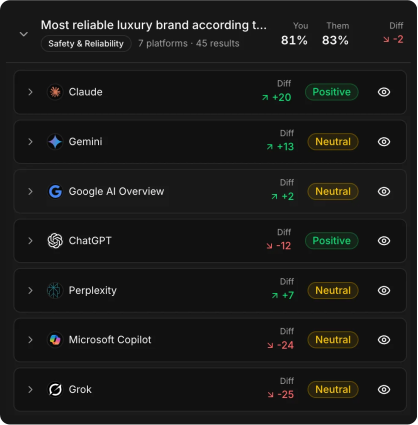
Platforms such as Ansvisor help organizations analyze structured data alongside authority signals, content quality, E-E-A-T factors, trust indicators, and AI visibility performance to identify opportunities for improving AI search discoverability.
Common misconceptions
Common misconceptions about structured data for AI include:
- Structured data guarantees AI citations.
- AI systems only rely on structured information.
- All schema types improve AI visibility equally.
- Structured data replaces authority signals.
- Adding more schema always improves results.
Structured Data for AI is best understood as a machine-readable context layer that helps AI systems understand content more effectively, but meaningful AI visibility still depends on authority, trust, relevance, and retrieval quality.








.svg)
