


AI Rank Tracker
An AI Rank Tracker is a tool that monitors where and how a brand, product, website, or competitor appears across AI-generated answers. Instead of tracking only a webpage's numerical position in traditional search results, an AI Rank Tracker analyzes brand rankings, mentions, citations, prompt visibility, competitors, and answer-level presence across AI Search platforms.
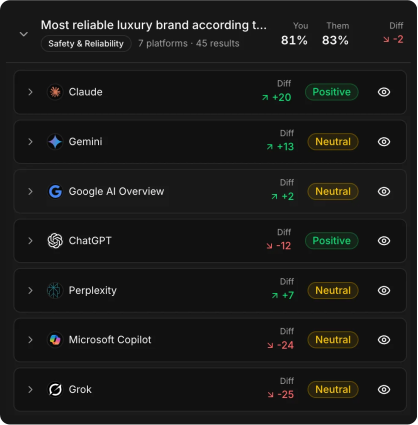
AI Rank Trackers are used to measure visibility across platforms such as ChatGPT, Gemini, Google AI Overviews, Google AI Mode, Claude, Perplexity, Microsoft Copilot, and other AI-powered discovery experiences.
How does an AI Rank Tracker work?
An AI Rank Tracker typically begins with a portfolio of prompts or questions that are relevant to a brand, product, market, audience, or customer journey.
Those prompts are repeatedly submitted to supported AI platforms. The resulting answers are then analyzed for signals such as:
- Whether the tracked brand appears.
- Where the brand appears within the answer.
- Which competitors are mentioned.
- Which brands are recommended or compared.
- Whether the brand's website is cited.
- Which third-party sources are cited.
- How visibility changes over time.
Repeating this process across many prompts and AI platforms creates a measurable view of a brand's AI Search visibility.
What does an AI Rank Tracker measure?
AI ranking cannot always be represented by a single numerical position. For this reason, modern AI Rank Trackers usually combine several measurements.
Common AI ranking signals include:
- AI Visibility Score.
- Brand ranking or answer position.
- Brand mentions.
- Citation frequency.
- Citation rate.
- Prompt visibility.
- Prompt coverage.
- Share of Voice.
- Competitor visibility.
- Platform coverage.
- Historical visibility trends.
The exact methodology differs between AI Rank Tracking platforms, which means ranking metrics from different tools should not automatically be treated as equivalent.
What does ranking mean in AI Search?
Ranking in AI Search can describe the relative prominence of a brand inside an AI-generated answer.
For example, an answer to a product recommendation prompt might mention five brands in sequence. A tracker may record which brand appears first, second, or later in the response.
But this is only one possible ranking signal.
AI Search systems can return paragraphs, lists, comparison tables, citations, product recommendations, summaries, or conversational responses. Some answers do not contain an obvious ordered ranking at all.
For this reason, AI ranking should usually be interpreted together with visibility, mentions, citations, and competitive presence.
Is AI ranking the same as Google ranking?
No.
Traditional Google rank tracking normally measures the position of a URL for a specific search query.
A simplified traditional model is:
An AI Search model is more complex:
The tracked entity may also be a brand rather than a webpage. A company can be prominently recommended even when its own domain is not cited.
This makes AI Rank Tracking partly a brand measurement discipline rather than only a webpage-ranking discipline.
What is the difference between an AI Rank Tracker and an SEO Rank Tracker?
An SEO Rank Tracker primarily monitors webpage positions in conventional search engine results.
An AI Rank Tracker monitors brand and source presence inside generated answers.
The distinction can be summarized as:
AI Rank Tracker → Prompt → AI Answer → Brand + Competitors + Citations
The two approaches are complementary. Search rankings remain valuable because traditional search signals and accessible web content can contribute to the wider information environment used by AI-powered discovery systems.
Why is AI Rank Tracking important?
Customers increasingly use AI systems to research categories, compare products, evaluate vendors, understand problems, and discover brands.
This creates discovery journeys where a company can gain or lose consideration before a user reaches its website.
An AI Rank Tracker helps answer questions such as:
- Does our brand appear for important customer questions?
- Which competitors appear ahead of us?
- Which prompts consistently exclude our brand?
- Are AI systems citing our website?
- Which external sources influence the answer?
- Is our visibility improving over time?
- Which AI platforms represent us most strongly?
What is prompt-level AI Rank Tracking?
Prompt-level tracking measures performance for individual questions rather than relying only on an aggregate visibility score.
For example, a software company might track prompts such as:
- What are the best project management tools?
- Which project management software is best for agencies?
- What are the best alternatives to a specific competitor?
- Which project management platforms support small teams?
The company could have strong visibility for broad informational prompts while being absent from high-intent comparison prompts.
Aggregate visibility alone could hide that difference.
Ansvisor's Prompt Monitoring & Volumes connects tracked prompts with AI answers, visibility, citations, competitors, and historical performance.
Why are tracked prompts important?
The quality of an AI Rank Tracker depends partly on the quality of the prompt set being monitored.
A useful prompt portfolio can include questions around:
- Problems and needs.
- Category discovery.
- Recommendations.
- Product comparisons.
- Competitor alternatives.
- Features and capabilities.
- Purchase considerations.
- Use cases.
Ansvisor's AI Prompt Generator researches brands, audiences, markets, competitors, and topics to discover prompts that can then be added to AI Visibility monitoring.
Are tracked prompts actual AI user queries?
Not necessarily.
Most AI Rank Tracking systems monitor a defined set of prompts selected or generated for measurement.
Those prompts should not automatically be interpreted as complete logs of private conversations occurring inside ChatGPT, Gemini, Claude, or other AI platforms.
Prompt monitoring is best understood as a controlled measurement framework for evaluating visibility across strategically relevant questions.
What is AI Visibility in an AI Rank Tracker?
AI Visibility measures how consistently a brand appears across monitored AI answers.
A visibility metric can combine signals such as mention frequency, citation presence, prompt coverage, or answer prominence depending on the platform's methodology.
Visibility provides a broader measurement than a single ranking position because AI-generated answers vary in structure.
What is AI Ranking?
AI Ranking describes the relative position or prominence of a brand within an AI-generated answer.
When an answer clearly orders brands or products, ranking can resemble conventional position tracking.
In less structured answers, prominence may need to be interpreted together with mentions, recommendation context, citations, and competitor presence.
What are AI mentions?
An AI mention occurs when an AI-generated response references a tracked brand, company, product, or other entity.
Mentions are an important ranking signal because they show whether the brand entered the generated answer at all.
However:
A brand could appear positively, neutrally, negatively, or simply as one option in a longer comparison.
What are AI citations?
AI citations are sources referenced by an AI system when supporting or constructing a generated answer.
Citation tracking can show whether an AI platform relies on:
- The brand's own website.
- Competitor websites.
- Editorial publishers.
- Review platforms.
- Forums and communities.
- Social platforms.
- Other third-party sources.
Ansvisor's Citation Monitoring connects citation sources with prompts, AI answers, competitors, and visibility analysis.
Is a mention the same as a citation?
No.
A brand can be mentioned without its website being cited.
Conversely, content from a domain can contribute to an answer even when the brand is not prominently recommended.
Tracking these signals separately provides a more accurate view of AI Search performance.
What is Share of Voice in AI Rank Tracking?
AI Share of Voice compares a brand's presence with competitors across a monitored set of prompts and AI responses.
It can help identify whether competitors consistently receive greater exposure within strategically important questions.
Share of Voice should be interpreted within the tracker's prompt portfolio, competitor set, AI platforms, and methodology rather than as a universal percentage of all AI conversations.
How does competitor tracking work in AI Search?
AI competitor tracking identifies other brands that repeatedly appear across the same monitored prompts.
Teams can compare:
- AI Visibility.
- Brand mentions.
- AI rankings.
- Citations.
- Prompt coverage.
- Share of Voice.
- Platform performance.
Ansvisor's Competitor Benchmarking is designed to compare these signals across brands and AI Search environments.
Can AI competitors differ from SEO competitors?
Yes.
AI systems can surface competitors that do not rank alongside a brand in conventional organic search.
They can also introduce marketplaces, publishers, review platforms, and adjacent products into recommendation-oriented answers.
This means AI Rank Tracking can reveal a competitive landscape that is different from traditional keyword rank tracking.
What is cross-platform AI Rank Tracking?
Cross-platform AI Rank Tracking compares brand performance across multiple AI Search and answer engines.
This matters because the same prompt can produce different brands, rankings, citations, recommendations, and sources depending on the platform.
AI Rank Tracking can include environments such as:
- ChatGPT Visibility Tracking
- Gemini Visibility Tracking
- Google AI Overviews Rank Tracking
- Google AI Mode Visibility Tracking
- Claude AI Visibility Tracking
- Perplexity Visibility Tracking
- Microsoft Copilot Visibility Tracking
A brand could perform strongly in ChatGPT while having limited visibility in Gemini, Claude, Perplexity, Microsoft Copilot, or Google's AI experiences.
Cross-platform measurement helps identify these differences instead of treating AI Search as a single channel.
Can you track rankings in ChatGPT?
Yes, but ChatGPT ranking should not be interpreted exactly like a Google SERP position.
A tracker can repeatedly analyze selected prompts and record which brands appear, their relative prominence, citations, competitors, and changes over time.
Ansvisor's ChatGPT Visibility Tracker monitors brand visibility, prompts, mentions, citations, competitors, and historical performance across tracked ChatGPT answers.
The resulting data provides a controlled view of ChatGPT visibility rather than a universal ranking for every private ChatGPT conversation.
Can you track rankings in Gemini?
Yes.
Gemini Rank Tracking can monitor selected prompts and analyze whether a brand appears, which competitors are present, which sources are cited, and how visibility changes over time.
Ansvisor's Gemini Visibility Tracker provides dedicated prompt-level monitoring for Gemini.
Gemini should be measured independently because the same prompt can produce different answers, sources, brands, and citations from other AI platforms.
Can you track rankings in Google AI Overviews?
Yes.
Google AI Overviews can be monitored for brand presence, cited sources, competitor visibility, queries, and answer-level ranking signals where applicable.
Ansvisor provides a dedicated Google AI Overviews Rank Tracker for monitoring rankings, mentions, citations, competitors, and visibility within Google's AI-generated summaries.
Can you track rankings in Google AI Mode?
Yes.
Google AI Mode can be monitored through a prompt-based visibility framework that analyzes brand mentions, citations, competitors, sources, and answer-level presence.
Ansvisor's Google AI Mode Visibility Tracker provides dedicated monitoring for this environment.
Can you track rankings in Claude?
Yes.
Claude visibility can be monitored by repeatedly analyzing strategically relevant prompts and measuring brand presence, citations, competitors, sources, and answer-level signals.
Ansvisor provides a dedicated Claude AI Visibility Tracker for monitoring Claude visibility over time.
Can you track rankings in Perplexity?
Yes.
Perplexity combines generated answers with prominent web citations, making both brand visibility and source visibility important measurement signals.
An AI Rank Tracker can analyze which prompts surface the brand, which competitors appear, and which domains and URLs are repeatedly cited.
Ansvisor's Perplexity Visibility Tracker provides dedicated monitoring for prompts, mentions, citations, competitors, and source visibility.
Can you track rankings in Microsoft Copilot?
Yes.
Microsoft Copilot can form another part of a cross-platform AI Rank Tracking strategy.
Tracking can measure whether a brand appears across monitored questions, which competitors are surfaced, which sources are cited, and how visibility changes over time.
Ansvisor's Microsoft Copilot Visibility Tracker provides dedicated visibility monitoring for Copilot.
Why can AI rankings change between runs?
Generative AI answers are not always deterministic.
Results can vary because of factors including:
- Model updates.
- Retrieval changes.
- Source availability.
- Prompt wording.
- Location.
- Freshness.
- Product configuration.
- Normal generative variation.
A single answer is therefore usually less informative than repeated monitoring over time.
Why is historical AI Rank Tracking important?
Historical tracking helps separate isolated response changes from persistent trends.
Teams can monitor whether:
- Visibility is increasing.
- Competitors are gaining ground.
- Citation coverage is improving.
- New content is beginning to appear.
- Important prompts are gaining visibility.
- Platform-specific performance is changing.
Historical data is particularly useful when evaluating AEO and GEO initiatives.
Can an AI Rank Tracker identify optimization opportunities?
Yes.
Ranking data becomes more useful when it can identify why a brand is underperforming and what could be improved.
Examples include:
- High-value prompts where competitors appear but the brand does not.
- Topics with low prompt coverage.
- Answers that mention the brand but do not cite its domain.
- Third-party sources repeatedly cited instead of owned content.
- Platforms where visibility is significantly weaker.
- Pages that need stronger AEO or GEO optimization.
How does Query Fan-Out relate to AI Rank Tracking?
Some AI Search systems can expand a user's original request into multiple supporting searches or retrieval queries.
This process is commonly called Query Fan-Out.
Understanding these sub-queries can help explain why particular brands, pages, or sources appear in an AI answer.
Ansvisor's Query Fan-Out Analysis connects these research paths with prompt monitoring, citations, competitors, and content opportunities.
How can content affect AI rankings?
Clear, useful, authoritative, and accessible content can improve the information available to search and AI systems.
Content opportunities may include:
- Answering missing customer questions.
- Improving existing pages.
- Publishing useful comparison content.
- Adding evidence and original research.
- Strengthening entity information.
- Improving internal linking.
- Making important information easier to extract.
Ansvisor's Content Intelligence turns AI Search gaps into research-driven content opportunities and briefs.
Does technical optimization affect AI Rank Tracking?
Technical accessibility can influence whether content is available for search and AI discovery systems to retrieve and understand.
Relevant factors can include page structure, internal links, schema, content architecture, authority, E-E-A-T, and trust signals.
Ansvisor's AI Visibility Site Audit evaluates public URLs across 47 weighted AEO and GEO signals covering Structure, Content, Authority, E-E-A-T, and Trust.
Technical optimization can improve readiness, but it cannot guarantee a specific AI ranking or citation.
Can an AI Rank Tracker measure AI traffic?
Rank tracking and traffic analytics are different measurement layers.
Rank tracking measures what happens inside AI-generated discovery experiences. AI traffic analytics measures identifiable visits arriving at a website from AI platforms.
Ansvisor's AI Traffic Analytics connects AI referral traffic with landing pages, visits, and traffic trends.
Does higher AI ranking guarantee more traffic?
No.
AI-generated answers can satisfy a user's question without requiring a website visit.
A brand can also influence a customer's decision even when the eventual visit occurs through branded search, direct navigation, another device, or a later session.
This means:
These signals should be connected rather than treated as interchangeable.
Can an AI Rank Tracker prove an optimization worked?
Historical tracking can provide evidence that performance changed after an action, but correlation alone does not establish causation.
AI answers can change because of model updates, retrieval changes, new sources, competitor activity, or other external factors.
A stronger measurement process records the action, monitors relevant metrics, and evaluates what changed afterward.
Ansvisor's AI Search KPIs & Action Center connects AI Search KPIs, signals, prioritized actions, execution progress, and historical results.
What makes a good AI Rank Tracker?
A useful AI Rank Tracker should provide more than a single visibility score.
Important capabilities can include:
- Multi-platform AI monitoring.
- Prompt-level tracking.
- Brand ranking analysis.
- Mentions and citations.
- Competitor benchmarking.
- Share of Voice.
- Historical trends.
- Source and citation analysis.
- Prompt discovery.
- Platform-level comparisons.
- Optimization opportunities.
- Connections with traffic and business outcomes.
Methodology transparency is also important because AI ranking metrics are not yet standardized across the industry.
What are the limitations of AI Rank Trackers?
AI Rank Tracking provides useful structured measurement, but it has important limitations.
- AI responses can change between repeated runs.
- Tracked prompts represent a selected monitoring portfolio.
- Private user conversations are generally not observable.
- Different tools can calculate rankings differently.
- A mention does not automatically represent a recommendation.
- A citation does not guarantee a click.
- Platform behavior can change after model or product updates.
- Location and personalization can affect some AI experiences.
- A single ranking number cannot fully describe AI Search performance.
These limitations make it important to analyze ranking together with mentions, citations, competitors, prompt coverage, historical trends, and business outcomes.
Who should use an AI Rank Tracker?
AI Rank Trackers can be useful for teams responsible for brand discovery and customer acquisition across AI-powered environments.
Typical users include:
- SEO and AEO teams.
- GEO practitioners.
- Brand and PR teams.
- Content teams.
- Growth teams.
- Agencies.
- Ecommerce companies.
- B2B companies.
- Founders and executives.
How does Ansvisor track AI rankings?
Ansvisor is an open-source AI Search Intelligence platform that connects AI Search behavior with search and business data.
Ansvisor monitors prompts and AI-generated answers across major AI platforms and analyzes signals including AI Visibility, rankings, mentions, citations, Share of Voice, competitors, sources, and platform performance.
Platform-specific tracking can be extended through dedicated visibility trackers for ChatGPT, Gemini, Google AI Overviews, Google AI Mode, Claude, Perplexity, and Microsoft Copilot.
Instead of treating rank tracking as the final output, Ansvisor connects measurement with a broader operating model:
This allows teams to move from identifying where a brand ranks to understanding which visibility gaps matter and what actions can improve performance.
From AI Rank Tracking to AI Search Intelligence
AI Rank Tracking answers an important question:
Where does the brand appear across AI-generated answers?
AI Search Intelligence extends the question further:
Why is the brand appearing there, which opportunities matter, and what should the organization do next?
This requires connecting ranking data with prompts, citations, competitors, search demand, content, traffic, and business signals.
This broader model helps organizations treat AI visibility as a measurable growth process rather than an isolated ranking metric.
Explore AI Rank Tracking with Ansvisor
Explore the Ansvisor platform and features connected with AI rankings, visibility, prompts, citations, competitors, traffic, and optimization:
- AI Search Intelligence Platform
- ChatGPT Visibility Tracker
- Gemini Visibility Tracker
- Google AI Overviews Rank Tracker
- Google AI Mode Visibility Tracker
- Claude AI Visibility Tracker
- Perplexity Visibility Tracker
- Microsoft Copilot Visibility Tracker
- Prompt Monitoring & Volumes
- AI Prompt Generator
- Query Fan-Out Analysis
- Citation Monitoring
- Competitor Benchmarking
- AI Traffic Analytics
- AI Visibility Site Audit
- Content Intelligence
- AI Search KPIs & Action Center
FAQ
What is an AI Rank Tracker?

An AI Rank Tracker monitors where and how a brand appears across AI-generated answers. It can measure brand rankings, mentions, citations, prompt visibility, Share of Voice, competitors, and changes across platforms such as ChatGPT, Gemini, Google AI Overviews, Claude, and Perplexity.
How is an AI Rank Tracker different from an SEO Rank Tracker?
An SEO Rank Tracker primarily measures a webpage's position for a keyword in conventional search results. An AI Rank Tracker analyzes brand and source presence inside generated answers, where visibility may involve rankings, mentions, recommendations, citations, and competitor presence rather than a single fixed SERP position.
Can you track rankings in ChatGPT, Google AI Overviews and other AI platforms?
Yes. AI Rank Tracking can repeatedly run strategically relevant prompts across supported AI platforms and analyze which brands appear, their relative prominence, citations, and competitor presence. These measurements represent the monitored prompt set rather than every private user conversation.
What metrics should an AI Rank Tracker measure?
Useful metrics include AI Visibility, brand ranking, mentions, citations, citation rate, prompt coverage, Share of Voice, competitor visibility, platform coverage, and historical trends. Because methodologies differ between platforms, these metrics should be interpreted within the tracker's own monitoring framework.
Can AI Rank Tracking help improve AI Visibility?
Yes. Rank tracking can identify prompts where a brand is missing, competitors are stronger, citations are weak, or platform coverage is limited. Those signals can then become content, citation, technical, competitive, or other AEO and GEO optimization opportunities.
Win customers from all major AI platforms
Understand, measure, and optimize your AI visibility via Ansvisor.
✓ Add brand, domains and competitors
✓ Discover prompts and growth opportunities
✓ Track your AI visibility across major AI platforms
✓ Monitor citations, mentions, and competitors
✓ Measure AI traffic and customer discovery
✓ Receive AI recommendations based on AI insights
✓ Optimize authority, trust, and content quality
✓ Create content, automate analysis & action with AI agents
AI Visibility Terms
Continue exploring key AI visibility concepts.
AI Visibility
Measure and improve how often your brand appears in AI-generated answers.
Learn more →Answer Engine Optimization (AEO)
Strategies for increasing visibility in answer engines and AI summaries.
Learn more →Generative Engine Optimization (GEO)
Optimizing content for AI-powered discovery experiences.
Learn more →ChatGPT Search
Understand how OpenAI retrieves and synthesizes information.
Learn more →Google AI Overviews
AI-generated summaries that appear directly in Google Search.
Learn more →Perplexity Search
Explore how Perplexity cites and presents sources.
Learn more →AI Citations
References and sources used by AI systems to support answers.
Learn more →Citation Authority
Measure the quality and influence of cited sources.
Learn more →Retrievability
How easily AI systems can discover and reuse your content.
Learn more →New terms are added regularly.
Help us improve the page or suggest a new term →
Cihan Geyik
Co-founder at Ansvisor
Cihan Geyik is the co-founder of Ansvisor, an open-source AI Visibility platform for AI Search. With more than 15 years of experience in digital marketing and growth, he writes about AI visibility, AI search, AEO, GEO, citations, and answer engines. He focuses on helping brands understand and improve their presence across ChatGPT, Gemini, Perplexity, Google AI Overviews, and other AI-powered discovery platforms.
Make Your Brand Visible in AI Answers.

INDUSTRIES


© 2026 Ansvisor. All rights reserved. Ansvisor is an open-source AI Search Intelligence Platform for AI Visibility.


.svg)
