.svg)








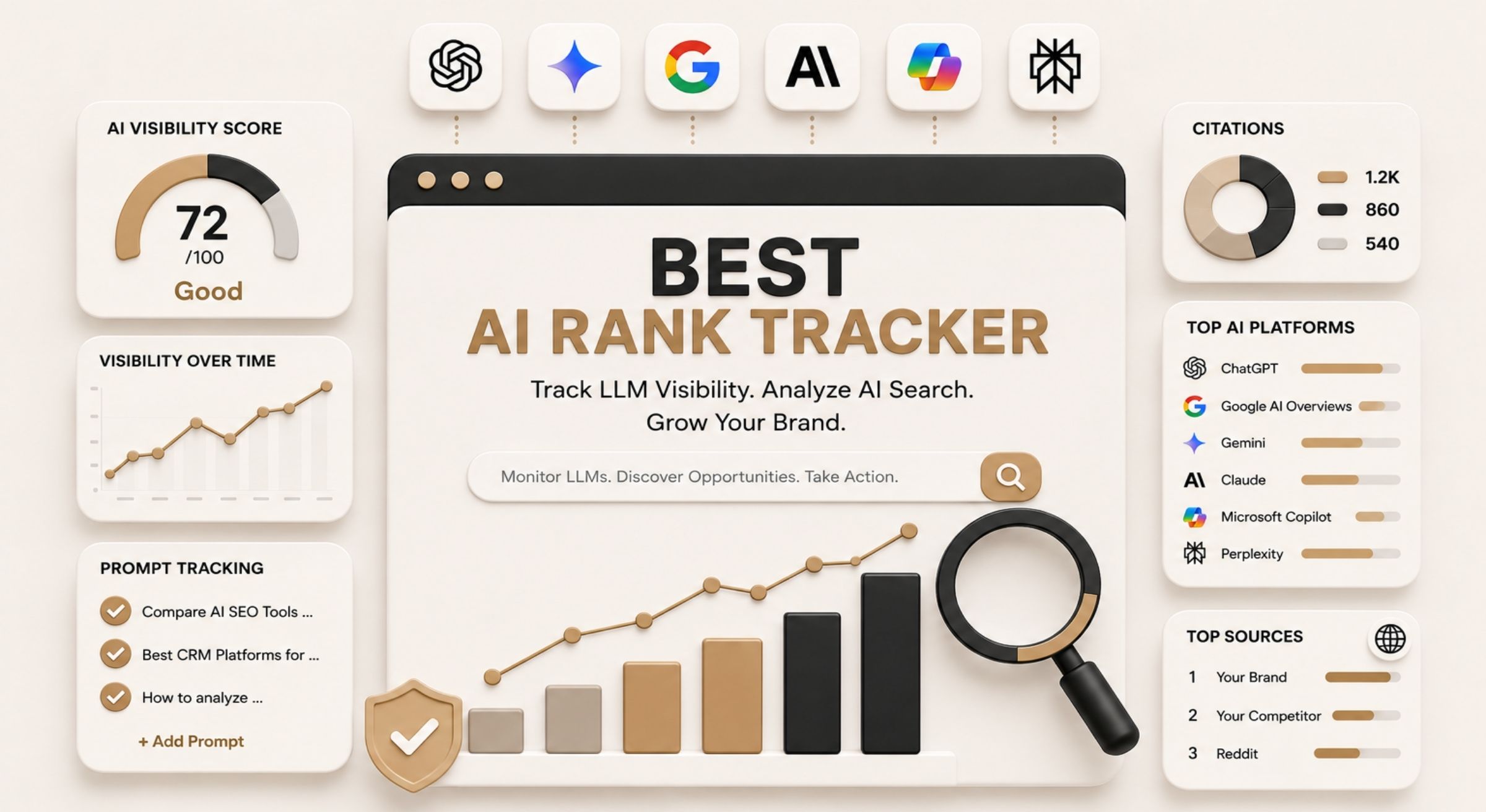
The best AI rank tracker should monitor LLM visibility and Google AI Search results at the prompt level—not just return a single “rank.” A useful platform should show where your brand appears, which URLs get cited, how competitors perform, and whether visibility changes over time across ChatGPT, Google AI Overviews, Gemini, Claude, Perplexity, and Microsoft Copilot.
For digital marketers, that means the best tool is the one that connects tracking with action. Ansvisor is our top overall choice because it combines AI visibility monitoring with prompt discovery, Query Fan-Out, citation intelligence, competitor benchmarking, content opportunities, AI traffic analytics, and open-source deployment.
TL;DR
- Ansvisor is the best overall AI rank tracker for teams that want monitoring plus optimization workflows.
- Profound is strong for enterprise intelligence and executive reporting.
- Peec AI is a focused option for visibility, position, sentiment, and competitor tracking.
- Searchable combines AI visibility with content and growth workflows.
- Promptwatch is useful for prompt, citation, and crawler intelligence.
- Athena is positioned around enterprise monitoring and action workflows.
What Is an AI Rank Tracker?
An AI rank tracker monitors how a brand, product, or website appears inside AI-generated answers for a defined set of prompts. Depending on the platform, it may track visibility, mentions, citations, answer position, competitors, sentiment, exact source URLs, and historical changes.
Direct answer: To monitor LLM visibility and Google AI Search results accurately, track a stable portfolio of relevant prompts and measure mentions, citations, competitors, source URLs, and historical visibility across multiple AI platforms.
Why AI Rank Tracking Is Different From Traditional SEO Tracking
Measures page rankings
Keywords, positions, impressions, clicks, organic traffic, and conversions remain essential for traditional search.
Measures answer visibility
Prompts, mentions, citations, recommendation context, source URLs, competitors, and AI referral traffic become additional signals.
Best AI Rank Trackers for LLM Visibility and Google AI Search
Most leading AI Visibility platforms now support prompt tracking, brand mentions, citations, and competitor monitoring. The more useful comparison is what each platform is best suited for and how well it fits your team’s workflow.
← Scroll horizontally to compare the platforms →
| Tool | Best for | Primary strength | Best fit |
|---|---|---|---|
| 1. Ansvisor | End-to-end AI Search optimization | Connects AI visibility data with opportunities, actions, citation intelligence, Query Fan-Out, AI traffic, and open-source deployment | SEO, AEO, GEO, content, growth, brand, agency, and enterprise teams that want more than reporting |
| 2. Profound | Enterprise AI visibility intelligence | Enterprise-scale monitoring, reporting, and governance | Large organizations with executive reporting and global AI Search programs |
| 3. Peec AI | Focused AI visibility analytics | Visibility, position, sentiment, and competitor monitoring | Marketing teams that want a streamlined reporting experience |
| 4. Searchable | AI Search performance and content workflows | Combines visibility tracking with content and growth-oriented workflows | Teams that want monitoring connected with content execution |
| 5. Promptwatch | Prompt and AI observability workflows | Prompt monitoring, citation analysis, and crawler-oriented visibility intelligence | Teams interested in technical monitoring and AI Search observability |
| 6. Athena | Enterprise AI Search operations | Monitoring connected with structured recommendations and action workflows | Enterprise teams that want organized AI Search execution |
What Should You Look for in an AI Rank Tracker?
← Scroll horizontally to review the evaluation criteria →
| Capability | Why it matters |
|---|---|
| Multi-platform tracking | Your customers use more than one AI system, so visibility should be measured across multiple answer engines. |
| Prompt-level monitoring | AI answers are prompt-driven, and visibility can change significantly from one question to another. |
| Historical visibility | Without history, you cannot tell whether an optimization, content update, or campaign improved performance. |
| Citation intelligence | Exact URLs and source domains reveal which pages AI systems repeatedly use as evidence. |
| Competitor benchmarking | Competitive gaps help prioritize the prompts and topics where your brand is missing. |
| Team collaboration | Notes, target URLs, statuses, and ownership help convert monitoring into coordinated action. |
| Integrations and automation | APIs, webhooks, and connected data sources make AI Search intelligence more useful across marketing workflows. |
| Transparent methodology | Teams should understand what visibility metrics mean and how the platform calculates them. |
Why Ansvisor Is the Best Overall AI Rank Tracker
Ansvisor: From Monitoring to Action
Ansvisor is built around a simple idea: AI Search tracking is only useful if the data helps the team decide what to do next.
- Answer Engine Insights for multi-platform visibility.
- Prompt Monitoring for tracked questions, visibility, mentions, citations, and demand estimates.
- Query Fan-Out for supporting searches and hidden intent.
- Citation Monitoring for exact URLs, prompt breakdowns, competitor gaps, and source intelligence.
- Competitor Benchmarking for prompt-level visibility and Share of Voice.
- AI Traffic Analytics to connect AI visibility with visits.
Choose Ansvisor if you want more than a dashboard. It combines AI rank tracking with opportunity discovery, citation intelligence, content actions, team workflows, and post-implementation validation.
Track More Than AI Rankings
Monitor LLM visibility, Google AI Search results, prompts, citations, competitors, and AI traffic with Ansvisor.