Can Google Search Console Track Google AI Overviews?
Google Search Console should still be part of your Google AI Overview monitoring workflow, but it answers a different set of questions than a dedicated AI Visibility platform.
Google now provides a Generative AI performance report for some Search Console properties. The report includes visibility from AI Overviews and AI Mode and can help you understand generative AI impressions by page, country, device, and date.
That makes Search Console useful for understanding how your own website performs inside Google's generative search experiences.
But if your goal is to understand the full competitive answer environment, you still need additional context.
For example, Search Console is not designed to show you:
- the full AI-generated answer for every prompt you monitor
- which competitors were mentioned in the same answer
- which competitor URLs were cited
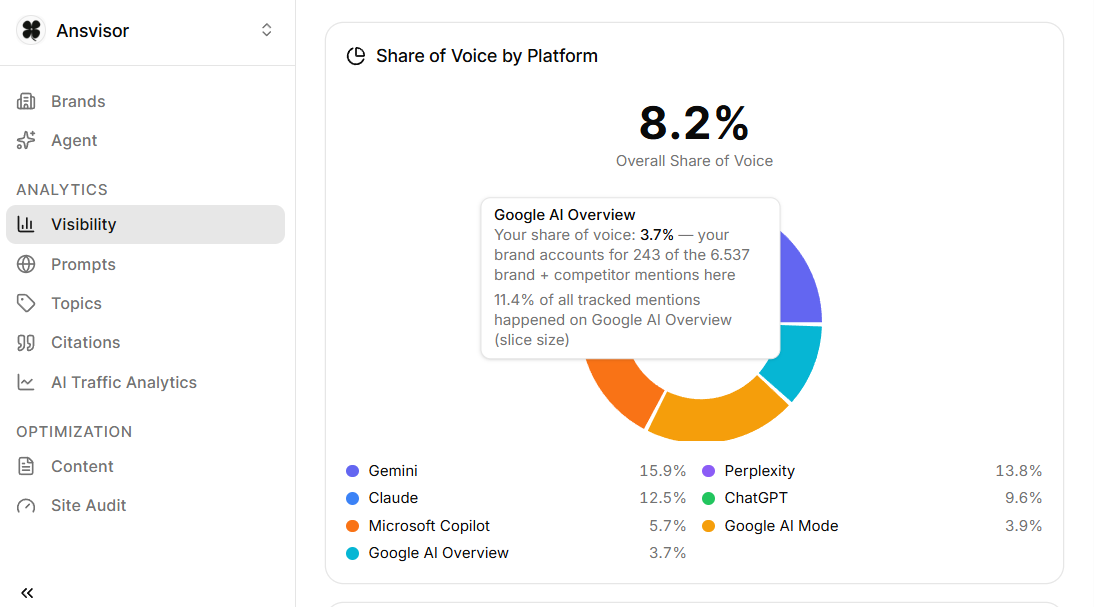
- your Share of Voice across multiple AI platforms
- prompt-level mention and citation history across ChatGPT, Gemini, Claude, Perplexity, Copilot, and Google AI
Best approach: use first-party Google Search Console data together with prompt-level AI Visibility and citation monitoring. Search Console shows how your site performs in Google Search; an AI Visibility platform adds the answer, competitor, prompt, and citation context around that performance.
Google AI Overviews and Google AI Mode Should Be Tracked Separately
Google AI Overviews and Google AI Mode are related, but they are not the same search experience.
AI Overviews appear inside the traditional Google Search results experience and summarize information from multiple web sources.
AI Mode is more conversational. Users can ask longer questions, receive a generated response, and continue with follow-up queries.
From a monitoring perspective, this distinction matters because the same brand may perform very differently across the two experiences.
A useful tracking setup should therefore let you separate:
- Google AI Overview visibility
- Google AI Mode visibility
- brand mentions
- citations
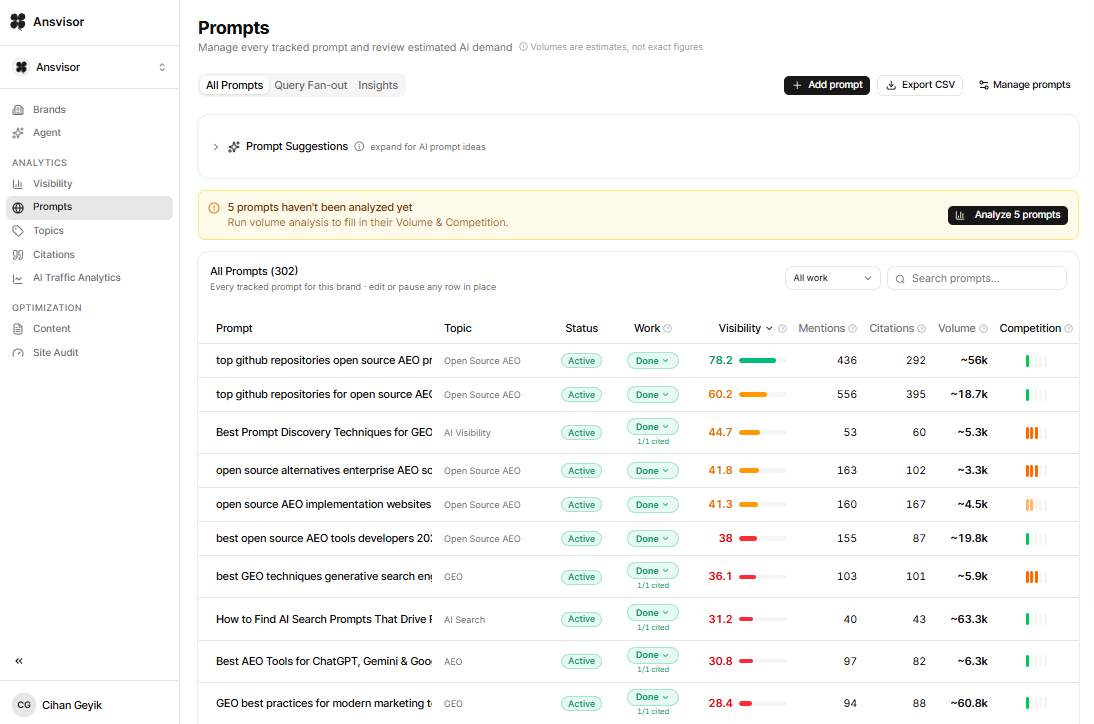
- prompt-level performance
- historical changes
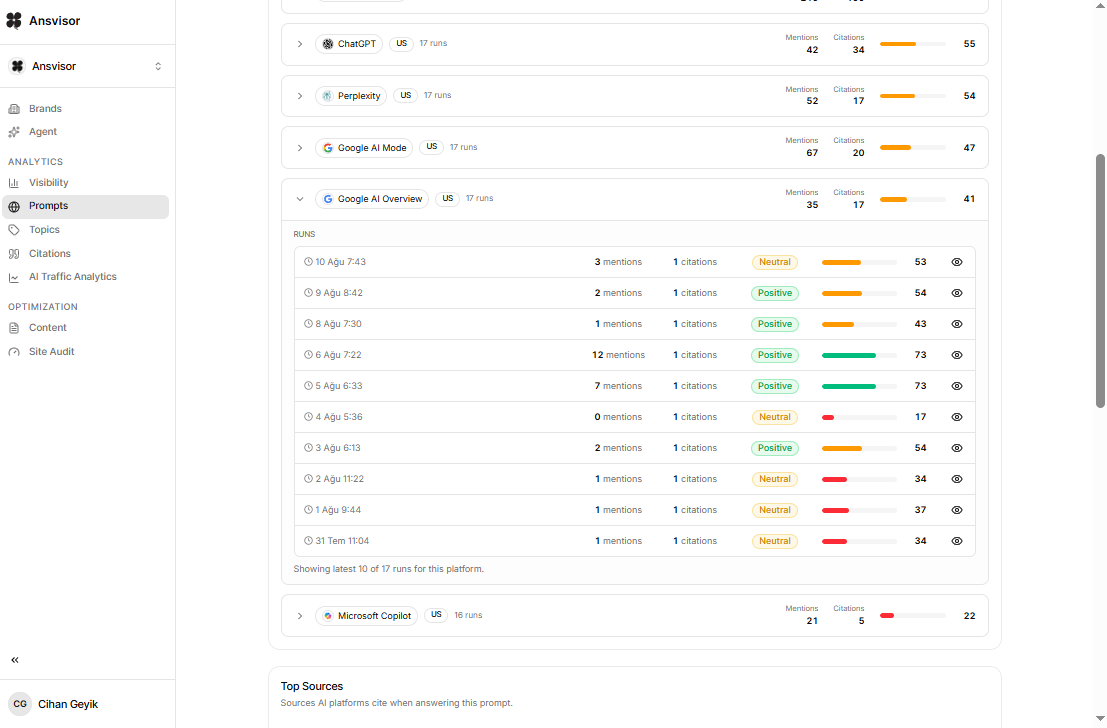
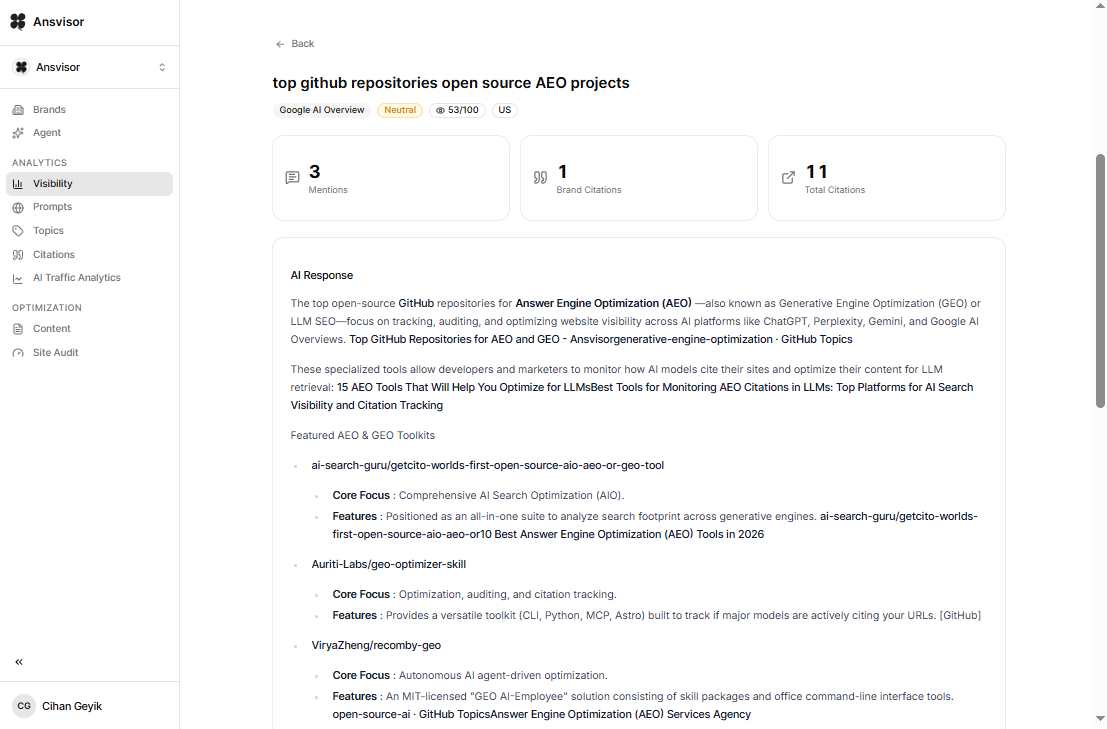
Ansvisor tracks Google AI Overviews and Google AI Mode as separate platforms while keeping them inside the same AI Visibility workflow.
Which Google AI Overview Metrics Matter Most?
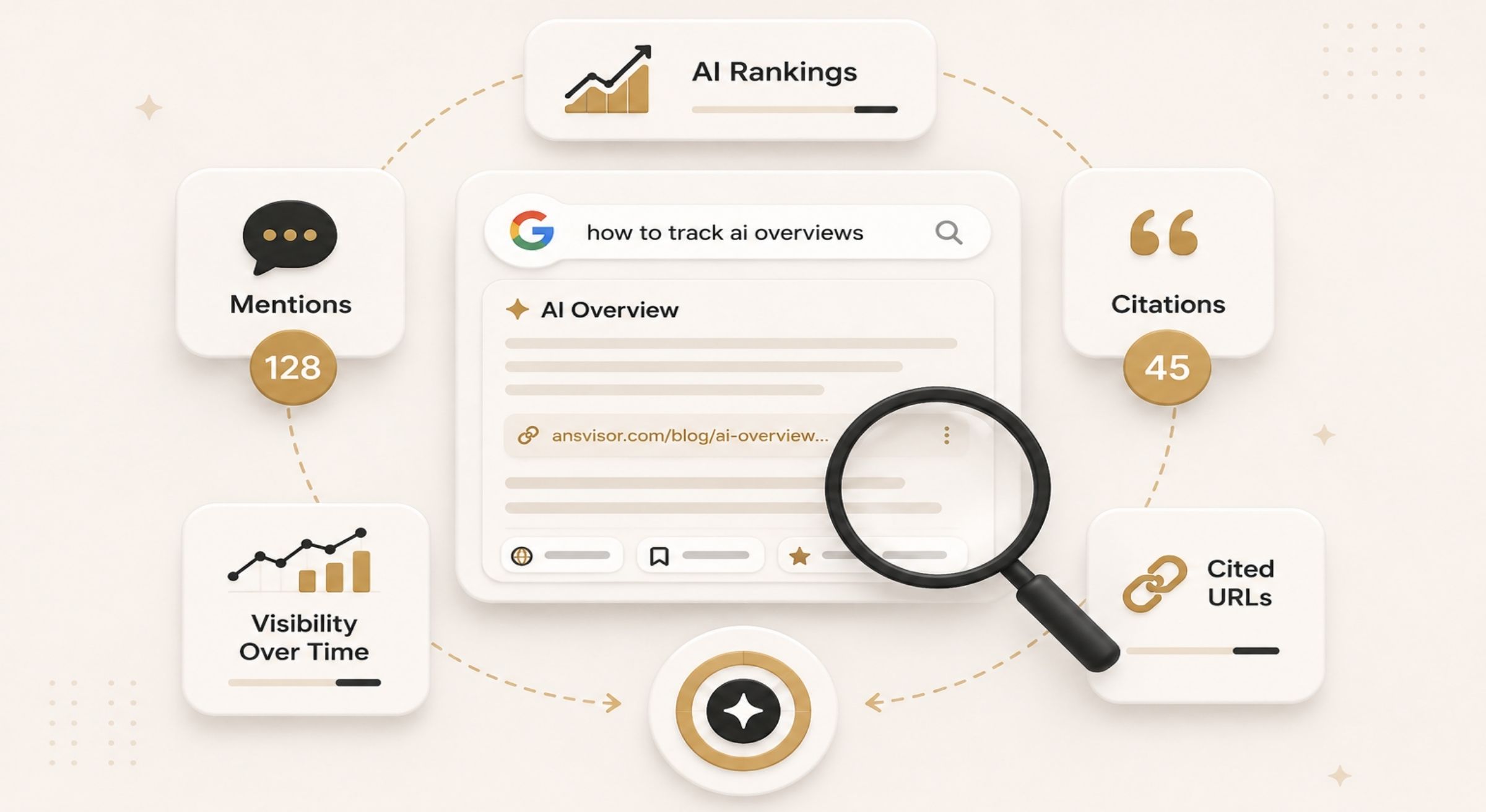
A useful AI Overview dashboard should not stop at a single visibility score.
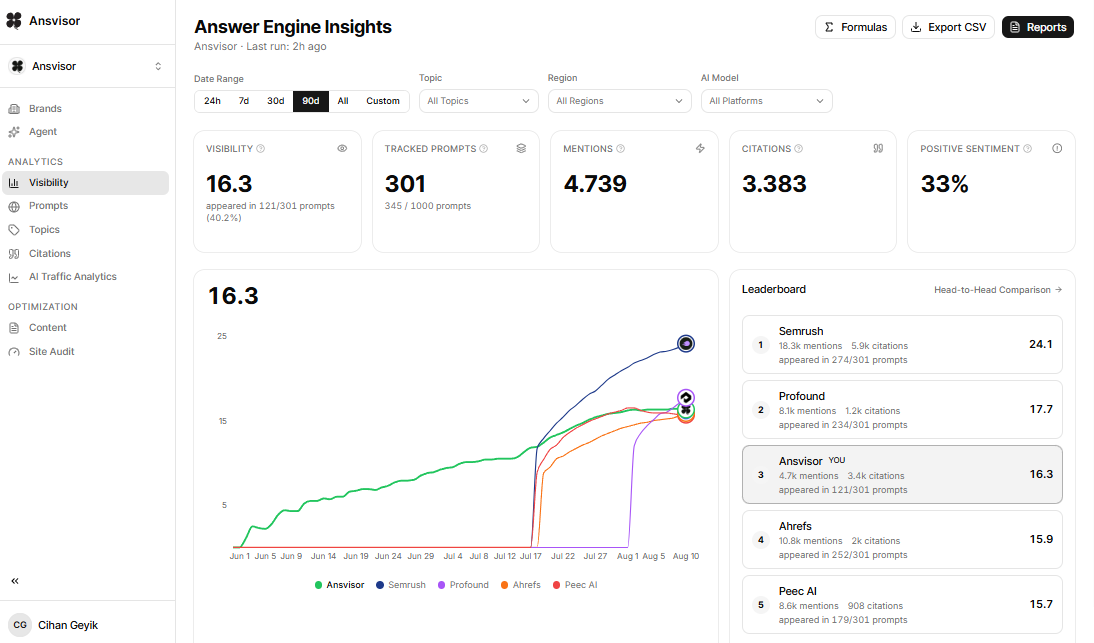
The strongest monitoring setup connects brand-level visibility with individual prompts, answers, citations, URLs, competitors, and traffic.
| Metric |
What It Answers |
Why It Matters |
| AI Visibility |
How visible is your brand across tracked answers? |
Provides a high-level view of your presence in AI-generated search experiences. |
| Mentions |
How often does Google AI refer to your brand? |
Measures brand presence even when your website is not cited. |
| Citations |
Which of your URLs are used as sources? |
Shows which pages Google AI considers useful enough to reference. |
| Prompt Coverage |
For which tracked questions does your brand appear? |
Reveals gaps across commercially important questions. |
| Share of Voice |
How does your visibility compare with competitors? |
Turns isolated brand data into competitive intelligence. |
| Cited URLs |
Which pages repeatedly earn citations? |
Helps identify content worth protecting, updating, and expanding. |
| Historical Runs |
How does performance change over time? |
Separates repeatable visibility from one-off appearances. |
| AI-Referred Visits |
Does AI visibility result in visits? |
Connects visibility with downstream traffic. |
How to Improve Your Visibility in Google AI Overviews
Tracking only becomes valuable when the data changes what you do next.
Once you know which prompts, competitors, answers, and citations are driving Google AI Overview visibility, you can turn those signals into optimization priorities.
Prioritize Prompts Where Your Brand Is Missing
Start with high-value prompts where competitors appear but your brand does not.
These gaps can reveal missing pages, weak topical coverage, insufficient evidence, or content that does not clearly answer the underlying question.
Prioritize gaps based on business relevance rather than trying to improve every tracked prompt at once.
Protect URLs That Already Earn Citations
A URL that repeatedly earns Google AI Overview citations is an asset.
Monitor those pages carefully. Keep information accurate, maintain clear structure, strengthen supporting evidence, and avoid unnecessary changes that could weaken the page's usefulness.
Citation monitoring can therefore be defensive as well as offensive: some pages should be improved, while others should first be protected.
Reverse Engineer Competitor Citations
When a competitor consistently earns citations for prompts where you are absent, inspect the actual source.
Do not copy the page.
Instead, identify why it may be useful for the answer:
- Does it answer the question immediately?
- Does it contain unique evidence?
- Does it use clearer comparisons?
- Does it provide original data?
- Is it more specific to the prompt?
- Does it cover supporting questions your page misses?
The objective is to understand the information pattern behind the citation and create a stronger resource of your own.
Build Around Prompt Clusters, Not Isolated Questions
AI-generated answers often depend on more than the exact wording of the original user prompt.
A strong page should therefore cover the central question together with closely related comparisons, definitions, constraints, examples, and supporting questions.
This is where
Query Fan-Out analysis
can help uncover the supporting searches and subqueries surrounding an important prompt.
Connect AI Visibility With Search Demand
Not every visibility gap deserves the same amount of attention.
Connecting AI Search data with traditional search signals can help distinguish a strategically important prompt from one with little business relevance.
For example, Google Search Console data can help identify topics that already generate impressions or clicks, while AI monitoring shows whether your brand is also being mentioned or cited inside generated answers.
This creates a stronger prioritization model:
Search Demand + AI Visibility + Citations + Competition → Opportunity.
Validate Every Optimization
Publishing a new page or updating an existing one is not the end of the workflow.
Continue monitoring the target prompts after the change.
Look for evidence that the action improved:
- prompt visibility
- brand mentions
- citations
- cited URL coverage
- competitive position
- AI-referred traffic
This creates a repeatable optimization cycle:
Measure → Find Opportunities → Act → Validate → Learn.
Common Google AI Overview Tracking Mistakes
Tracking Only Traditional Rankings
Organic rankings remain important, but they do not tell you whether your brand or URL appears inside the generated answer.
AI Overview monitoring should complement traditional rank tracking rather than replace it.
Treating Mentions and Citations as the Same Metric
A brand can be mentioned without its website being used as a source.
Track both separately so you can distinguish brand awareness from source authority.
Checking Google AI Overviews Manually Once
One search is a snapshot.
The answer, competitors, sources, and citation order can change. Historical tracking gives you the context required to understand whether visibility is stable or temporary.
Tracking Citations Without Tracking the URL
Domain-level citation totals can hide the pages actually driving performance.
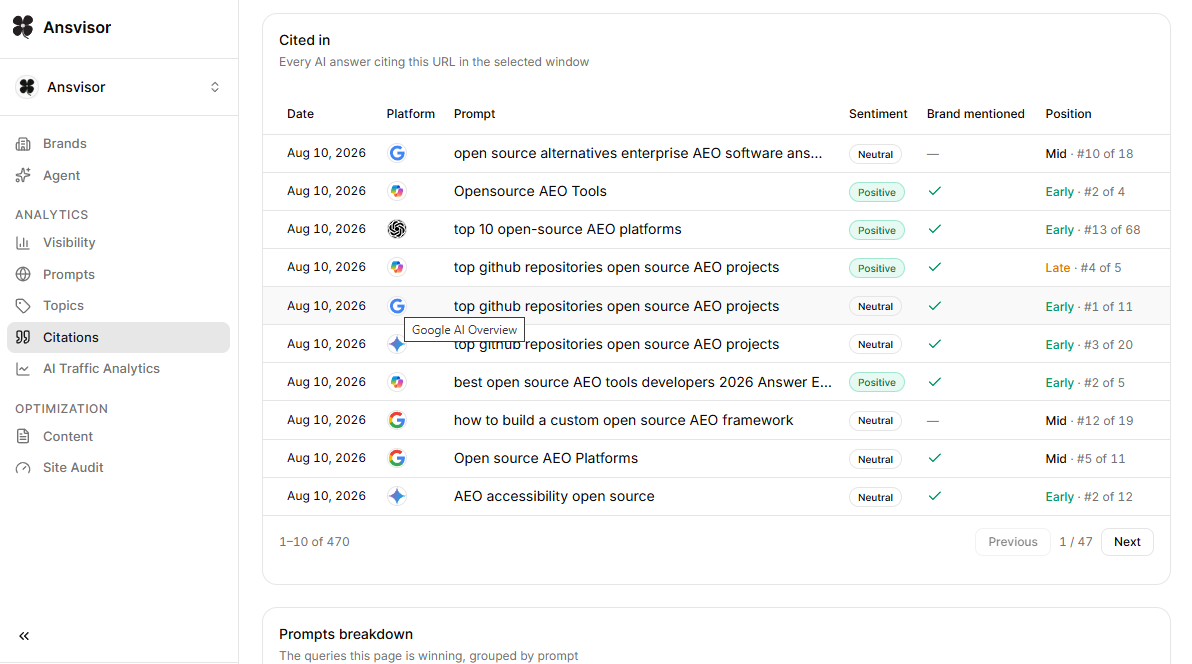
Always connect citations back to individual URLs and then connect those URLs back to the prompts that generated them.
Ignoring Competitors
A visibility score without competitor context can be misleading.
You need to know who appears when you do not, which URLs they earn citations with, and whether their visibility is growing faster than yours.
Treating Every Prompt as Equally Valuable
A prompt that influences buying decisions or protects an existing high-value search topic should usually matter more than an informational prompt with little strategic relevance.
Use search demand, competition, business value, and existing traffic to prioritize what to optimize first.
How Often Should You Monitor Google AI Overviews?
The right frequency depends on the importance of the prompt and how quickly the answer environment changes.
For strategically important prompts, continuous or daily tracking creates a much more useful dataset than occasional manual searches.
The objective is not to react to every small change.
Instead, look for patterns such as:
- consistent citation growth
- repeated loss of visibility
- new competitor appearances
- changes in the URLs being cited
- new high-value prompts entering the market
Trends are more actionable than isolated runs.
Frequently Asked Questions About Google AI Overview Tracking
How can I monitor my website rankings in Google AI Overviews?
Track the prompts relevant to your business and monitor whether your brand appears, whether a page from your domain is cited, and how those results change over time. A dedicated AI Visibility platform can also connect each result to competitors, citations, URLs, and the original generated answer.
How can companies track their position in Google AI Overview search results?
Companies can combine Google Search Console with prompt-level AI monitoring. Search Console provides first-party Google performance signals, while dedicated monitoring adds answer-level visibility, brand mentions, citations, competitor comparisons, historical runs, and the specific URLs used as sources in generated responses.
Does Google Search Console track AI Overviews?
Yes. Google has introduced a Generative AI performance report for selected Search Console properties that includes impressions from AI Overviews and AI Mode. Availability is still being rolled out, and Search Console serves a different purpose from tools that capture full generated answers, competitor mentions, and prompt-level citation history.
What is an AI Overviews rank tracker?
An AI Overviews rank tracker monitors how a brand performs inside Google's generated answers rather than only recording traditional organic positions. Useful trackers measure prompt visibility, mentions, citations, cited URLs, competitors, historical changes, and ideally the exact AI response generated for each monitored prompt.
How can I track brand mentions in Google AI Overviews?
Monitor a defined set of prompts and record whether Google AI explicitly names your brand in each generated answer. Mention tracking should be separated from citation tracking because Google may discuss a company without linking to its website, or cite a page without making the brand equally prominent.
How can I find which URLs Google AI Overviews cite?
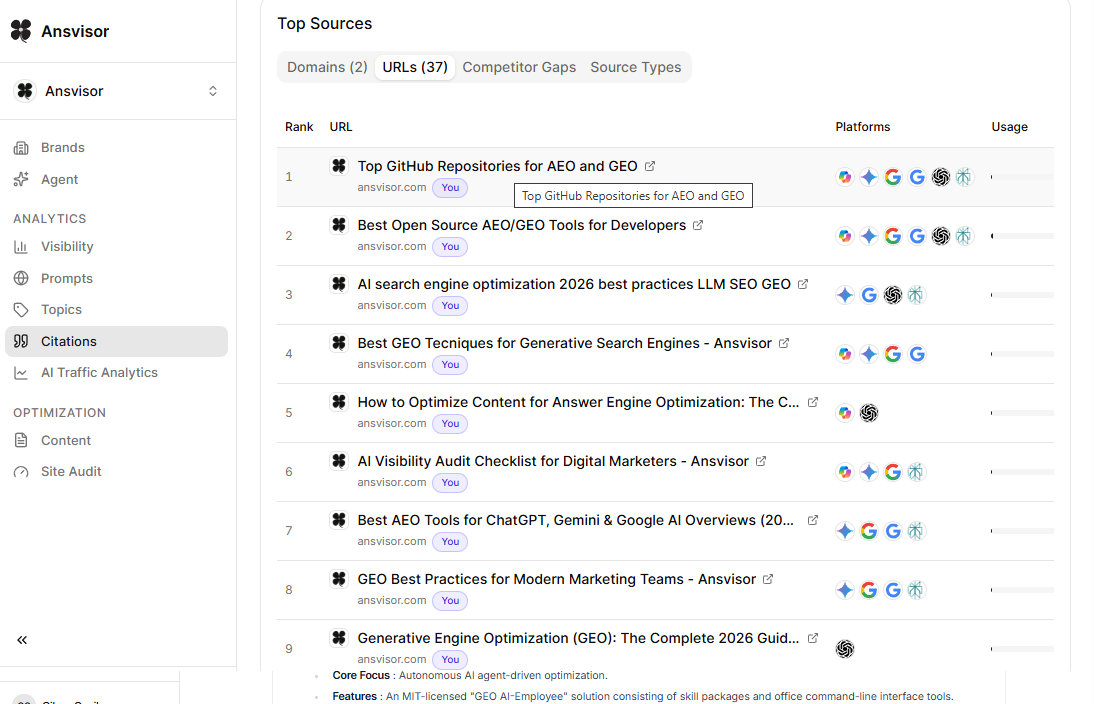
Use URL-level citation monitoring rather than relying only on domain totals. A citation report should show which pages were cited, how often they appeared, which prompts triggered those citations, which platforms used them, and the historical AI responses associated with each citation.
Can I track competitors in Google AI Overviews?
Yes. Competitor monitoring lets you compare Share of Voice, mentions, citation frequency, and cited URLs across the same prompt set. This helps identify prompts where competitors dominate, sources repeatedly trusted by Google AI, and content gaps that may represent your strongest optimization opportunities.
What is the difference between a mention and a citation in Google AI Overviews?
A mention occurs when the generated answer refers to your brand. A citation occurs when Google AI links to a URL from your domain as a supporting source. Both matter, but they measure different things: brand presence on one side and source usage on the other.
Should I track Google AI Overviews and ChatGPT together?
Usually, yes. Customers increasingly discover brands across multiple AI platforms, and performance can differ substantially between them. A unified view makes it easier to compare Google AI Overviews with ChatGPT, Gemini, Claude, Perplexity, Microsoft Copilot, Google AI Mode, and other answer engines.
Start Tracking Google AI Overviews With Real Answer Data
Google AI Overview visibility should not be reduced to a single rank.
The useful questions are more specific:
- Which prompts surface your brand?
- How often are you mentioned?
- Which URLs are cited?
- Which competitors appear instead?
- What did the actual AI answer say?
- Is your visibility improving over time?
Ansvisor connects those signals across Google AI Overviews and the wider AI Search ecosystem so you can move from monitoring to opportunities and actions.
Track Your Google AI Overview Visibility
Monitor prompts, mentions, citations, cited URLs, competitors, Share of Voice, historical AI responses, and AI-referred traffic from one platform.
Start with Ansvisor Cloud and explore the platform free for 14 days.







.svg)