


Ansvisor vs Semrush: Answer engine visibility meets traditional SEO
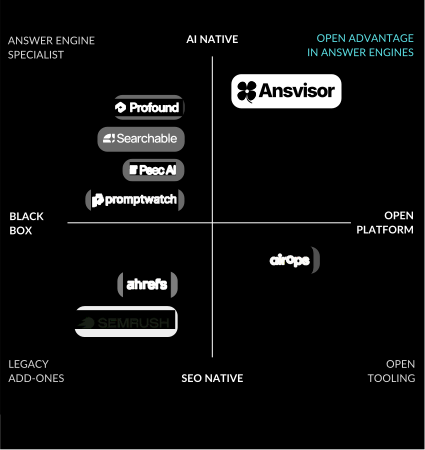
Why add Ansvisor to your SEO stack?
More Action for
AI Search Visibility
Compare Ansvisor vs Semrush
A quick comparison.
Ansvisor

Semrush

Traditional SEO suite
Answer-engine visibility and optimization
Primary focus
Rankings, keywords, backlinks, and site audits
Tracking, understanding, and improving AI visibility
Built for
Part of a broader SEO toolkit
AI visibility workflow
Core platform capability
Traditional SEO teams
SEO, content, developer, brand, and PR teams
Best fit
Search research and SEO workflows
AI visibility insights
and optimization
Core strength
SEO-led workflows
Cross-functional workflows
Team orientation
Traditional search
AI-driven discovery
Discovery focus
Analysis and SEO execution
Action layer
Insight plus optimization
Broad SEO platform
Focused answer-engine platform
Platform model
Traditional SEO
is the priority
AI visibility
is the priority
Best choice when
Yes
Yes
Free Trial
No
Yes
Open Source Version

Better pricing, more action for every team.







.svg)
FAQ

Not usually. The two platforms are built for different goals. Semrush is designed for traditional SEO workflows like keyword research, rankings, backlink analysis, and site audits. Ansvisor is built for answer-engine visibility, helping teams understand and improve how their brand appears across AI-driven discovery. Many teams use both as part of a broader search strategy.
Semrush has expanded into AI-related search features, but its core strength remains traditional SEO and search marketing. Ansvisor is built specifically for answer-engine visibility, with workflows centered on tracking, understanding, and improving how brands appear across AI-driven discovery environments.
Yes. This is a practical setup for teams that need both traditional SEO coverage and answer-engine visibility. Semrush can support classic search workflows, while Ansvisor helps teams monitor and improve how their brand is surfaced and represented in answer engines.
No. Ansvisor is not a traditional SEO suite. It is focused on answer-engine visibility, recommendations, and optimization workflows. Teams that rely heavily on keyword research, backlink analysis, or technical SEO often use a traditional SEO platform alongside Ansvisor.
Teams should choose Ansvisor when answer-engine visibility is the priority. If your goal is to understand how your brand appears across AI-driven discovery and to improve that visibility with cross-functional workflows, Ansvisor is the better fit. Semrush is stronger when traditional SEO is the main focus.
No. Ansvisor is designed for SEO, content, brand, and PR teams working together on AI visibility. Answer-engine performance depends on more than classic SEO signals alone, so Ansvisor is built to support broader collaboration across teams.
Yes. Ansvisor is designed to connect visibility insights with recommendations and optimization workflows, helping teams move from understanding answer-engine performance to improving it.
Open Platform.
Not a Black Box.





Read Other AI Visibility Tool Comparisons
Crown your brand in AI.








.svg)
